Is this what urban mobility of the future will look like?
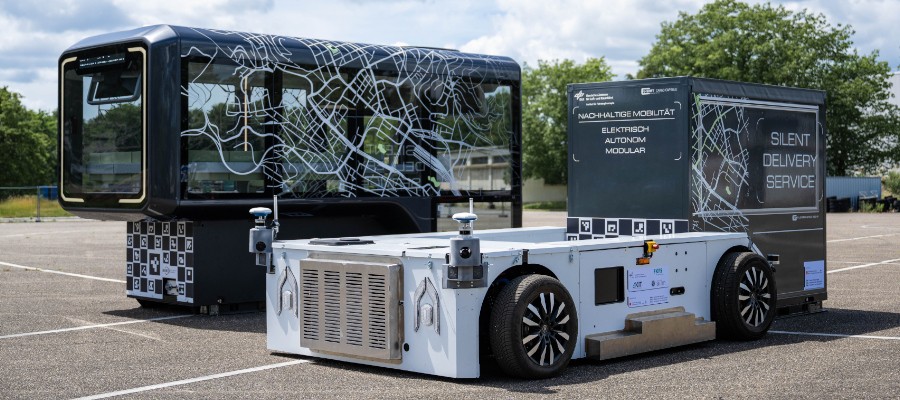

A vehicle that transports people in the morning and delivers packages autonomously at night—something like this could soon become a reality. At least, that’s the vision of researchers working on the U-Shift II project. That’s because the project has now overcome the key hurdle to this vision: the fully automated coupling of the propulsion and transport modules. Thanks to high-precision control technology, docking is achieved with an accuracy of just a few centimeters. This could have a lasting impact not only on local transportation but also on the entire logistics industry.
The U-Shift II research project is making decisive strides in the development of modular, autonomous vehicle concepts. Led by the German Aerospace Center (DLR), researchers from Baden-Württemberg have now presented technological advances in the coupling of propulsion units and multifunctional capsules. Thanks to its flexibility—ranging from passenger transport to logistics solutions—the concept promises an efficient response to the challenges of urban mobility and the last mile.
How does the modular principle work?
The U-Shift system is based on a U-shaped drive unit, known as the Driveboard, which operates autonomously and electrically. The U-Shift team unveiled the first drivable—though still remote-controlled—prototype in September 2020. The Driveboard is combined with interchangeable capsules that can be adapted as needed, for example, for passenger or freight transport. While the Driveboard houses the technical components for operation, the capsules enable high economic utilization, as the drive module can remain in operation nearly around the clock and be used for various purposes.
Precision in Capsule Swapping
A central focus of the second project phase was on automating the shunting and coupling process. Since there is only a few centimeters of clearance when docking the capsules to the Driveboard, the participating institutes developed high-precision systems for localization and motion control. A new prototype successfully demonstrated the automated switching of the superstructures. In addition, a special connector was developed that not only handles the mechanical locking but also ensures the electrical and data connection between the modules.
A key focus of the Stuttgart Research Institute for Automotive Engineering and Vehicle Engines (FKFS) was on the powertrain, energy and thermal management, as well as the control and monitoring of all central vehicle functions. The institutes at the Karlsruhe Institute of Technology (KIT) focused on the vehicle’s electrical and electronic components. Using dynamic over-the-air reconfigurations, they enable the flexible integration of sensor systems and vehicle functions across different capsule variants. In addition, the Karlsruhe researchers developed a chassis with an integrated lifting system for the U-Shift II prototype, allowing for flexible and rapid capsule changes without external tools.
The Institute for Measurement, Control, and Microtechnology at the University of Ulm developed the automation of the U-Shift, ranging from the distributed sensor concept for the driveboard, capsules, and infrastructure to the vehicle’s flexible motion planning. Together with the systems developed at the FKFS for localization and control of vehicle movements—known as motion control—this enables highly precise maneuvering and docking maneuvers.
Technology Transfer into Practice
The project, which received approximately 10 million euros in funding from the Baden-Württemberg Ministry of Economic Affairs, Crafts, and Tourism, serves as an important foundation for technology transfer. As early as 2023, a prototype completed a six-month research operation at the Federal Horticultural Show in Mannheim, during which it transported approximately 10,000 people and covered a total of 2,800 kilometers. Starting in mid-2027, another field test will take place in the Schwarzer Berg district of Braunschweig, where a test fleet will supplement public transit and logistics processes as part of the IMoGer project.
Minister of Economic Affairs Dr. Nicole Hoffmeister-Kraut emphasized the project’s great significance for technology transfer: “U-Shift II demonstrates that Baden-Württemberg has the potential to be a frontrunner in the vehicle and mobility concepts of the future. The key now is to bring innovations to the road more quickly. By providing the right support for our companies, we are strengthening jobs, value creation, and the competitiveness of our automotive industry.”
Federal Minister of Transportation Patrick Schnieder also sees great potential in the U-Shift project: “Transporting people around the city during the day and moving goods from A to B at night: The U-Shift mobile platform from the DLR enables an innovative mobility concept. […] With our 35 million euro grant, we aim to advance more efficient processes, sustainable transportation, and maximum cost-effectiveness. In this way, we are accelerating the development of autonomous vehicle systems and strengthening Germany as a hub for innovation.”
Potential for Air Logistics as Well
The U-Shift concept is not only significant for purely ground-based operations but also serves as an interface between unmanned ground vehicles and air logistics. The technologies developed in the project for autonomous navigation, high-precision docking, and the dynamic reconfiguration of sensor systems are directly transferable to the requirements of modern drone hubs and automated logistics ecosystems.
More News

Furthermore, the project underscores the growing importance of collaborative, autonomous systems. The ability to seamlessly link different modules—whether ground platforms or, in the future, possibly air-to-ground interfaces—is a decisive factor for the scalability of autonomous supply chains. U-Shift provides important blueprints for the integration of unmanned systems into the urban environment.
If you use Google as your search engine, you can set Drones as your preferred source so that our content appears more frequently in your search results. Add Drones as your preferred source.