Autonomous systems are becoming strategic industrial infrastructure

The past 18 months have been historic for the uncrewed industry. Market capitalizations are climbing; fundraising has reached record levels, acquisitions are accelerating, and new manufacturing facilities are opening on both sides of the Atlantic. Taken together, these developments point to something bigger than industry growth: autonomous systems are becoming strategic industrial infrastructure.
Two forces are driving that momentum. First, the wars in Ukraine and the Middle East have fundamentally changed how governments view uncrewed systems and the need to defend against them. Worldwide, military budgets, procurement priorities, and industrial strategies are responding. Second, AI and autonomy have merged into a single investment thesis. Increasingly, drones and robots are the vehicles through which AI enters the physical world.
The largest round in European history
At AUVSI, our research team tracks funding, contracts, M&A, and manufacturing announcements across the global autonomy ecosystem. The numbers tell a remarkable story. Since January 2025, we have recorded roughly $75 billion in closed investment rounds across 390 companies worldwide and over 200 M&A announcements. Q1 2026 was the largest quarter on record: $35.4 billion. Air-domain companies took $10.9 billion (131 firms). Europe’s share was $11 billion across 107 companies, led by the United Kingdom (27), Germany (19), and France (10). And the rounds keep getting bigger. In the first half of July alone, Quantum Systems closed a $1.2 billion Series D at an $8 billion valuation co-led by Blackstone and Airbus, Britain’s Kraken Technology Group raised $175 million with Rheinmetall among its backers, and Helsing sealed a $1.8 billion Series E at an $18 billion valuation – the largest defense startup round in European history.
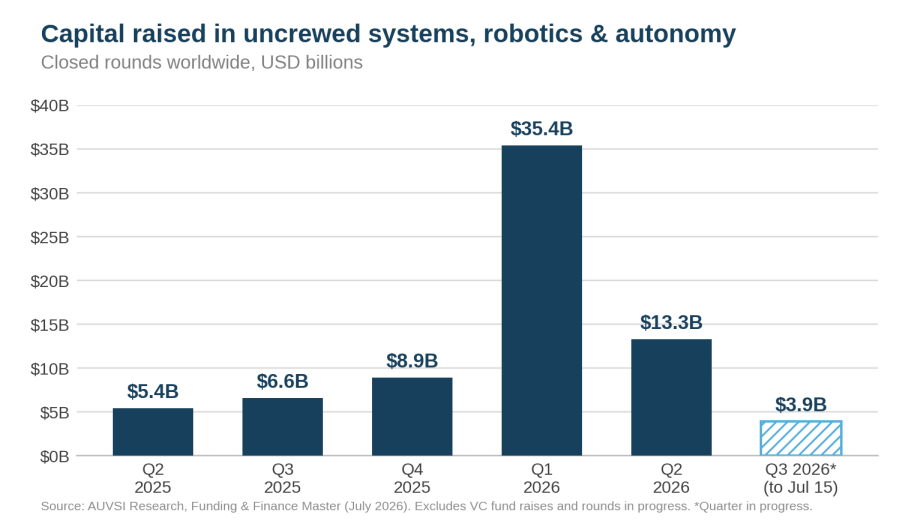
Quarterly capital raised in uncrewed systems, robotics & autonomy (Source: AUVSI Research)
Capital is also reshaping the competitive landscape. The USA and Europe share a market structure that features a handful of primes – Lockheed Martin, RTX, and Boeing in the U.S.; Airbus, Thales, BAE Systems, and Rheinmetall in Europe – that have dominated defense contracting for decades. These primes are now challenged by heavily funded startups such as Anduril and Neros in the U.S. and Helsing and Quantum Systems in Europe. Historically, primes answered competition with acquisitions. This cycle has already begun with venture positions where, for example, Airbus co-lead the funding round for Quantum Systems and Rheinmetall is backing Kraken. This is a situation where the primes are dipping their toes and testing the waters before the acquisitions come. In the first week of July, those acquisitions arrived, concentrated in maritime: Thales agreed to buy Exail for roughly $4.5 billion, Lockheed Martin acquired Ultra Maritime for $3.5 billion, and Italy’s Fincantieri announced four uncrewed-maritime deals in a single day.
Ground autonomy is where the two markets diverge. U.S. ground domain companies raised $29 billion against Europe’s $4.7 billion, since January 2025. As increased emphasis is being placed on the pursuit of physical AI in the form of self-driving cars (led by Waymo’s $16 billion round) and humanoid robots.
The U.S. market is open for business
Policy, meanwhile, is pulling the two industrial bases closer together. In December, the FCC, the American telecoms regulator, added foreign-made drones and critical components to its Covered List, closing the U.S. market to new foreign models – above all Chinese ones. The aim is not a closed market but a trusted one. As a result, domestic production accelerated with 103 U.S. factory announcements since January 2025 accounting for over 20 million square feet, $17 billion in facility investment, and 22,000+ jobs. Interestingly, instead of deterring allied foreign manufacturers, the restriction drew them in as 18 foreign firms have announced or opened U.S. facilities, onshoring production to participate directly in the domestic uncrewed vehicle ecosystem. Poland’s EU Motors, Croatia’s Orqa, and Ukraine’s General Cherry are opening American factories; Portugal’s Tekever opened its first U.S. office next to Fort Bragg; and Helsing, days after its record round, picked West Virginia for a $50 million factory with a targeted output of 2,000 strike drones per month. The message is clear: for companies that invest in secure supply chains and onshore manufacturing, the U.S. market is open for business.
Defense spending plans and new venture funds point in the same direction demand remains strong, and more capital is coming. The Pentagon has requested $54 billion for its Defense Autonomous Warfare Group (DAWG); NATO committed over $40 billion to counter-drone defenses; and the UK pledged more than GBP 5 billion for uncrewed systems. On the capital side, Prometheus raised a $12 billion fund, Founders Fund $6 billion, and Europe’s Expeditions a EUR 197 million defense-tech fund backed by BAE Systems and the NATO Innovation Fund. This is important as it shows that venture funds are lining up more capital
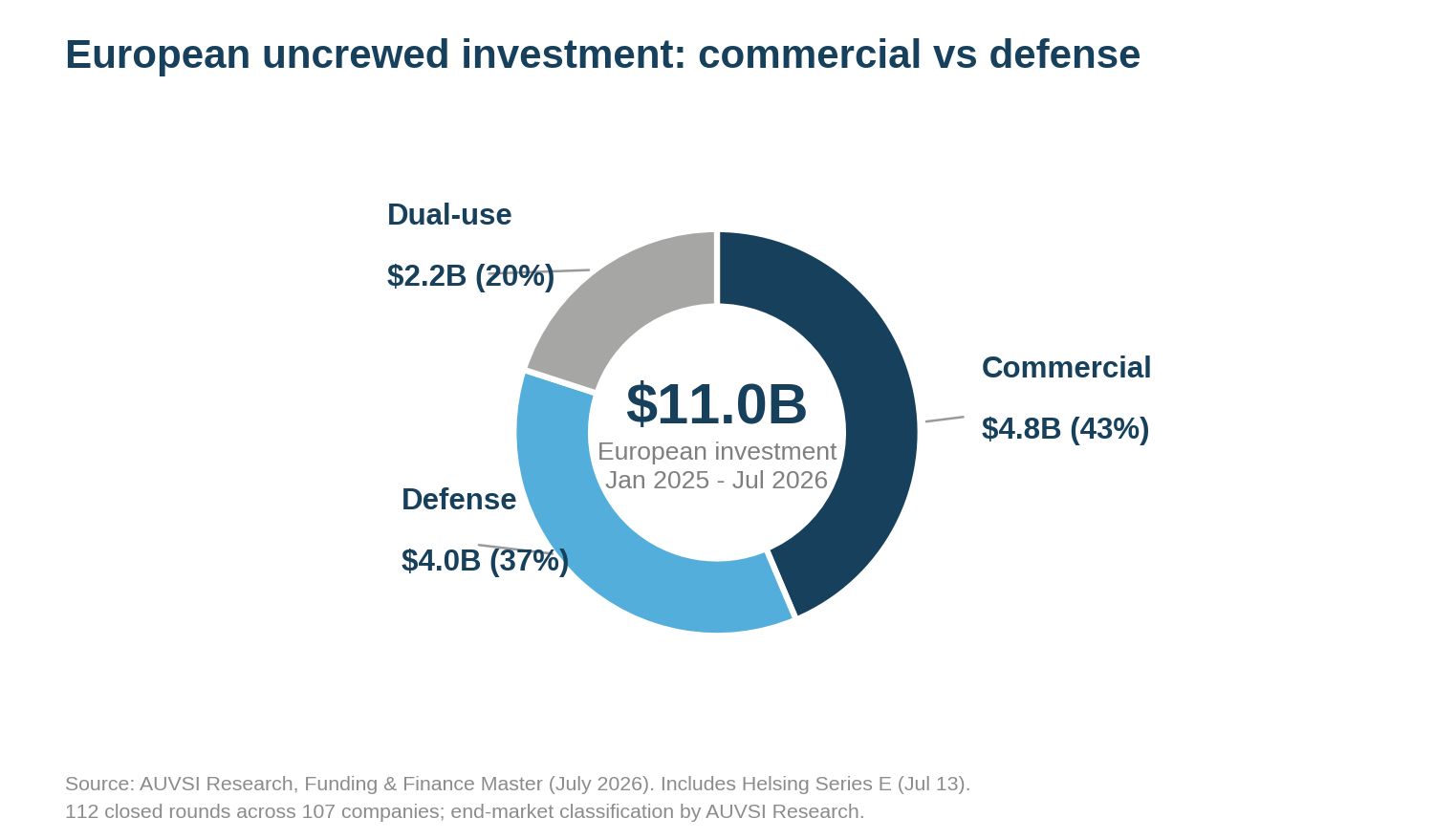
Even though defense dominates the headlines, European investment still flows to commercial systems (Source: AUVSI Research)
One caution for Europe, however, is worth emphasizing. Defense may dominate the headlines, but our data shows that over 40% of European investment still flows to commercial systems used in applications like logistics, agriculture, inspection, and medical robotics. And the commercial sector needs something different from the state. Defense is funded by the government itself, through budgets and contracts, whereas commercial operators need rules that let them operate reliably, repeatedly, at scale. Manna learned this the hard way. Over seven years, the Irish startup flew more than 300,000 delivery orders domestically to suburban doorsteps, only to be refused the planning permissions it needed to grow. In June, it paused Irish operations and moved its expansion, along with 1,000 planned jobs, to Tulsa, Oklahoma.
More News


Europe has companies and, increasingly, the capital. The remaining question is whether policy and regulation will allow commercial autonomy to scale alongside defense. If not, Europe risks becoming the birthplace of innovation while other regions capture the long-term economic benefits of deployment.
If you use Google as your search engine, you can set Drones as your preferred source so that our content appears more frequently in your search results. Add Drones as your preferred source.