Fully automated „Hub-to-Hub“ sample transport via drone
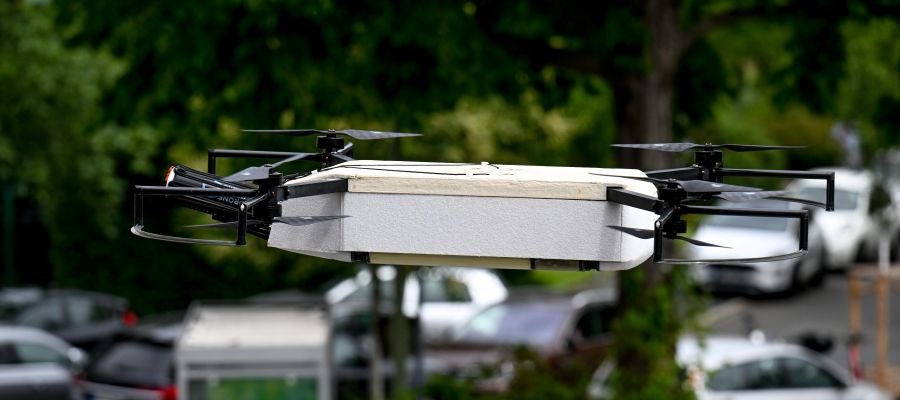

The fact that unmanned aerial systems (UAS) can transport items is no longer news. However, it is often less clear how UAS can be efficiently integrated into existing logistics networks without additional effort. The Medical Care Center for Laboratory Medicine and Microbiology Ruhr (mvzlm Ruhr), the St. Josef Hospital, and the drone operator Urban Ray have now demonstrated a system in Essen that allows for flights at the push of a button to become part of everyday life.
Samples are collected, packaged, transported by courier vehicle, and analyzed by an external service provider. Not all hospitals can afford the „luxury“ of having their own lab anymore. So far, so familiar. Just as well-known are the associated difficulties, from staff shortages to delays due to traffic jams and clogged roads. The straight-line route offers certain advantages, but aside from regulatory challenges, there are also tangible handling issues that need to be addressed. Even if the flight is fully automated, infrastructure must be built, and on-site staff must be trained in drone handling.
Fully automated operation, pre-programmed route
A process developed by the startup Urban Ray minimizes the „touchpoints“ between hospital and lab personnel on one side and the drone on the other to zero. Drone hubs are placed at both the departure and arrival locations – or at multiple departure and arrival locations. Staff on site deliver the payload through an opening in the hub, while the specific loading and unloading of the drone takes place fully automated inside the „pack station“. As a result, personnel do not come into direct contact with the UAS; they only need a transponder to open the loading flap and can initiate transport at the push of a button. The flight itself is fully automated along a pre-programmed route and is monitored by specially qualified personnel at a control center.
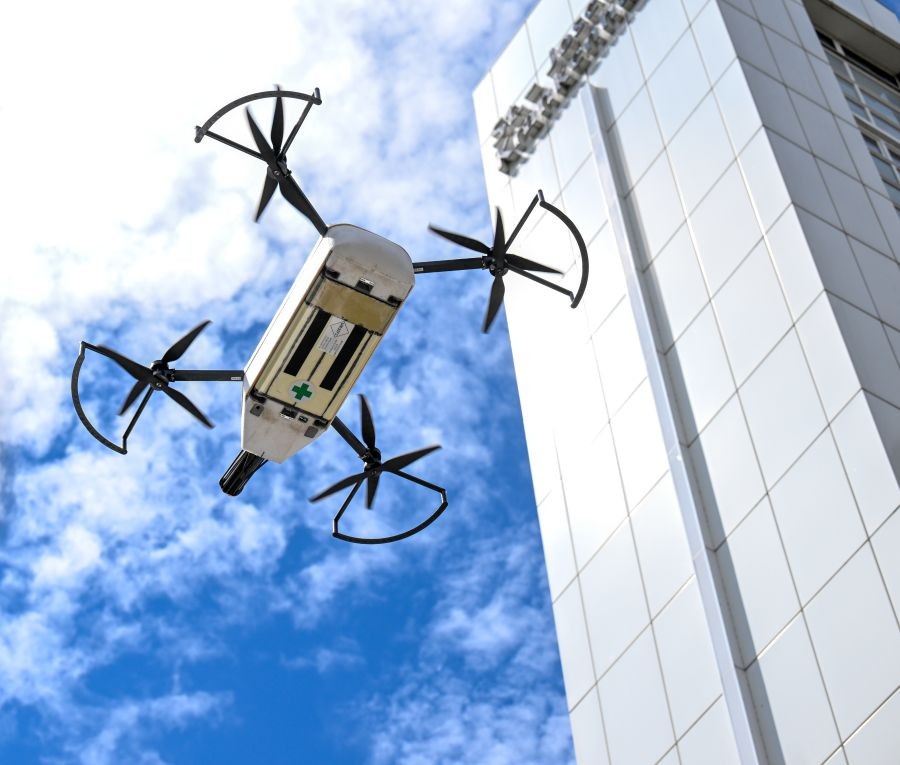
In Essen, a week-long demonstration showed how drones can be integrated into modern logistics networks
„We’re not flying to prove that drones can fly; they’ve been able to do that for a long time. We fly because it is simply the best way for the lab and the hospital to transport samples“, emphasizes Cem Uyanik, Managing Director of Urban Ray GmbH, reflecting on the successful test week in Essen. And according to Cem Uyanik and his colleagues, this concept can extend beyond just medical transport. It can naturally be integrated into other sectors where quick and efficient transportation is crucial.
Twice as fast as by car
The technology developed by Urban Ray has proven well-suited for integration into existing logistics networks during a week-long test conducted in the Kupferdreh district of Essen under real-world conditions. The distance between the St. Josef Hospital and the Medical Care Center for Laboratory Medicine and Microbiology Ruhr is about 8 kilometers in a straight line, which the Urban Ray drone covered in just a few minutes at a top speed of 70 kilometers per hour.
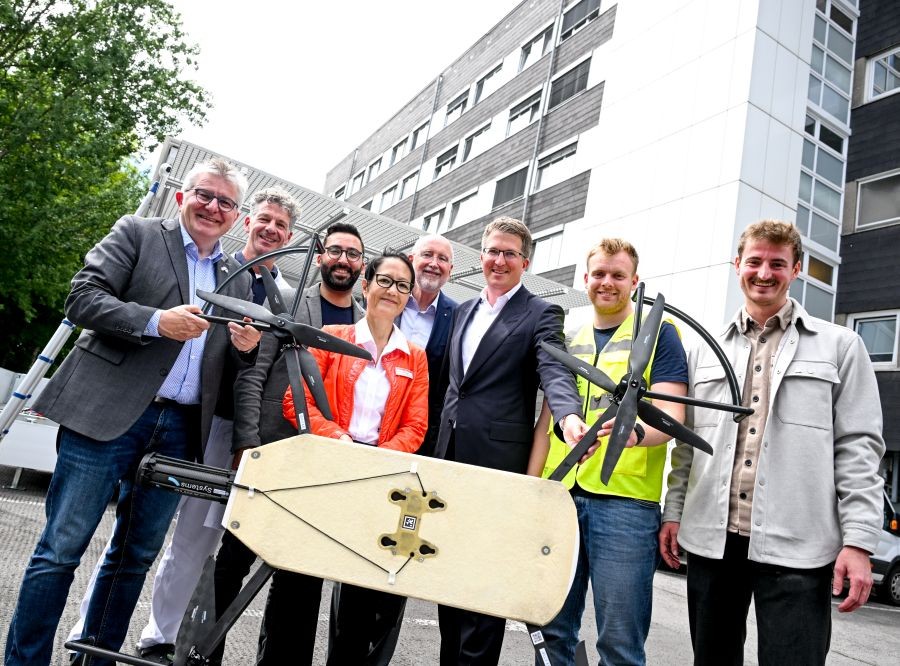
By the end of a successful test week, participants were highly satisfied with the results achieved
More News


This allows for the transport of up to 6 kilograms of blood, urine, and tissue samples to the lab about twice as fast as by car under optimal traffic conditions. „As a hospital, we want to provide our patients with the best possible care. Faster results are a real clinical advantage. The week has shown the potential of combining medical care with innovative technology“, emphasizes Peter Berlin, Managing Director of Katholische Kliniken Ruhrhalbinsel gGmbH.
If you use Google as your search engine, you can set Drones as your preferred source so that our content appears more frequently in your search results. Add Drones as your preferred source.