“The world must not forget what is happening here.”

For more than four and a half years, resistance against the Russian war of aggression has defined the lives of Ukrainians. This is also true on the 35th anniversary of independence, following the Soviet Union’s collapse. Meanwhile, Russian President Vladimir Putin is trying to turn back time with ruthless brutality, using drones, glide bombs, and grenades. In Kramatorsk, journalist Dmytro Hlushko documents the events of the war, while drone hunters attempt to stop the flying death.
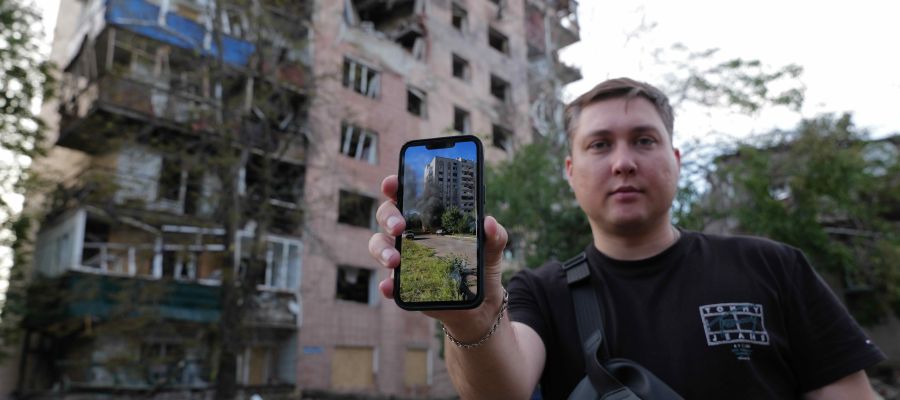
In Kramatorsk, a city in the Donetsk region in the heavily contested east of Ukraine, Dmytro Hlushko – a little out of breath – is climbing up the stairwell. On the third floor stands an elderly woman with cats weaving around her legs. She scoops cat food from a can onto a small plate and places it on the ground. The two exchange a brief smile. Between the third and fourth floors, rubble begins to accumulate on the concrete steps. Debris on the smooth surface. A gray layer quickly covers the shoes of the 32-year-old journalist. Just a few days prior, he had been here in the early morning hours when a glide bomb struck the apartment block. The explosion ripped a rectangular hole in the building, three stories high. Since then, one can look behind the facade like in a dollhouse. The insight reveals devastation – broken masonry has buried furniture beneath it. These are disturbing glimpses into the dim light. The young man looks from the stairwell through a shattered door out onto an empty apartment and across Kramatorsk.
Documenting Attacks
“Not everyone survived this strike. I saw one dead person lying in the rubble”, says Dmytro Hlushko quietly. He doesn’t speak much. After the Russian attack, he filmed, as he often does with other attacks. “I didn’t have my camera with me and used my smartphone instead”, he explains. Dmytro Hlushko, known as Dima, documents the war in Kramatorsk. It is perhaps the saddest form of local journalism. He used to film weddings in his hometown. It sounds surreal when he talks about it. A wedding that celebrates life does not belong in today’s Kramatorsk. The war is slowly, but increasingly, tightening its grip on the heart of the city. It is in the process of squeezing it. Before the full-scale Russian invasion, nearly 150,000 people lived in the industrial city. Almost 80 percent of them have likely fled. Day by day, more continue to leave. Kramatorsk is no longer a safe place to stay.
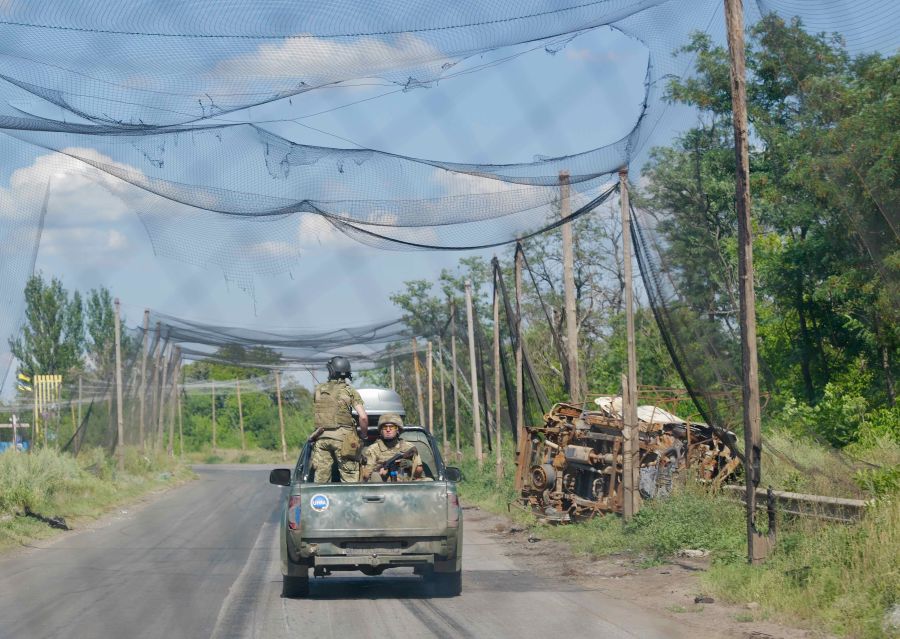
Between Kramatorsk and Kostjantyniwka: Burned-out wrecks stand by the roadside. Death from above can arrive at any moment. Drivers accelerate whenever possible
The front lines are moving closer. It’s only 12 kilometers away now. Kramatorsk can now be reached by small, agile kamikaze drones. Russian glide bombs, long-range drones, and grenades strike the city almost daily. Dmytro Hlushko captures their destruction. He documents a city under bombardment, his hometown. He films the next apartment block that gets hit. Sometimes, he says, it feels as if his chest is breaking from the pain.
Deadly Double Strikes
Kramatorsk has become quiet, except for the noise of the nearby front. Thundering artillery and explosions persist. Still, week by week, fewer cafés and supermarkets are open. The young journalist reports for the digital newspaper “Kramatorsk Post”; his photos and clips are shared on social media. However, he also films for international clients: “From ARD to Voice of America,” he says. “It is important for me to show what is happening to my hometown,” he adds. It’s not an easy task. Russian attacks often employ double strikes: after the initial hit, attackers fire another shell, drone, or glide bomb at the same target to kill those who are trying to help—or those like Dmytro Hlushko who report.
In the city, net tunnels are growing over the streets, as is common near the front. According to Ukrainian sources, around 1,200 kilometers of roads are protected by nets. As Dmytro Hlushko drives beneath them through Kramatorsk, dragon’s teeth—angular concrete sections that serve as tank barriers—whiz by at the side. Fresh barbed wire glitters in the sun along the pedestrian paths. The Ukrainian army is beginning to prepare the city for a possible street fight. “I’d rather not think about how long I can stay. What Kramatorsk will look like at the end of the year,” the journalist muses. His parents and grandparents are still there. “I would feel better if they left the city,” he explains.
Defense Belt
Kramatorsk and nearby Sloviansk belong to Ukraine’s defense belt in the Donbas. For Putin, the invasion is not going according to plan. The economy is struggling, completely subordinated to the war in many areas. Russia continues to arm itself. Debts are rising, and society is being militarized. 1.5 million children and young people are being drilled into the youth army, learning to kill. The state’s foreign reserves in Russia are dwindling. More than half of the Russian state budget is funneled into the war, even though the Kremlin downplays the numbers.
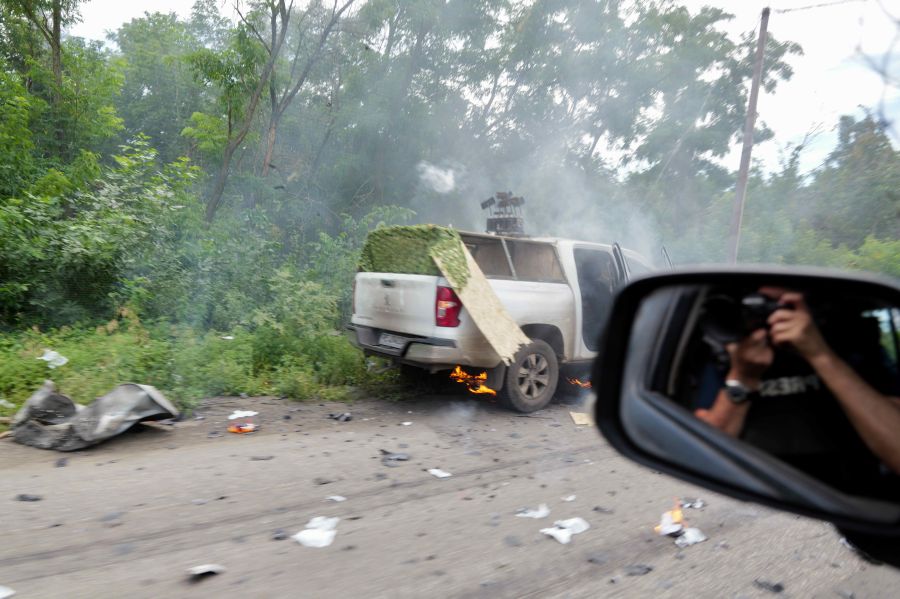
In the death zone: Moments before a kamikaze drone has struck a car …
For the first time in over four years of full invasion, large parts of the Russian population are feeling the effects of the war — albeit in a very different manner than the people of Ukraine. Due to drone attacks on refineries deep in the hinterland, there is a fuel shortage in Russia. The Ukrainian armed forces have severely damaged the logistics of the Russian military with persistence. Ukraine has developed its own cruise missiles, gaining an edge in the innovation of lethal drones. At the front, the invaders are making slow progress. In short, Putin needs successes.
Incomplete List
To maintain his image as the leader of an authoritarian state, he must show strength. The complete conquest of the Donbas by the year’s end would help the ruler achieve his goal. To reach this goal, Putin is not sparing his own military either. According to Ukrainian sources and Western intelligence, Russia is reportedly experiencing up to 1,500 deaths and injuries daily. A new wave of mobilization is set to send another 500,000 soldiers to the front. For the people in the Donbas, this means further destruction. Mariupol, Bakhmut, Toretsk, Chasiv Yar, Pokrovsk, Kostiantynivka: this is the incomplete list of destroyed cities in the Donbas. Dmytro Hlushko fears that Kramatorsk will also find its place on that list. “I hope that my recordings convey the seriousness of the situation,” he says as he takes his leave.
The nearby Drushkivka is already a ghost town. The buzzing of a kamikaze drone signals danger. Oleg raises his assault rifle and aims: one shot, a dull bang. “One shot, one hit. That doesn’t happen so often,” cheers the 58-year-old. In front of him stretches one of the main streets of Drushkivka. The net tunnel above the asphalt is damaged from explosions. A shell has completely burned out an armored military vehicle. The protective grilles on the chassis couldn’t prevent that. Almost 54,000 people lived in the city before the invasion. Drushkivka lies between the contested Kostyantynivka and Kramatorsk. Today, kamikaze drones can bring death at any moment. Oleg hunts them, bringing them down from the sky. He risks his life doing so. If the drones spot him, he himself becomes a target. His gaze sweeps over the plaza in the center. Empty window cavities stare down at the street. The houses surrounding the plaza date back to Stalin’s times. None of them are undamaged. The supermarket across the street is now just a ruin.
Streets as Landmarks
Oleg is also hunting drones on the road from Kostyantynivka to Kramatorsk. The asphalt band runs alongside half-destroyed, abandoned villages. Not a half-hour goes by without the bursts of automatic or machine guns sounding somewhere. The drone hunters, concealed among bushes, take aim at the Russian FPV drones flying towards Kramatorsk, directing themselves along the road as a landmark. Or they track vehicles that speed by in breakneck fashion because of that. The land drones bringing food and supplies to the units move less quickly. Every few hundred meters, burned-out cars and unmanned ground vehicles mark the locations of drone hits. “Better not to miss the drones in the air; otherwise, it can end fatally,” says Oleg.
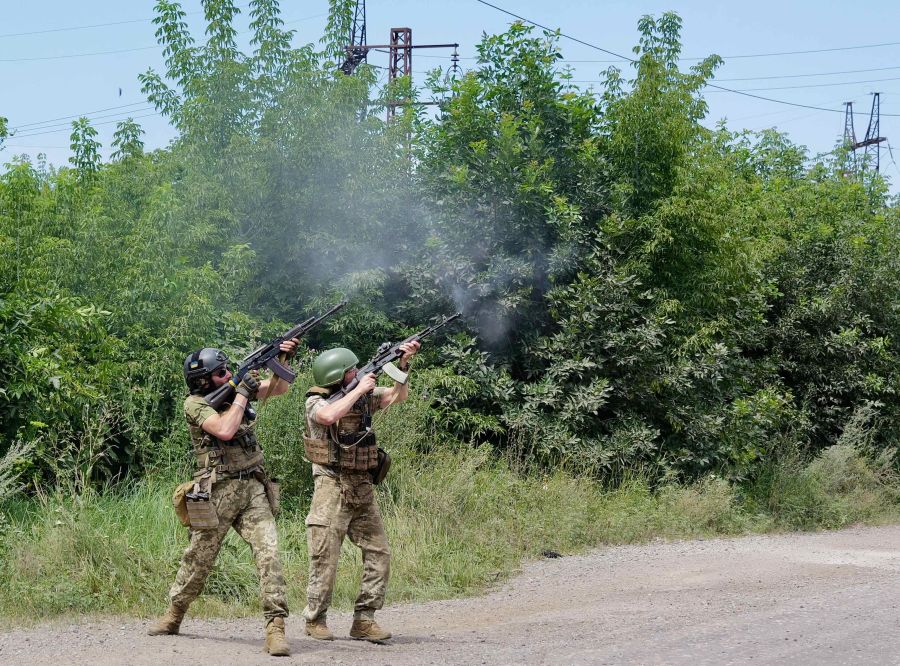
Drone hunters at work between Kramatorsk and Kostyantynivka. The soldiers risk a lot. If they miss their target, it can mean death
More News
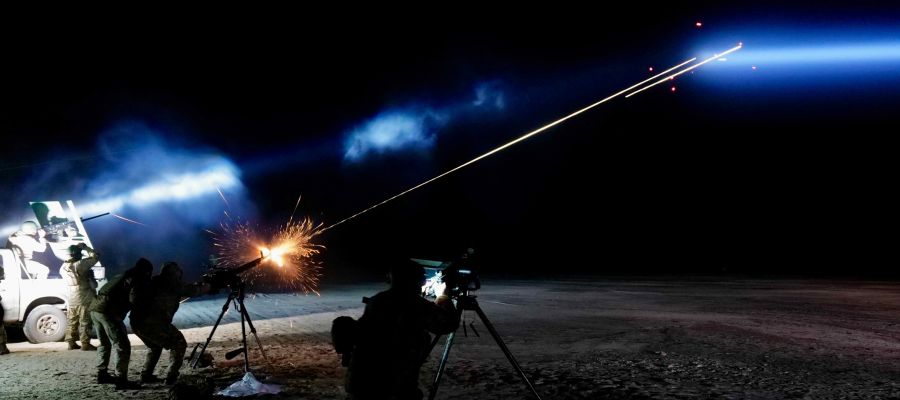


Dmytro Hlushko is grateful for soldiers like Oleg. “They protect us,” he says, recounting the many drone attacks that have already occurred in Kramatorsk. “Many civilians have lost their lives. Russia bombed the train station, residential buildings, cafes, and hotels. Nothing is safe,” he explains. Journalists have also lost their lives between Kramatorsk and Kostyantynivka, especially due to drone attacks. The 32-year-old is aware of this. “As long as I can, I will fulfill my duty. This is Kramatorsk, my hometown. The world must not forget what is happening here,” he says as he takes his leave.
If you use Google as your search engine, you can set Drones as your preferred source so that our content appears more frequently in your search results. Add Drones as your preferred source.