From Partner to Opponent?

For weeks, Russia has been terrorizing the Ukrainian capital with airstrikes. Civilians wonder how much longer they can stay in Kyiv; parents are sending their children to relatives in the countryside. Moreover, the once strongest partner is threatening to become an opponent. The Trump administration’s behavior and recent statements have shocked people. Consequently, many are watching the Midterms in the USA closely. The balance of power in Washington can directly influence their fate.
It looks like a shattered aquarium. In the window frame, shards hang, while a swimmer dives beneath. In front of an oversized swimsuit advertisement in Kyiv, thousands of small glass shards lie on dark gray asphalt. It’s as if spray and foam crowns are spreading. But the destruction on the other side of the street quickly makes such romantic comparisons forgettable. As a result of a Russian airstrike, a huge hardware store has collapsed. Metal cladding is twisted as if made of thin cardboard. Firefighters are extinguishing the last glowing embers in the ruins. They stand on the debris, on collapsed walls. Soot and sweat on their faces tell of exhaustion after hours of work.
Several Waves of Attacks
Several times a day, sirens wail in Kyiv, and warning apps rattle on smartphones. On the night of October 21 to 22, the residents of the Ukrainian capital experienced an especially intense attack: The explosions from three waves of ballistic missile strikes and four waves of drones shook the city. Residential buildings, emergency services, restaurants, and metro facilities were destroyed or damaged. One dead and 22 injured, according to local authorities. Shortly before, the United Nations had published the September statistics for Ukraine: 328 dead and 2,105 injured civilians. According to the UN, this is the highest September figure since the beginning of the Russian full-scale invasion. Most cases are due to airstrikes.
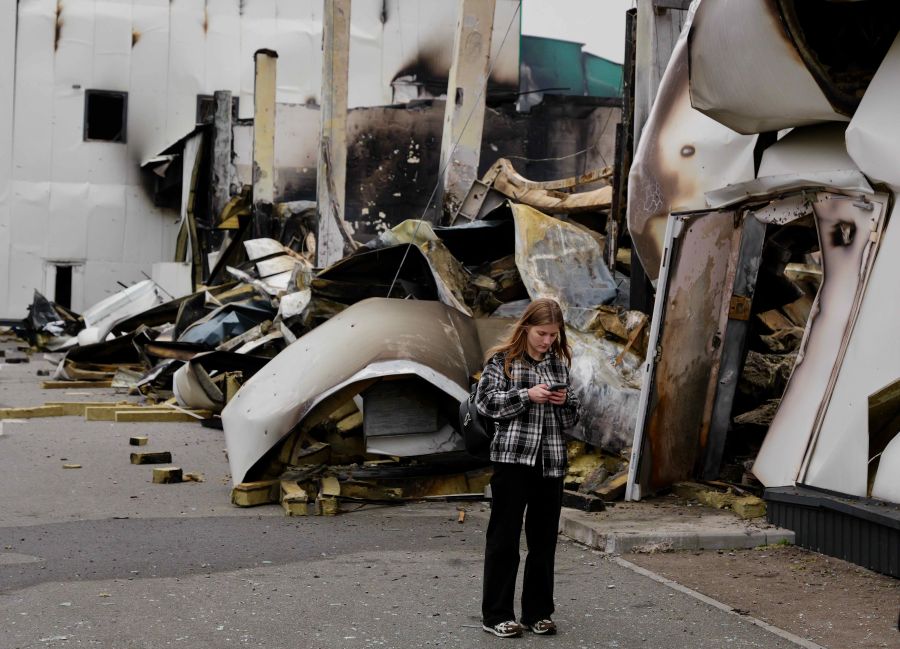
On the night of October 21 to 22, Kyiv was hit by a particularly severe air attack
As the war mercilessly escalates in intensity, US President Donald Trump reacts in a way that the people in Ukraine can only perceive as a new betrayal. “Russia, frankly, has been fine on Ukraine. They haven’t been doing much”, he declares in mid-October. His special envoy, Steve Witkoff, even called Russian leader Vladimir Putin a “humanitarian” during a visit to Moscow. Words that deeply wound Ukrainians. While Trump repeatedly attacks Ukrainian President Volodymyr Zelensky, he is full of praise for dictator Putin. This recalls the brutal humiliation of Zelensky in front of cameras in the Oval Office. It was a turning point for Ukraine. At that time, the most important partner openly turned away. Now he even threatens to become an opponent.
Fields of Debris
Russia is bombarding all of Ukraine with airstrikes. Blackouts are once again a daily reality. In the Donbas, Russian artillery, missile, drone, and glide bomb strikes are driving life out of the cities of Sloviansk and Kramatorsk. East of there, the invaders have already turned towns and villages into fields of debris. To label Putin a “humanitarian” feels like blatant mockery.
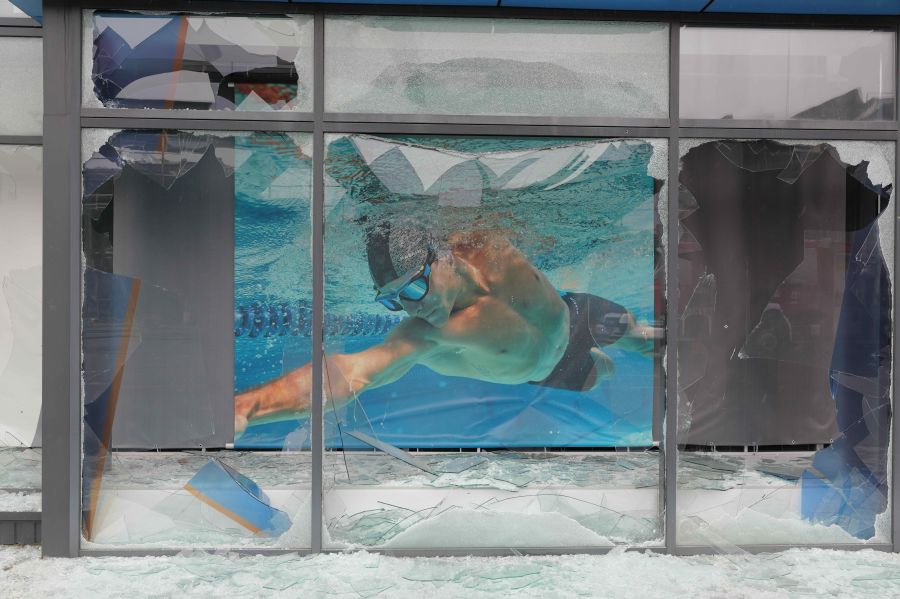
In a destroyed storefront, a swimwear model is preparing to dive
But it’s not just about words; it’s also about concrete actions. The USA’s purchase of Russian diesel was only the tip of the iceberg. Restrictions also limited “intelligence sharing”, including the dissemination of intelligence findings and reconnaissance data crucial for early warning of missile strikes. Meanwhile, the war-critical Starlink and its military version, Starshield, were hampered. The throttling apparently occurred without any prior announcement. After a few days, Defense Minister Evenii Khmara said sufficient data capacity was available again. But the breach of trust has happened. What if it happens again? What if Elon Musk completely shuts down Starlink?
Frontline Communication
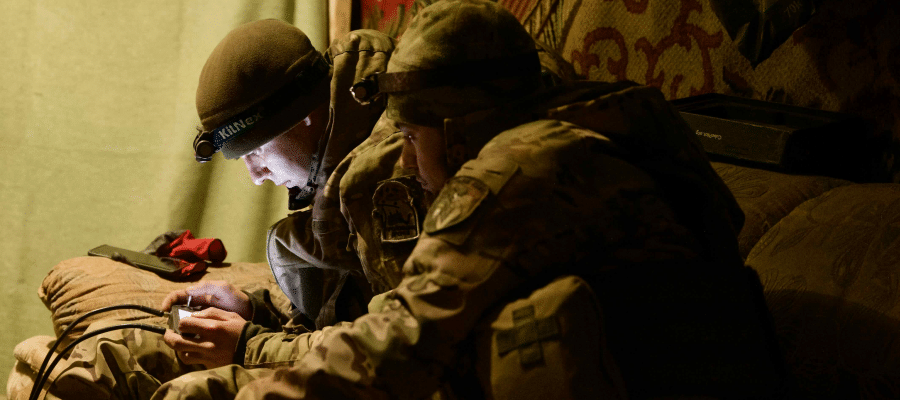
Dmytro Shumlianskyi understands what the satellite communication provider Starshield/Starlink means for Ukraine’s defense. The young man is an editor for the portal “Militarnyi”, the largest independent medium for military and defense topics. “The system is practically in use everywhere, from backup in hospitals to the front line. Starshield is Starlink for military use. It’s better encrypted and allows for greater speed”, explains Shumlianskyi. Around 80 percent of frontline communication runs over Starlink/Starshield. One example: A radio-controlled drone detects a Russian troop advance. The video footage or coordinates it records are transmitted directly online to the fire control center. Even positions on the contested front line are online. Starlink/Starshield makes this possible.
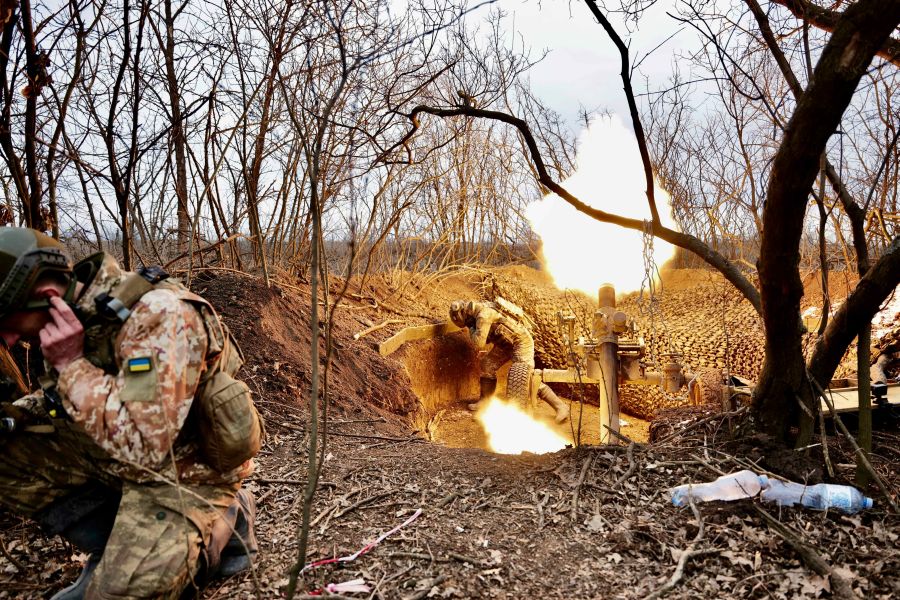
Starlink/Starshield is vital for communication at the front positions. Trust has been destroyed after the system’s temporary throttling
Musk accused Ukraine of using Starlink as an offensive weapon against contract rules. However, Ukraine cannot use Starlink/Starshield to attack refineries, for example. Due to a geofence restriction, Starlink/Starshield is inoperable on Russian territory. The moment a Ukrainian drone controlled by Starlink/Starshield crosses the state border, the connection is lost, and the drone crashes. UAS targeting areas occupied by Russia can, however, utilize the satellites from the US company to successfully help destroy military infrastructure. Unlike radio-controlled drones, they cannot be intercepted by jamming devices.
No Full Replacement
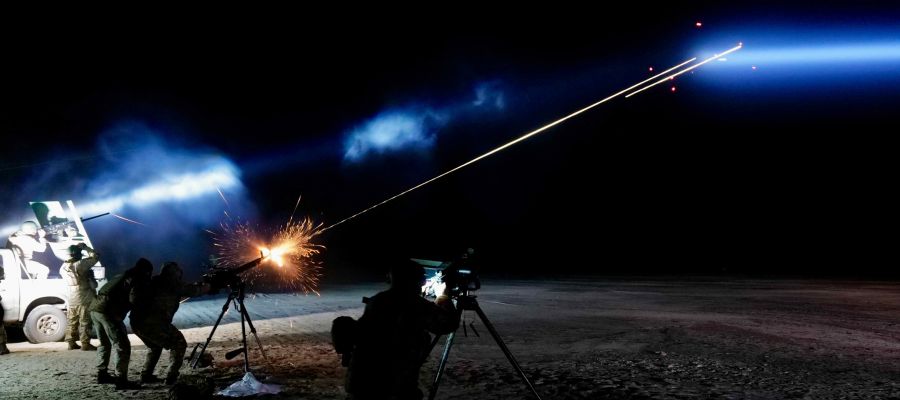
The throttling of Starlink/Starshield has particularly affected the defense drones used by Ukraine’s air defense. “Almost every day we are attacked here in Kyiv by jet drones. These drones kill and destroy in our city. They can be intercepted, for example, with fast interceptor drones”, explains Dmytro Shumlianskyi. However, some of them use Starshield for control. “At only 161 kilometers per hour, they are useless as a defense weapon”, he adds. They could use them only up to this speed while the Starlink/Starshield connection was throttled.
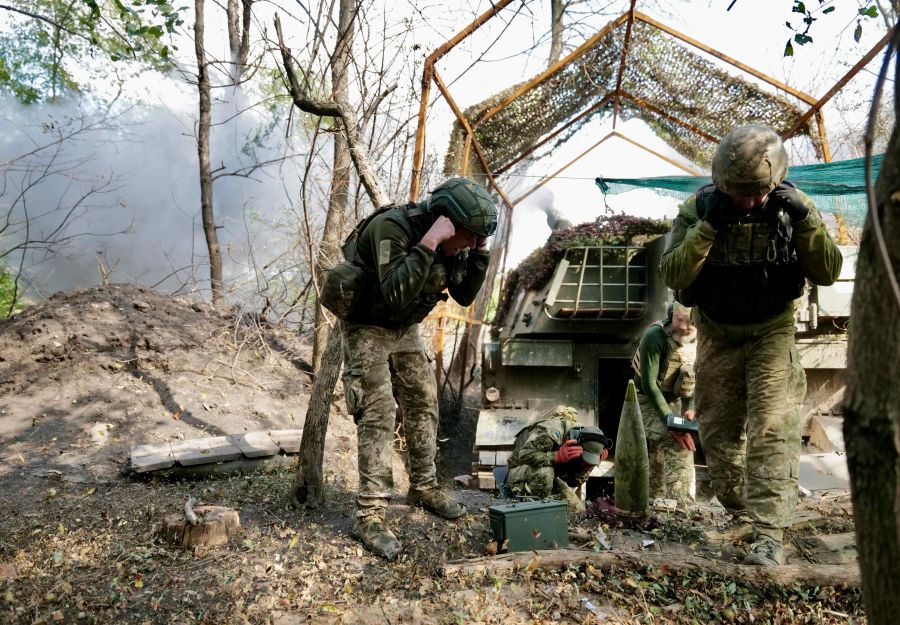
Data transmission from the reconnaissance drone pilots to the fire control center is done via Starlink/Starshield. Next, the artillery receives its target coordinates
“Let’s assume the worst-case scenario that Starlink/Starshield is no longer available to Ukraine. At least there would be no time for panic; we would have so much to do”, says Dmytro Shumlianskyi. Ultimately, no comparable satellite-based alternative exists. Starlink has 11,000 satellites in operation. A terminal in Kyiv, for example, has 58 satellites available at the same time. Europe offers nothing comparable: Eutelsat OneWeb (France/UK) has 650 satellites in orbit. Its terminals are also significantly slower and more expensive. GOVSATCOM became operational in January 2026, aggregating European military satellites. Commercial providers are expected to be integrated starting in early 2027. Ukraine is negotiating full membership. However, it will meet only the basic requirements for military communication. Then there’s IRIS, the EU’s flagship project, scheduled to launch in 2029. “Fully operational by 2030”, sighs the Ukrainian expert. Too late and also not as powerful as Starlink. Intensive contract negotiations are currently underway with the Finnish company ICEYE. “With fiber optics, radio waves, and node switching, short-term solutions could be created in some areas”, the expert suggests. “This must also be a lesson for Europe: to become independent from US systems. From defense missiles to satellite usage. Lost time ultimately costs lives. It has to go faster”, says Dmytro Shumlianskyi. He finishes his coffee and hurriedly returns to the office.
Cold as a Weapon
Since the full-scale invasion began in 2022, the Russian army has tried to use cold as a weapon. Power plants, transformers, gas, and water supply facilities are attacked year after year with drones and rockets. Especially in the fall. Last winter, 600,000 people had to leave Kyiv. They risked freezing in their homes as outside temperatures dropped below minus 25 degrees Celsius. The Ukrainian army is regaining territory at the front. Strikes against Russian refineries are limiting the flow of money for Russia’s war of aggression. However, this does little to help the people in Kyiv and cities across the country in the face of Russian airstrikes.
More News
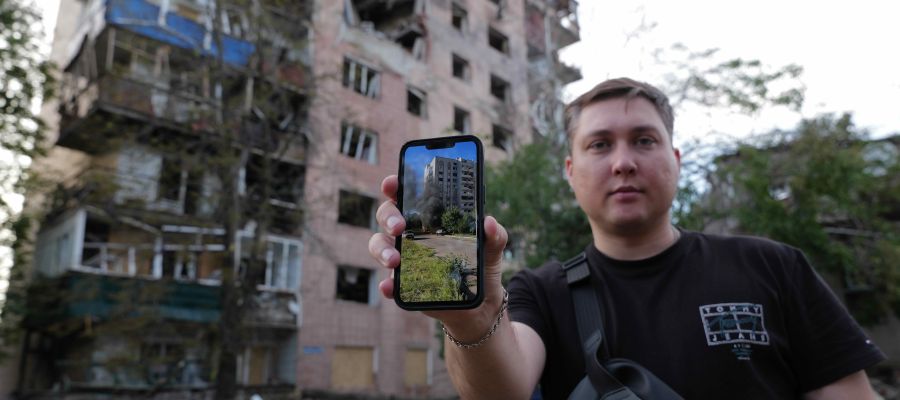
People like 40-year-old Hanna, who is heading to the Arsenalna metro station in the city center with her two daughters (ages 7 and 9). It’s her mother’s birthday, and she’s holding a bouquet of flowers. “Living under constant attacks is frightening”, she explains. “I worry about my children. At the beginning of the war, we fled for two months. Then the homesickness became too strong”, she shares. “Now I’m thinking about whether we should return to our relatives in Spain. The situation is terrible”, she adds. “The news hurts me too much. My husband always watches it. I can’t manage it. But it’s clear, America’s course is just shocking”, she says as she departs.
Dangerous Crossing
About 750 meters away, a viewpoint in a park overlooks the Dnipro and Kyiv from the “left bank.” Yulia stands there, gazing at the mighty bridges that have already been attacked by drones. “Many feel uneasy crossing the Dnipro now”, she says. She herself lives on the other side. “My son has been staying with his grandparents in the countryside, far away from Kyiv, for a few weeks. He is 15 years old. His classes are online. I visit him whenever I can. I miss him, of course. But he is safe”, she says. Yulia is not alone. Many families are questioning whether they can let their children endure a brutal winter like last year. Whether the city is still safe enough for a family. The people of the city have understood Putin’s goal: Kyiv is to become uninhabitable.

Yulia has sent her 15-year-old son to his grandparents in the countryside. “It has become too unsafe in the city”, she explains
“A few days ago, I accompanied my husband on a business trip to the Carpathians. It was so quiet. No alarms, no explosions. Silence and nature. I felt how good it was for my body, my nerves. Finally able to sleep through the night.” Then it’s time to go back for Yulia. By car over the Dnipro. And with a tight feeling in her stomach.
If you use Google as your search engine, you can set Drones as your preferred source so that our content appears more frequently in your search results. Add Drones as your preferred source.