Maritime Security in the Baltic Sea Through USVs


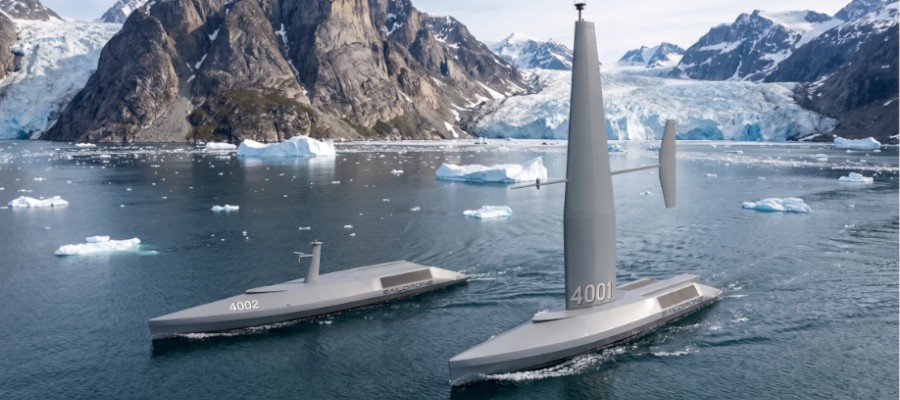
The Baltic Sea is one of Northern Europe’s most important maritime lifelines. In light of increasing threats to critical underwater infrastructure, the need for seamless surveillance is growing. Saildrone is now supporting the Swedish Armed Forces with a one-year mission in which four unmanned surface vessels (USVs) collect maritime data around the clock.
How does continuous surveillance work?
The Voyager systems deployed by Saildrone are designed to operate autonomously for months at a time. Under the current agreement with the Swedish Defense Materiel Administration (FMV), the four drones will each be deployed for 360 days, resulting in a total of 1,440 contractually agreed-upon deployment days. The goal is to maintain a continuous situational awareness of Swedish territorial waters and the exclusive economic zone in order to identify and track suspicious activities at an early stage.
This significantly reduces the burden on the Swedish Navy. While manned ships and aircraft must respond flexibly to acute threats, the unmanned systems handle continuous patrols. Johan Wahren, project manager at the FMV, emphasizes that the focus is not primarily on the hardware, but rather on access to sustainable intelligence gathering. Sweden is procuring a maritime surveillance service that is fed with precise data by the Saildrone fleet.
More News

A Model for Nordic Cooperation
The mission in Sweden marks the first national deployment of Saildrone systems under the framework of the Nordic Defense Cooperation (NORDEFCO). This agreement enables participating nations to access maritime reconnaissance services quickly and easily. Additional national deployments in the region are already being planned. To consolidate its operational presence in Europe, Saildrone has also begun registering its Voyager systems under the Danish flag.
The integration of unmanned systems is part of a broader NATO strategy to secure the Baltic Sea. Following incidents involving undersea cables in 2024 and 2025, Operation Baltic Sentry was launched, which gave rise to Task Force X Baltic. This task force aims to accelerate the integration of unmanned technologies into naval operations. Saildrone has already demonstrated that this concept works during a six-month deployment for the Danish Navy: The fleet achieved 92 percent availability and covered more than 20,000 nautical miles, tracking over 170,000 vessels.
For manufacturers of unmanned systems, the example of Sweden shows that government entities are increasingly willing to invest in long-term, data-driven services rather than merely procuring platforms. The scalability offered by international framework agreements presents enormous market opportunities for companies that have already validated their systems in demanding maritime environments.
Furthermore, the mission underscores the growing importance of interoperability and regulatory certainty. By registering under a European flag and integrating into NATO structures, Saildrone builds trust with government agencies. This sends an important signal to the industry: Those who wish to take on complex security tasks must not only demonstrate technological resilience but also be able to integrate seamlessly into existing military and political defense architectures.
If you use Google as your search engine, you can set Drones as your preferred source so that our content appears more frequently in your search results. Add Drones as your preferred source.