
Over the course of a decade, the Spanish coastal city of Benidorm has evolved from a pilot project for maritime rescue into a highly complex drone ecosystem. By integrating airspace management, detection technologies, and close coordination with city administration, the local police are setting new standards. This article analyzes how public authorities are efficiently and safely controlling urban airspace through strategic planning and pioneering regulatory efforts.
The Spanish coastal city of Benidorm on the Costa Blanca is a popular beach resort for tourists from all over the world. Especially during peak season, the beaches and pedestrian zones here are packed with people. It is no easy task for local law enforcement agencies to maintain an overview of the situation. To meet this challenge, law enforcement agencies are relying on drones. Over the past ten years, Benidorm has thus become a prime example of police use of UAS.
What began in 2015 as a pragmatic idea to optimize water rescue operations on Benidorm’s busy beaches has, within a decade, grown into a highly complex government drone ecosystem. The impetus for the UAS program came from Paco Albero, who now holds a leadership position in the local police department’s specialized drone unit. While on duty at the beach and along the coast, he recognized the enormous potential of thermal imaging sensors on unmanned aerial vehicles. The conventional method of
searching for missing persons using inflatable boats was inefficient and extremely time-consuming. The bird’s-eye view—often referred to metaphorically in Spanish as “Ojos en el cielo” (“Eyes in the Sky”)—offered the opportunity to drastically shorten search times, minimize risks to first responders, significantly increase the chances of survival for those in distress, and, last but not least, provide a solid foundation for real-time tactical decision-making. These considerations served as the starting point for a comprehensive municipal drone program.
Lack of Experience
However, the practical implementation initially encountered significant administrative and operational hurdles. In 2016, no municipal police department in Spain was yet using unmanned systems for such purposes; there was simply a lack of legal precedents and operational experience in an urban context. It was only through the political and administrative support of City Councilman Lorenzo Martínez—who was responsible for public safety at the time—that the first official drone, a DJI Phantom 4 Pro, could be purchased and put into service. The aviation unit owes the fact that this pioneering phase proceeded entirely without incident to a combination of fortunate circumstances and uncompromising safety management during every single flight mission. This solid foundation was essential for securing the long-term trust of political decision-makers and police leadership.

The Benidorm Police Department was honored with the DronExpo Award for its extensive use of unmanned aerial systems
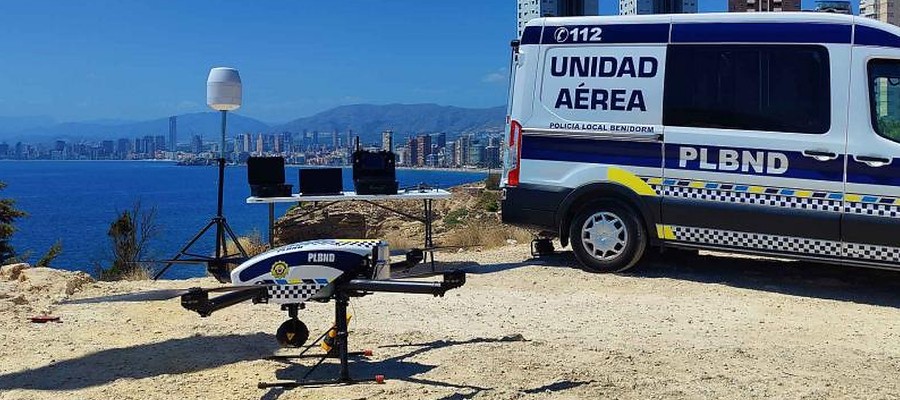
Today, ten years later, the use of UAS by the Benidorm local police is fully established. In addition to searching for missing persons, the unit’s range of tasks includes traffic monitoring, surveillance of heavily frequented coastlines, and support for patrols in rural and urban areas.
In addition, the unit handles tasks such as wildfire prevention, photogrammetric surveying of accident sites, inspection of torrents and ravines, and support for the fire department. Beyond mere hazard mitigation, the unit also makes its systems available for civilian tasks carried out by the city administration, such as urban planning, mobility research, historic preservation, and environmental monitoring. The Benidorm Police drone unit thus does not operate in an isolated niche but forms the center of a holistic municipal ecosystem.
Expanding the Field of View
The fact that Benidorm, of all places, has become an ideal testing ground for unmanned systems is due to the city’s specific topography and demographics. In the summer, the population swells dramatically, causing pedestrian traffic, heavy traffic, hotel complexes, and large-scale events to converge in a very confined space. In this challenging scenario, the drones primarily serve as a preventive tool to expand the field of view. They do not replace ground response teams but rather optimize their coordination and enable the monitoring of inaccessible or particularly heavily frequented areas, thereby significantly reducing response times on the ground.
Their operational value in emergency management was demonstrated, for example, during the inspection of infrastructure damage following the rupture of a main water line: camera drones precisely analyzed the extent of the damage—some of which was difficult to see from the ground—without endangering personnel. Today, these systems are firmly integrated into everyday operations—whether during demonstrations, in crowded areas with limited visibility, or during the search for fugitives. This success was also recognized at the national level when the relatively small municipal UAS unit won the DronExpo Award for the best public drone operation in Spain, prevailing over the far better-resourced units of the national security agencies.

In the airspace above Benidorm, the joint operation of a man-carrying Ehang drone with twelve smaller UAS was successfully demonstrated (Photo: Telefónica)
Airspace Management
A key insight from operational experience in recent years is that the responsibilities of a modern security agency in airspace must undergo a fundamental transformation. It is simply not enough to deploy one’s own drones effectively and safely. The real challenge lies in the comprehensive management of low-altitude airspace and in the detection of potentially unauthorized airspace users. Benidorm is already using UAS detection and counter-UAS technologies for this purpose. In the past, this has made it possible to detect unauthorized drone flights in sensitive areas such as the castle grounds, locate the pilots on the ground, and refer the incidents to law enforcement authorities due to the lack of required permits. Local governments must know who is operating in their airspace in order to ensure public safety and order. To provide a legal basis for this requirement, the city, in close collaboration with the Universitat Politècnica de València, has developed local guidelines for the operation of unmanned aerial vehicles, which gives the project special significance that extends beyond Benidorm.
This integration of operational experience with foundational regulatory work serves as a bridge to the European U-Space, whose introduction in Benidorm is viewed not as a distant prospect but as an ongoing process.
The U-Space concept is designed to enable the safe coordination of a wide range of drone operations—from police emergency response and emergency medical services to commercial logistics and future Advanced Air Mobility platforms—all within the same airspace. Benidorm leveraged its geographical and administrative advantages, such as stable weather and the support of local authorities, to serve as a real-world testing ground. The city became a key player in European test programs because, thanks to its years of practical experience, it was already able to provide answers to fundamental questions regarding flight clearance, interface coordination, and the detection of non-cooperative aircraft. This culminated, among other things, in demonstration flights as part of the European U-ELCOME project, as well as in the first simultaneous conduct of air taxi and drone operations in a real urban environment.

What began as a tool to help search for missing swimmers has since evolved into a comprehensive municipal ecosystem (image generated by AI)
Integrated Data Platforms
With the increasing use of UAS, the focus in Benidorm is also shifting noticeably from questions about the hardware used or operational scenarios to the critical issue of data sovereignty. Drones used by government agencies are not merely flying cameras, but highly integrated data platforms that capture sensitive infrastructure information, operational tactical details, and images of individuals. This raises profound security concerns regarding the software architectures used, the physical locations of servers, and dependence on foreign manufacturers that dominate the global market. This is because it carries the potential risk that sensitive data could leave European server infrastructures or that, in the event of a crisis, systems could be impaired in their function due to restrictions imposed by manufacturers. To maintain public safety at both the local and national levels, technological independence and data control must therefore be strategic priorities in UAS procurement.
While in rural areas, complex BVLOS flights with high-performance drones are primarily limited by economic factors, urban airspace presents a completely different risk profile. The projected, virtually unlimited increase in civilian and commercial drone flights in cities poses not only technical accident risks for the population on the ground but also potential for misuse. The future scope of responsibility for law enforcement agencies will therefore expand and must encompass criminal offenses such as the interception of valuable cargo drones, the hacking of autonomous flight systems, or even targeted attacks using unmanned systems. Although the police will operate as a privileged operator with special rights in the future U-Space ecosystem, they will also bear at least a share of the responsibility for protecting this entire critical infrastructure.
More News


An Integrated System Is Required
The Benidorm model shows that the sustainable success of unmanned systems in urban areas cannot be achieved simply by purchasing aircraft. Real added value for public safety is only realized when the technology is fully embedded in an integrated system consisting of qualified personnel, standardized operational tactics, an appropriate legal framework, and institutional cooperation.
In practice, this means that the recruitment and ongoing motivation of specialized teams must take precedence over hardware selection, as highly advanced drone systems completely lose their operational effectiveness without the corresponding personnel and technical infrastructure. Only through this holistic approach can the transition from an isolated innovation project to a reliable tool for modern public services in the airspace of tomorrow be achieved.
If you use Google as your search engine, you can set Drones as your preferred source so that our content appears more frequently in your search results. Add Drones as your preferred source.