Off to the Stratosphere: HAP-alpha Completes Maiden Flight
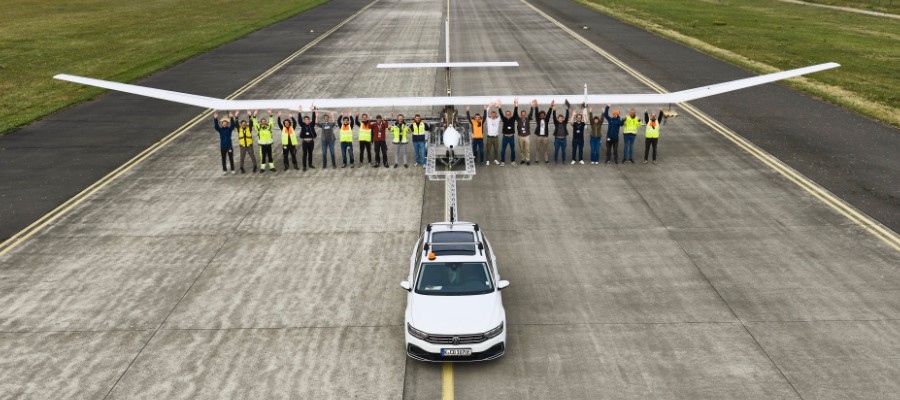

On September 2, 2026, the German Aerospace Center (DLR) reached an important milestone in the development of unmanned high-altitude platforms. The HAP-alpha, a highly specialized aircraft designed for use in the stratosphere, successfully completed its maiden flight at the National Test Center in Cochstedt. The test marks the beginning of an ambitious program aimed at strengthening Europe’s technological leadership in the field of solar-powered high-altitude platforms.
The greatest technical hurdle in the development of the HAP-alpha lies in its extreme design. With an impressive wingspan of 27 meters, the aircraft weighs only 138 kilograms. This lightweight construction leads to significant aeroelastic deformation, making the system vulnerable even to minor turbulence. To minimize the risk of structural instabilities, such as dangerous wing flutter, the wind speed during the maiden flight was limited to no more than one meter per second.
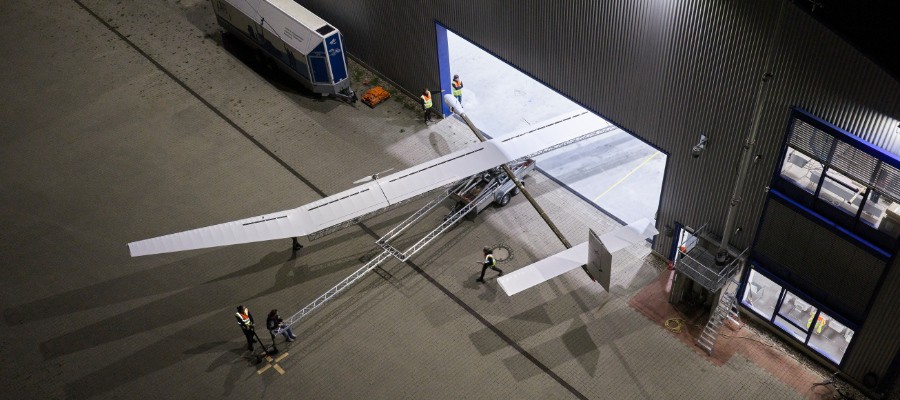
In the future, the HAP-alpha is expected to fly at altitudes of up to 20 kilometers (Photo: DLR/Leon Jakobs)
Precision in Test Operations
During the 70-minute maiden flight, the platform reached an altitude of up to 180 meters above ground level. A 25-member interdisciplinary team monitored all flight maneuvers from the mission control center. The HAP-alpha was controlled by a remote pilot, while a safety pilot stood by directly on the runway in case of emergencies. The goal of the flight was to collect validation data for flight dynamics models in order to precisely map the aircraft’s behavior at speeds between 30 and 50 kilometers per hour.
The DLR’s long-term goal is to deploy the HAP-alpha at altitudes of up to 20 kilometers. There, the platform is intended to serve as a flying test bed for high-resolution camera systems and synthetic aperture radar. Following the analysis of the current test data, additional flights at higher altitudes over uninhabited areas are planned. The project, in which 16 DLR institutes are involved, positions the DLR as the only major European research institution that independently develops and operates such a platform.
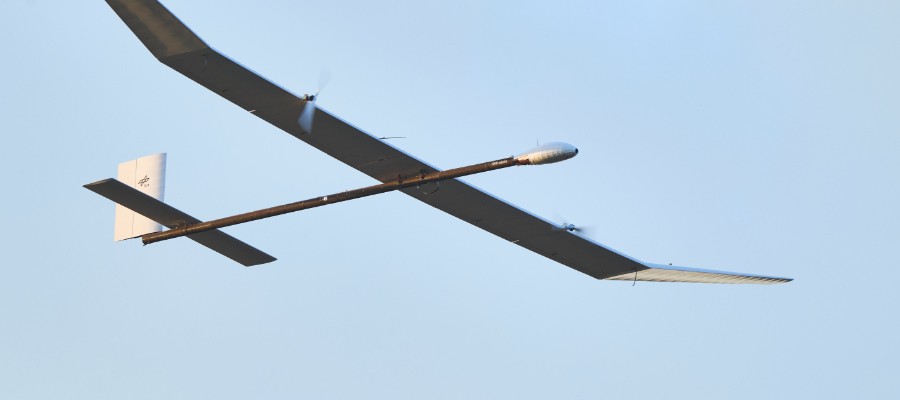
The unmanned high-altitude platform completed a safe flight lasting about 70 minutes, reaching altitudes of up to 180 meters above ground level (Photo: DLR/Leon Jakobs)
For the drone industry, the HAP-alpha project underscores the growing importance of High Altitude Platform Stations (HAPS). These systems bridge the gap between terrestrial networks and satellite-based services. This development demonstrates that the future of unmanned aviation increasingly lies in the combination of ultra-lightweight construction, autonomous flight control, and sustainable solar energy.
More News


At the same time, through this project, the DLR is providing valuable insights for the entire industry, particularly in the areas of aeroelasticity and model validation for large-span UAVs. For manufacturers and developers of unmanned systems, the project offers a technological blueprint for how complex payloads — such as those for Earth observation — can be operated efficiently and cost-effectively in the stratosphere.
If you use Google as your search engine, you can set Drones as your preferred source so that our content appears more frequently in your search results. Add Drones as your preferred source.

-City-outdoor-3.jpg)