The Airspace Stayed Secure


For six weeks this summer, the United States – along with Canada and Mexico – hosted the largest FIFA World Cup in history. In the US, 11 cities were involved. Millions of fans filled the stands. The airspace above them stayed secure. For the global drone industry, that’s the proof point that matters most. Especially when it comes to recent incidents in European skies, there’s one lesson to be learned: Europe doesn’t have long to put that same capability to work.
The European Games arrive in Istanbul next year, and Albania hosts a NATO Summit in Tirana months later, a political target that’s already seen unauthorized drone activity near European airspace. Euro 2028 follows in Britain and Ireland, and the World Cup returns to European soil in 2030, co-hosted by Spain, Portugal, and Morocco. None of those dates leave much runway, which makes it worth looking closely at what actually worked in the U.S. this summer and why.
A layered air picture
Across 11 host cities, security teams detected roughly 1,600 drones operating near World Cup venues and seized more than 700 of them. Most operators likely meant no harm: a souvenir photo, bad judgment, unfamiliarity with restricted airspace despite having been publicized for months. But the risk to a crowd of 70,000 people is the same regardless of intent, and detection alone doesn’t resolve it. Someone still has to work out what is flying, whether it’s a hobbyist, a credentialed public safety asset, or something worse, and act in seconds.
That’s the part that worked. Security teams had a real-time, layered air picture pulling together radar, RF detection, and electro-optical tracking – and the authority to act on what it showed them. It ran as a sustained, simultaneous operation, coordinated among agencies that don’t often work together at this scale. The systems held up under exactly the conditions they were built for.
Industry built the capability
AUVSI member companies designed, built, and fielded the detection and mitigation systems deployed around every venue. U.S. federal agencies led the operation with state and local partners, training at a dedicated counter-UAS center built for this purpose. The hardware and software behind it is the same class of technology fielding rapidly across European counter-UAS and security programs too.
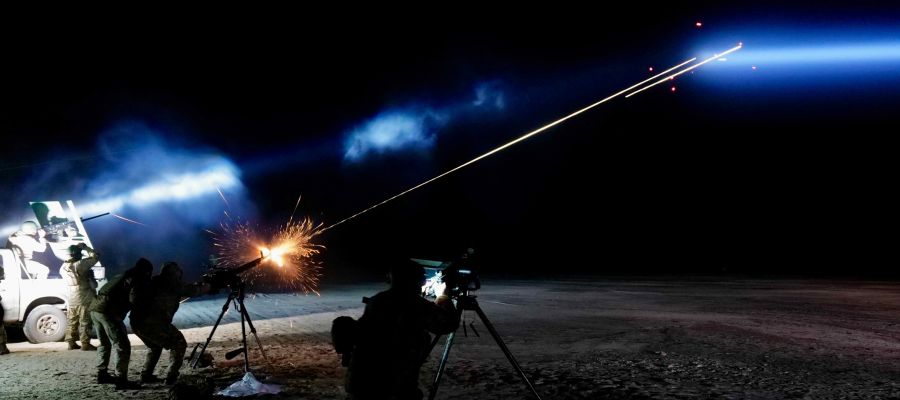
During the football World Cup, a demonstration was given of what efficient drone detection and defense can look like
The technology only worked because the legal authority to use it existed too. Late last year, the U.S. extended counter-drone authority beyond a small number of federal agencies to trained state and local officers, so they could act at major events without federal delay. Europe is working through the same problem on a longer timeline: the European Commission’s February 2026 Action Plan on Drone and Counter-Drone Security acknowledges that counter-UAS authority remains fragmented across member states, with a unified EU-level regulatory framework not targeted until 2030. The World Cup is the clearest large-scale precedent yet for what a working authority-plus-technology model looks like once the legal side catches up.
Critical infrastructure and BVLOS
Drones are increasingly showing up near airports, power stations, refineries, ports and border regions on both sides of the Atlantic, sites without anything close to the layered protection a World Cup venue had this summer. That same detection and mitigation architecture maps directly onto Europe’s own critical infrastructure gap.
There’s a second, faster-growing opportunity running the other way. The same airspace awareness that flags unauthorized drones enables authorized ones. BVLOS operations, including drone-as-first-responder, search and rescue, and infrastructure inspection, have been gated less by aircraft capability than by the lack of a low-altitude air picture regulators trust, which is exactly the gap EASA‘s U-space framework, operational since 2023, is still working to close across member states. That’s the enabling layer for routine BVLOS in Europe as much as anywhere else, and it’s where a meaningful share of this industry’s growth sits.
Funding and training at scale
The 2026 World Cup effort worked because it was concentrated, well-funded, and backed by a defined training pipeline and dedicated grants. Scaling that model, in the U.S. or across EU member states, is a different undertaking. One training center can’t cover a country’s worth of agencies, let alone a continent. Companies with proven counter-UAS and airspace awareness systems should be positioning now for what comes next: sustained infrastructure contracts, training partnerships with the agencies that will need them, and the BVLOS enablement work already underway in European markets.
More News



The 2026 World Cup proved the system works. What’s next is scale. And the industry that delivered this summer is the one ready to deliver across Europe.
If you use Google as your search engine, you can set Drones as your preferred source so that our content appears more frequently in your search results. Add Drones as your preferred source.