Innovation matters. But industrial capacity is decisive


For years, the autonomy industry has measured progress through technological advancement. Better sensors. More capable platforms. Advances in artificial intelligence. Increasingly sophisticated autonomous missions. Those innovations remain essential. But a recent visit to Taiwan reinforced a reality confronting the global autonomy ecosystem: the next phase of industry leadership will be determined less by who develops the next breakthrough and more by who can build, manufacture and deploy trusted systems at scale.
Most people know Taiwan for its critical role in semiconductor manufacturing. Increasingly, however, Taiwan is positioning itself as an important player in the future of drones, robotics, and advanced manufacturing. During my visit, discussions consistently focused on how democratic partners can work together to build more resilient and scalable autonomy ecosystems.
Those conversations reflected the seriousness with which Taiwan is approaching AI, supply chain resilience and drone manufacturing as part of a broader strategy for economic resilience, technological competitiveness and national security. The underlying message was clear: in autonomy, innovation matters, but industrial capacity is what determines whether innovation reaches scale.
This thinking echoes what AUVSI has said in Washington, at XPONENTIAL in Detroit, and elsewhere: industrial capacity is national power. In an era increasingly defined by autonomy, robotics and physical AI, the ability to manufacture and deploy trusted systems at scale will become a defining source of economic and strategic advantage.
The commercial drone market offers a clear lesson. For years, AUVSI has argued that the world cannot afford to repeat in robotics and autonomy what it allowed to happen in commercial drones: a market shaped by scale, subsidies, supply chain leverage, and strategic dependence on systems from untrusted sources.
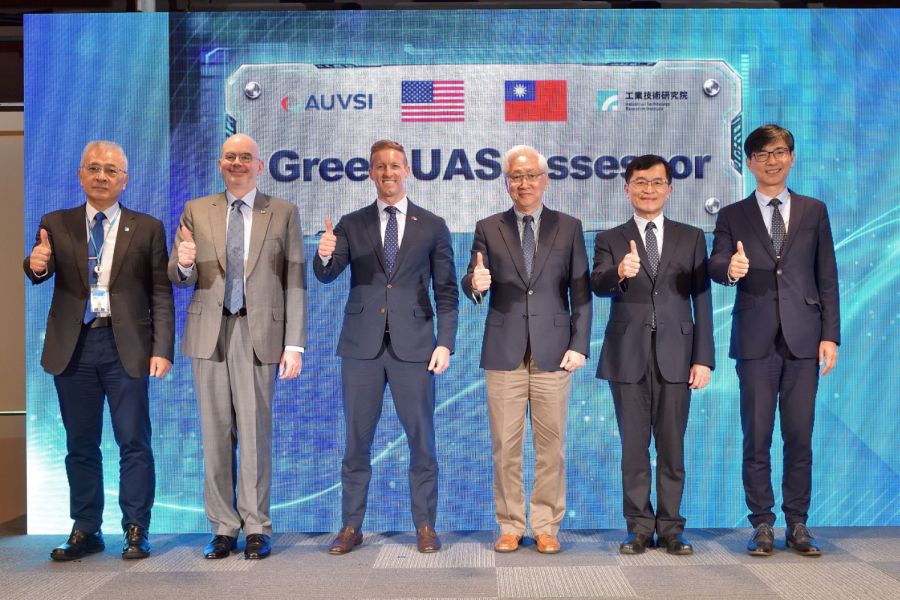
Taiwan’s Industrial Technology Research Institute (ITRI) recently became the first Green UAS assessment body outside the United States
That is one reason AUVSI‘s work with Taiwan’s Industrial Technology Research Institute (ITRI) is so significant. During my visit, I joined ITRI for the launch of Green UAS Taiwan and a major milestone: ITRI becoming the first Green UAS assessment body outside the United States. This creates a practical pathway for manufacturers to demonstrate cybersecurity, supply chain assurance, and trusted sourcing while connecting trusted producers to international markets.
The significance extends beyond Taiwan. Similar conversations are taking place across Europe, the United States and the Indo-Pacific as governments and industry leaders work to strengthen technological sovereignty while maintaining the openness and collaboration that drive innovation.
One of the strongest impressions I took away from Taiwan was the importance of industrial depth. During a visit to Taichung, a region known for precision machinery, aerospace manufacturing, automation, and advanced sensing technologies, I was reminded of my hometown of Detroit. Both regions demonstrate that autonomy does not scale through technology alone. It scales through manufacturing ecosystems, workforce pipelines, supply chain coordination, testing infrastructure, and sustained public-private collaboration.
That may be the most important lesson Taiwan offers the global autonomy industry. The organizations and nations that lead the next chapter of autonomy will be those that can turn innovation into industrial capacity. That is the real challenge before our industry and one of its greatest opportunities.
ABOUT MICHAEL ROBBINS
More News


Michael Robbins is President and CEO of the US-based Association for Uncrewed Vehicle Systems International (AUVSI), the world’s largest trade association for unmanned systems, autonomy, and robotics. Robbins is a member of the Aviation Advisory Committee of MITRE Corporation and a member of the Advisory Committee of the National Advanced Mobility Consortium. He is also a reserve officer in the United States Navy.
If you use Google as your search engine, you can set Drones as your preferred source so that our content appears more frequently in your search results. Add Drones as your preferred source.