No sooner have the first pilot projects for automated public transit vehicles gotten off to a successful start than the news is coming in fast and furious. Munich, Herford, and St. Ingberg are just a few of the German cities where driverless systems are now set to transport passengers. And in Norway, the first bus route has even entered regular service that operates entirely without a safety driver on board. According to findings by the German Aerospace Center (DLR), such projects are more than just technical demonstrations. They are indispensable for the mobility transition.
Since April 2026, a driverless bus has been transporting passengers in Norway. Stavanger is the first city in Europe to receive approval from the Norwegian Public Roads Administration (Statens Vegvesen) to deploy autonomous buses in regular scheduled service without the need for a supervisor to ride along in the vehicle. This groundbreaking project has already completed a roughly four-year test phase. An autonomous bus has been operating on a 2.6-kilometer route with five stops in the city since
May 2022. Until now, however, the law required that a human safety driver always be on board for safety reasons, to intervene in case of an emergency. With the new decision from April 2026, this requirement is now being lifted for the first time.

Politicians also see public transportation as (partially) autonomous in the future: Federal Transport Minister Patrick Schnieder praised the Munich mobility project MINGA (Munich Innovation Network for the Design of Automation) as groundbreaking. The insights gained are intended to help create the legal and technical framework for the widespread deployment of driverless buses in Germany (Photo: Tobias Koch)
Safety Through Remote Monitoring
However, the vehicles are not entirely unsupervised. Control is simply shifting from the driver’s seat to a digital control center. From there, specialized staff monitor the bus’s journey, which travels at speeds of up to 40 kilometers per hour. Should unforeseen obstacles arise or technical problems occur, the teleoperators can intervene directly.
One of the companies behind the project is Applied Autonomy. Its CEO, Olav Madland, sees the technology as an enormous opportunity for public transit operators worldwide. The use of autonomous vehicles could alleviate the driver shortage in public transit and make it possible to maintain or expand route services even in areas where there is a lack of staff or where operation with conventional buses would be unprofitable.
The bus model deployed in Stavanger (an electric e-ATAK from the Turkish manufacturer Karsan) is already being tested in various European cities, including Paris and Burgdorf near Hanover in Lower Saxony. The Norwegian authorities’ decision could send a signal to all of Europe, as it demonstrates that the technology is ready for real-world daily operation without a safety net on board.
It remains to be seen how well the driverless bus performs in Stavanger and what level of public acceptance it receives. Automated public transit suffered a major setback as recently as Pentecost this year. In Gothenburg, Sweden, an autonomous bus without a safety driver collided with a tram after just one hour of operation. A Karsan e-ATAK was also used in that incident. According to media reports, the project is therefore set to be scrapped immediately.
One thing is clear, however: it won’t stop at isolated projects. Especially in recent months, there have been regular reports of similar projects across Europe. It is therefore likely only a matter of time before vehicles without safety drivers become a common sight in cities.
MAN launches project in Munich
And so technical development continues at a rapid pace. Commercial vehicle manufacturer MAN Truck & Bus has developed a fully automated electric bus in cooperation with technology specialist ADASTEC. The vehicle is set to be tested in real-world city traffic shortly and marks a significant milestone for Germany’s transportation transition.
The technical basis is the fully electric MAN Lion’s City E city bus. This was equipped with a corresponding software platform from ADASTEC. The system enables automated driving at SAE Level 4—meaning the bus can operate completely autonomously on defined routes without requiring human intervention in normal operating situations. For safety reasons, however, the first test runs in Munich will still be monitored by specially trained personnel.
The test run is part of the Munich mobility project MINGA (Munich Innovation Network for the Design of Automation). This consortium brings together the City of Munich, Stadtwerke München (SWM), and various partners from industry and research. The goal is to make public transportation more efficient through automation and to find technological solutions for the growing mobility needs in metropolitan areas.
Federal Transport Minister Patrick Schnieder praised the project as groundbreaking. While autonomous robo-buses are already a common sight in many places in countries like China, MAN is doing important pioneering work for the European market with this test in Munich. The insights gained are intended to help create the legal and technical framework for the widespread use of driverless buses in Germany.
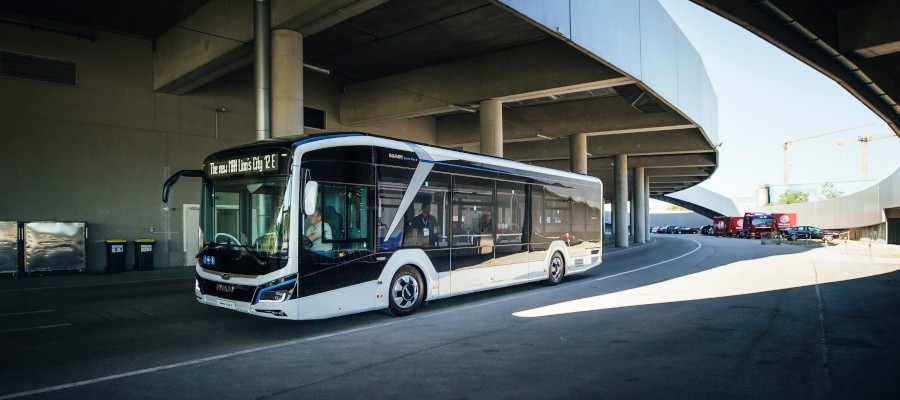
Commercial vehicle manufacturer MAN, in cooperation with technology specialist ADASTEC, has developed a fully automated electric bus based on the MAN Lion’s City E
Beyond Major Cities
The Saarland town of St. Ingbert is also planning to deploy autonomous shuttle buses. This pilot project primarily aims to bridge the so-called “last mile” and connect residential areas more efficiently to the city center and the train station. This is intended to close gaps in the existing route network that are often uneconomical for conventional buses.
Despite all the high-tech equipment on board, the initial plan here is also for a human operator to remain on board to monitor the systems and intervene if necessary. The project is not only intended as a pure transportation service but also as an important research field to examine public acceptance of AI-controlled vehicles and to optimize technical details under real-world conditions.
However, implementing this project requires close coordination between the city administration, technology partners, and public transit operators, as the legal hurdles for autonomous operation in public spaces are particularly high. With the support of funding, St. Ingbert aims to take a pioneering role and demonstrate how climate-friendly and smart connectivity can function in a rural area. If the field trial is successful, the model could serve as a blueprint for the entire region and transform public transportation in a sustainable way.
A similar approach, albeit on a much smaller scale, is being pursued in Bad Schönborn in the Karlsruhe district. There, as part of the EU research project “GINEVRA,” the use of an autonomous shuttle bus was tested for several days in mid-April 2026. On a special test course, a fully electric minibus from the manufacturer Navya demonstrated how driverless technology detects obstacles, reacts to hazardous situations, and navigates safely. Residents had the opportunity to participate in guided test rides, during which, although there was no longer a traditional driver behind the wheel, safety personnel on board provided information about the technology. The project aims to demonstrate how autonomous vehicles can bridge the “last mile” in the future, particularly in small and medium-sized cities—for example, as shuttles from residential areas to train stations or downtown.
Due to enormous fees of around 90,000 euros that would have been incurred to conduct the trial on public roads, the team opted for private property: the grounds of a former nursing clinic in the Mingolsheim district. And financing such projects is a problem not just here.
Autonomous Public Transportation: The Only Way Forward
In the debate over German public transportation, Sascha Meyer, CEO of Volkswagen subsidiary Moia, views autonomous shuttles as an existential necessity. In a recent podcast interview with Table.Today, he emphasized that, given the growing labor shortage in the transportation sector, this technology is not merely a technical experiment, but the only means of maintaining current mobility levels in German cities in the long term. Without automated solutions, public transit faces the threat of a drastic reduction in service.
To ramp up the market, Meyer outlines a concrete, large-scale roadmap that, however, requires massive government investment. His proposal calls for the creation of three model regions, each of which would operate approximately 2,000 autonomous vehicles. To turn this vision into reality, the Moia CEO estimates the funding requirement at around 500 million euros per region. He justifies these sums with the enormous development costs for the technology, which are already in the billions.
Despite its strategic relevance, the initiative has met with a muted response from the Federal Ministry of Transport. While the ministry has expressed a general interest in the project’s innovative potential, it has rejected the high financial demands for the time being. Citing the current budget situation and a lack of funds for projects of this scale, the federal government is dampening hopes for an imminent, comprehensive injection of funds for the widespread deployment of autonomous shuttles.
And there is another problem: bureaucracy. In addition to the high costs, project leaders in Bad Schönborn complained above all about the lengthy approval process. Eileen Gatzke, head of the Bad Schönborn municipal administration, reported that they had spent about three years trying to obtain a permit for autonomous driving in public spaces in Bad Schönborn, but ultimately failed due to the conditions imposed.
In Herford, East Westphalia, officials are grappling with different challenges. As reported by WDR, the test operation of Deutsche Bahn’s driverless shuttles as part of the European research project “Ultimo” was technically insightful. However, it was announced in early March that the project would be suspended for the time being due to the termination of the partnership with project partner ZF. ZF reportedly plans to discontinue the development of autonomous transport systems. Deutsche Bahn is therefore looking for a new vehicle manufacturer for the Herford project.

Moia CEO Sascha Meyer sees autonomous shuttles as an existential necessity to address the growing labor shortage in the transportation sector (Photo: Moia)
Driverless ferries
There is currently no need to worry about premature termination in Kiel. The Federal Ministry of Transport intends to advance the development of driverless passenger ferries and support a groundbreaking innovation project in Schleswig-Holstein with approximately 3.3 million euros for the third phase of the CAPTN (Clean Autonomous Public Transport Network) project. The goal of the initiative, which is backed by a consortium of science, industry, and politics, is to establish an environmentally friendly and intelligently connected network of autonomous vehicles.
So far, the technological foundations—such as complex sensor technology, radar, and camera systems for autonomous navigation—have been tested on the test vessel “MS Wavelab.” With the new funding for the “CAPTN Förde Areal III” phase, the project is now moving from pure research to practical implementation under real-world conditions. The goal is to develop and prepare a fully automated, electrically powered passenger ferry.
Talking Cars in Munich
A brand-new project launched in June of this year. Ride-hailing service Uber, chip giant Nvidia, and the Israeli AI startup Autobrains have launched a joint pilot project. On the streets of Munich, autonomous taxis (Level 4) will transport passengers, who can conveniently book them via an app.
What makes this project unique is its technological approach. Instead of a single, massive AI computing unit, the partners are relying on Autobrains’ so-called “Agentic AI.” In this system, several specialized AI agents work in parallel: One agent monitors pedestrians, another evaluates right-of-way rules, and yet another is responsible for lane changes. A higher-level system consolidates this data in real time. The technical foundation is provided by the Nvidia Drive Hyperion platform. Unlike many U.S. competitors, the system does not navigate using expensive lidar sensors but relies primarily on a more affordable, camera-based AI system.
During the initial six-month phase, a specially trained safety driver will continue to sit in the car for monitoring purposes. To build trust among passengers, the car communicates actively: The AI agent announces planned maneuvers, such as lane changes, in advance, and passengers can speak directly to the system.
A key advantage for the planned mass production is the so-called OEM-agnostic approach. The technology is designed to be manufacturer-independent. This means that automakers can integrate the software directly into their production vehicles. In return, Uber handles the logistics and provides access to customers via its platform.
The Bavarian capital was deliberately chosen because it offers a challenging environment with dense city traffic, highway sections, and the German legal system. According to Autobrains founder Igal Raichelgauz, the motto is: “If you can make it in Munich, you can make it anywhere.” Even in the initial phase, the taxis are expected to cover around 40 percent of Munich’s urban area and reach speeds of up to 110 km/h.
More News

Between technological breakthroughs and structural obstacles
The momentum in the autonomous local transport sector makes it clear that driverless systems have long since moved beyond the stage of mere laboratory experiments. The Scandinavian pioneering example serves as an international trailblazer: it demonstrates that eliminating on-board personnel through digital remote monitoring is technologically feasible and sets the course for the future of European transportation. This development comes at the right time, as the labor shortage in the transportation sector requires innovative solutions to maintain mobility services at all. The diversity of test areas—ranging from inner-city scheduling to connections in rural areas and local maritime transport—also underscores the enormous strategic importance for the upcoming transportation transition.
What is no longer decisive for widespread everyday use are technological hurdles, but rather the framework conditions for implementation. While the industry is developing highly flexible, manufacturer-independent AI systems, the administrative and financial infrastructure is lagging behind. Lengthy approval processes and regulatory bottlenecks are blocking the rapid transfer from test tracks to the road. Furthermore, the reluctance to provide government funding reveals a deep divide between politically articulated innovation goals and actual budget planning. Combined with technological volatility, which manifests itself in sudden shifts in partnerships or unforeseen setbacks, it becomes clear that the breakthrough of autonomous public transport in Central Europe will primarily be a matter of political will and bureaucratic modernization.
FURTHER ARTICLE ON AUTONOMOUS DRIVING
If you use Google as your search engine, you can set Drones as your preferred source so that our content appears more frequently in your search results. Add Drones as your preferred source.