A New Model for Alpine Rescue
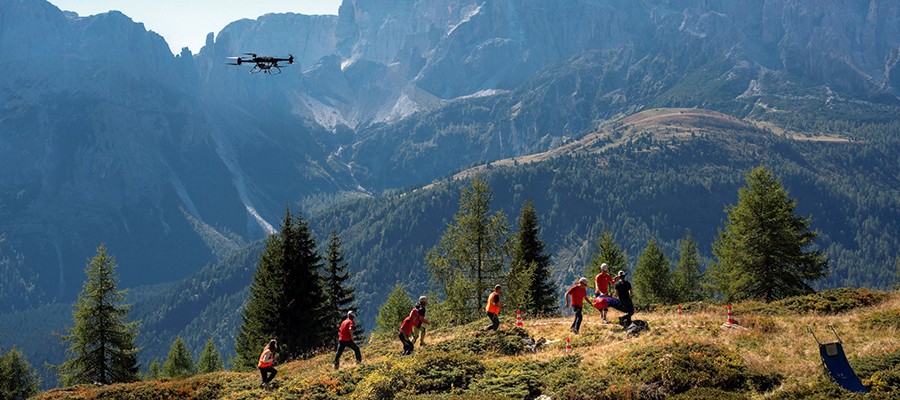

Moritz Moroder, CEO of FlyingBasket, explains: “Our technology enables faster interventions, reduces risks for rescue workers, and improves transport conditions for patients.”
Heavy-lift drones fill an important gap in mountain rescue
In a mountain emergency, every minute counts. However, traditional rescue methods often reach their limits in alpine terrain: helicopters cannot land everywhere, ground-based evacuations are often slow, physically demanding, and pose risks for both rescue teams and patients. Heavy-lift drones can fill this important gap.
As part of the “START2 Living Lab” project, research was conducted in the Dolomites to investigate how cargo drones can support rescue teams during evacuations in difficult terrain. The results show significant potential: evacuation times can be up to three times shorter. At the same time, air transport via drone is significantly less taxing for patients than ground transport, as shocks and vibrations are considerably reduced.
Among the central technology partners of the project is the South Tyrolean company FlyingBasket, an internationally active manufacturer of heavy-lift drones for industrial logistics. FlyingBasket provided its drone platform, operational expertise, and training measures for rescue personnel. The focus was on a collaborative development process: research, companies, and rescue organizations tested the technology under real conditions and developed it step by step—from the specific problem to field trials to the next stage of product maturity.
From field test to operational solution
During the field trials, traditional ground evacuation methods were compared with operations supported by heavy-lift drones. The development process was accompanied by the innovation process at the NOI Techpark and the medical and scientific expertise of Eurac Research. The focus was not only on the technical functionality of the drone but also on its direct benefits under real operational conditions: under time pressure, in difficult terrain, and in situations where safety, accessibility, and reliability are crucial.
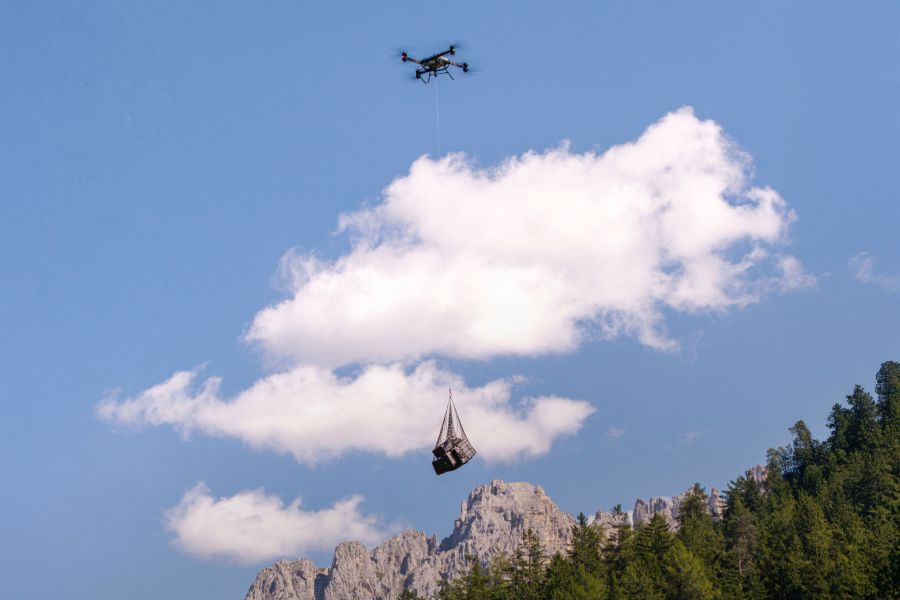
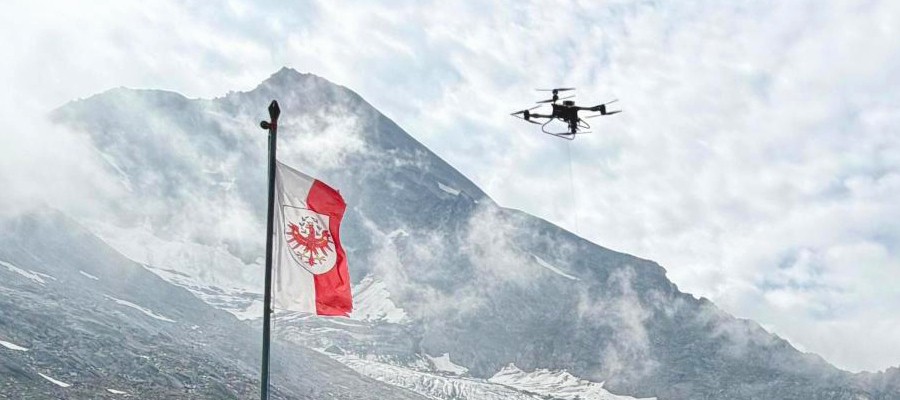
The FlyingBasket FB3 cargo drone can carry up to 100 kilograms of payload in operation
An important development step was the “Hot-Loading” procedure, developed in collaboration with researchers and experts in mountain rescue medicine from Eurac Research. This procedure allows patients to be safely loaded while the drone remains airborne. This enables the drone to be used in situations where landing is not possible or safe. Particularly in steep or inaccessible terrain, this significantly expands the operational possibilities.
“With this project, we have made a fundamental step forward: drones are no longer just tools for transporting material but can become an active component of rescue operations,” says Moritz Moroder, CEO and co-founder of FlyingBasket. “Our technology allows for quicker interventions, reduces risks for rescue staff, and improves transport conditions for patients. What’s essential is that the solution is not only technically efficient but also fits into the operational workflow of the rescue teams.”
Michiel van Veelen, a physician and researcher at the Institute of Mountain Emergency Medicine and consultant for emergency medicine, is also convinced that drones can provide added value: “If we utilize this technology in the future, we can significantly enhance mountain rescue safety and reduce reliance on resources like helicopters.”
New operational models for challenging alpine terrain
While the legal framework for transporting people with drones is still developing, cargo drones can already make an important contribution to rescue operations today. They enable the rapid transport of equipment, support teams in remote areas, and contribute to reducing risk exposure in demanding situations. Insights gained from the project also indicate that heavy-lift drones can offer advantages over smaller systems—such as in payload, stability, operational range, and integration into complex alpine scenarios.
The “START2 Living Lab” project is co-funded by the European Union under the Interreg VI-A Italy–Austria program. The initiative emerged from the collaboration of a multidisciplinary consortium that brings together actors from research, technology, and rescue services. Partners include the NOI Techpark, Eurac Research – Institute of Mountain Emergency Medicine, MAVTech, FlyingBasket, CNSAS – Soccorso Alpino e Speleologico Veneto, as well as Carinthia University of Applied Sciences and FH Kufstein.
“The value of START2 lies in the collaboration between the various partners. It has made it possible to test the technology under real-world conditions and move it step by step closer to operational deployment,” adds Moroder. “Our goal is to develop solutions that make rescue operations faster, safer, and more efficient, and to help define new standards for missions in alpine environments.”
The project results confirm that heavy-lift drones can become a key component of the mountain rescue ecosystem. They open up new operational models that prioritize speed, precision, and safety—demonstrating how a combination of technological development, scientific support, and operational experience can yield a practical solution for alpine rescue.
More News
CONTACT
FlyingBasket
Phone: +390471172660
Email: publicrelations@flyingbasket.com
Internet: www.flyingbasket.com
If you use Google as your search engine, you can set Drones as your preferred source so that our content appears more frequently in your search results. Add Drones as your preferred source.