Speed up by detour?
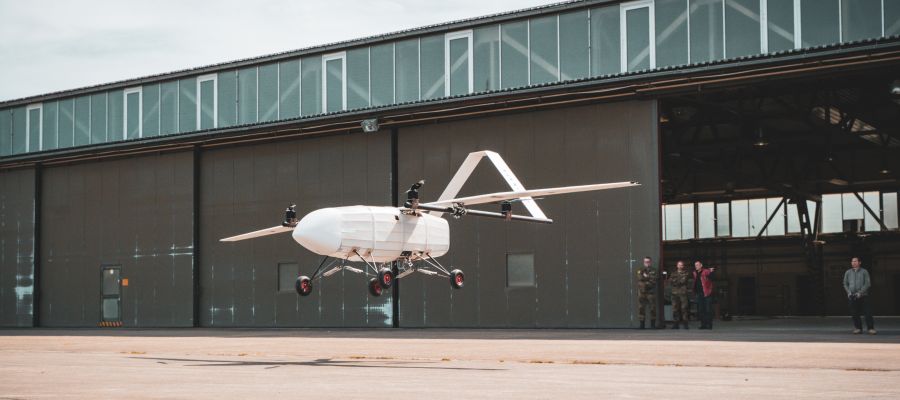

The road to success is often long and seldom straight. Blessed is he who finds a shortcut. Founded in 2021, Odonata GmbH set out to build a manned hydrogen-powered eVTOL. However, in 2024, the company underwent a strategic realignment. Since then, the previously conceived system architecture has been used to develop the unmanned multi-mission platform Pantala. A successful hovering test of the 1:1 prototype offers hope that the right course has been set.
With a maximum takeoff weight of 280 kilograms and a payload capacity of up to 80 kilograms, the VTOL-capable UAS weighs significantly more than its animal namesake. However, with a wingspan of nearly 8 meters, Pantala shares some characteristics with grasshopper species known for their relatively large wings. While the lightweight unmanned aircraft system did not cover a particularly large distance at the Bundeswehr airfield in Roth, the successful completion of the first hovering test is likely to hold a special place in the history of the young company Odonata, headquartered in Weßling, Bavaria.
More efficient market access
„The successful hovering test of our 1:1 prototype is a crucial milestone for us. It not only confirms our technological architecture but also demonstrates that we have developed a platform with operational relevance, scalability, and an exceptionally broad range of applications“, said CEO Dennis Furchheim. „Our goal now is to implement the next test steps consistently and quickly move Pantala toward operational readiness.”
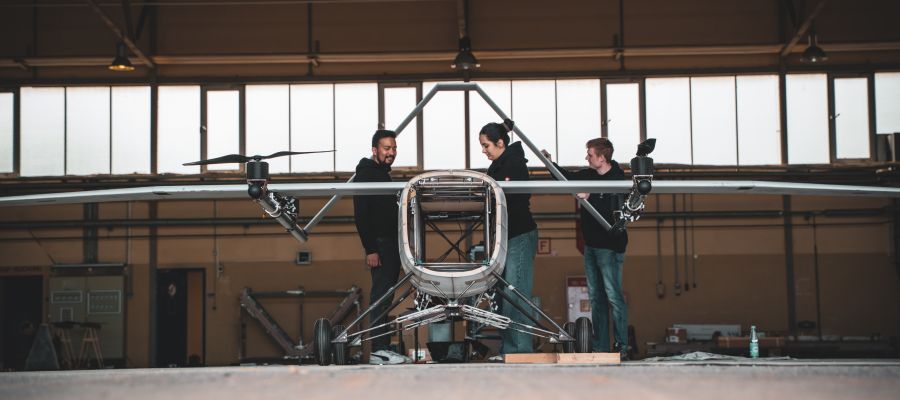
Despite the impressive wingspan of nearly 8 meters, the chosen fuselage structure allows for a comparatively low takeoff weight while still providing a fairly large payload capacity
The prospect of faster, more efficient market entry led the Odonata team to rethink the company’s strategic direction. It was no easy decision, as much time, energy, and money had already been invested in the design of a manned eVTOL. However, what could be a breaking point for established, significantly larger companies could have been a dead end for the startup. „The realignment was a deliberate decision in favor of capital discipline, market proximity, and strategic feasibility“, explains Dennis Furchheim. The focus on the UAS industry was validated by participation in the Offshore Drone Challenge organized by EnBW and DLR. „It became clear there that we are very close to a market-ready product in this segment. Therefore, the pivot was not a step backward, but a consistent move toward a faster scalable, capital-efficient, and market-oriented business model – while still maintaining our long-term hydrogen vision.”
Hybrid drive
The unmanned system Pantala is based on a hybrid drive architecture: takeoff and landing are electric, while efficient cruising flight is powered by a fuel system that can currently operate on fossil fuels and is designed for hydrogen in the future. Thus, according to Odonata, the platform combines immediate operational capability with a clear technological development perspective toward low-emission long-distance missions.
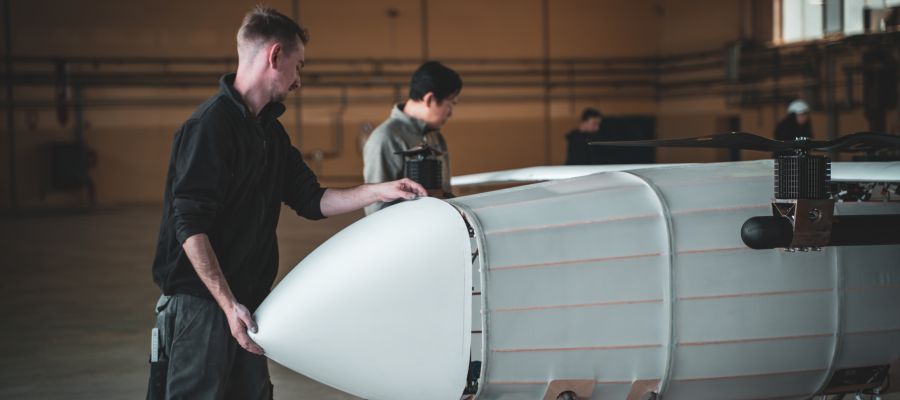
While final assembly is still done in-house, the entire manufacturing process is expected to be carried out by production partners in the future
In addition to the propulsion technology, the chosen structural approach is also intriguing. The lightweight fuselage framework is designed to be cost-effective for series production while allowing for a very flexible structure. „This combination of scalability, structural efficiency, and modular adaptability is a key part of our technological approach“, states CEO Furchheim. „The central unique selling proposition lies in how we integrate structure, payload, and center of gravity management.” The ability to flexibly adjust weight distribution is what makes the innovative approach stand out, and it aims to either expand the Pantala drone’s operational spectrum or extend its already significant operational range beyond 1,000 kilometers.
Variable center of gravity
The ability to shift part of the propulsion system allows changes to the aircraft’s center of gravity during operation. By adjusting the weight distribution, the system can respond to varying payloads or fuel consumption, optimizing aerodynamic stability and efficiency in different flight phases. „Our technological USP is that we can shift part of the powertrain through the fuselage to optimally align the center of gravity across various loading states and throughout the flight“, explains Dennis Furchheim. „The system is designed to adjust digitally during operation. The major advantage is that this enables a flight condition that is both efficient and stable. At the same time, loading and unloading are significantly simplified for the customer, as the positioning of the cargo is much less critical than in conventional concepts.”
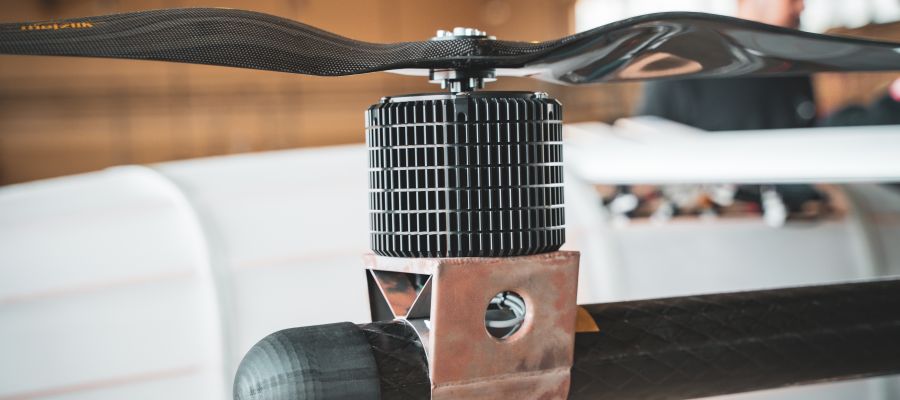
The Odonata team is pursuing a hybrid drive concept for the Pantala drone
Even though the recent hover test represents a success in the development process, there is still a long way to go before the Pantala drone is ready for market launch. As with most startups and product developments, the successful realization of its vision largely depends on available financial resources. While funding was secured through the recent full-scale hover test, a new financing round is now underway to deliver the final proof of concept. „Our current plan is to serve initial pilot customers starting in 2027 and to deploy the platform in the first real application scenarios“, outlines Dennis Furchheim. „The focus is on not just demonstrating technology, but transferring it into a robust operational deployment.”
If you use Google as your search engine, you can set Drones as your preferred source so that our content appears more frequently in your search results. Add Drones as your preferred source.