Running Robot from Austria Wins World Championship


The DYNAMICS team from the University of Applied Sciences Upper Austria successfully defended its title in the Rescue League at this year’s RoboCup World Championship in South Korea. Led by University of Applied Sciences Assistant Professor Dr. Raimund Edlinger, the seven-member team prevailed against top-tier international competition, including multiple world champions from Japan and Thailand. With a consistent performance throughout all phases of the tournament, the team underscored its technological leadership in rescue robotics.
Dominance Through Precision
The team, consisting of master’s students David Oberngruber, Markus Ertl, and Benedikt Mayrhofer, as well as bachelor’s students Alexandra Eichberger, Oskar Gnadlinger, and Nathalie Weiß, presented a highly advanced legged robot system. It impressed with its stability and performance. Right from the starting signal, the team took the lead and held its own against renowned competitors such as the Japanese team Shinobi, Team Quix, and the eight-time world champions from iRAP.
Technology for Emergency Situations
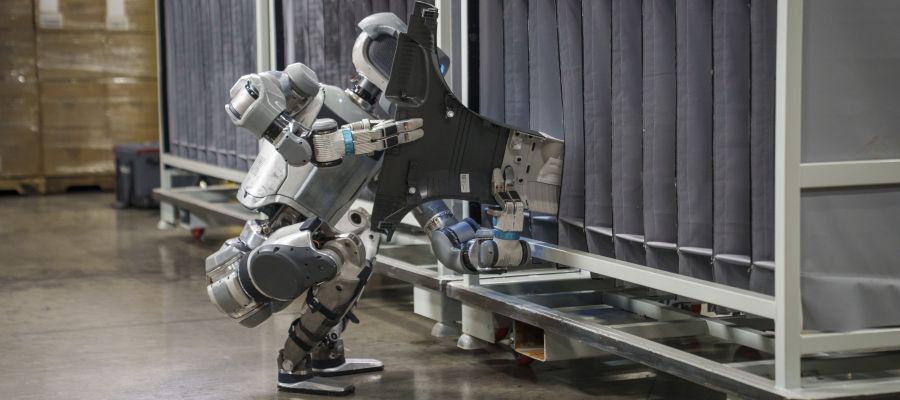
The success at the World Championship lays the foundation for the LARX research project, which begins in September and is supported by the State of Upper Austria as part of the “Security Technologies & Solutions” funding call. The goal is to develop a modular robotic system for extreme missions, which is to be demonstrated up to Technology Readiness Level 6. The system comprises a walking robot for autonomous reconnaissance and a tracked rescue robot with a biomechanically safe transport mechanism.
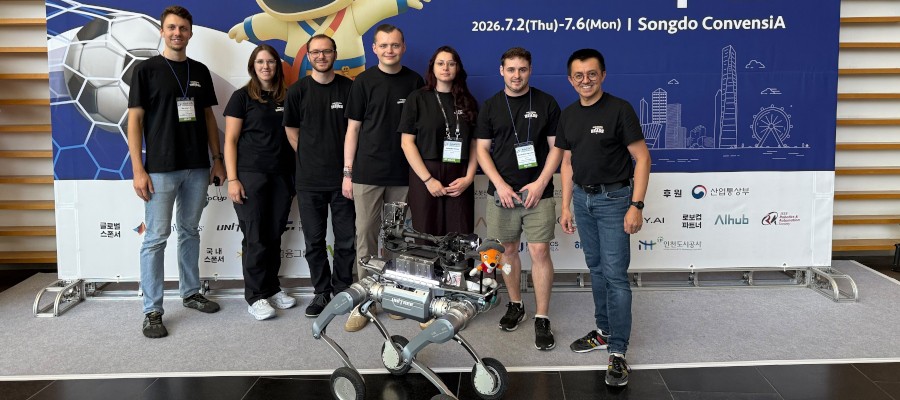
The winning team from the University of Applied Sciences Upper Austria, from left to right: Markus Ertl, Alexandra Eichberger, Benedikt Mayrhofer, Oskar Gnadlinger, Nathalie Weiß, David Oberngruber, Raimund Edlinger
By integrating multimodal sensor technology for real-time detection of hazardous materials, environmental conditions, and people, the system aims to provide a situational picture that can be used for tactical decision-making. FH Professor DI Dr. Roman Froschauer emphasizes the practical benefits: “With the help of robots, we can provide assistance more efficiently while also enhancing the personal safety of firefighters.” The LARX project thus specifically addresses complex scenarios such as building collapses, tunnel accidents, or hazardous material leaks.
More News
This success underscores the growing importance of autonomous systems in the field of public safety. For the drone and robotics industry, the LARX project serves as a pioneering example of the successful translation of cutting-edge academic research into operational applications. Close collaboration between developers and end users is a crucial factor in increasing the acceptance and practical viability of unmanned systems in critical infrastructure.
If you use Google as your search engine, you can set Drones as your preferred source so that our content appears more frequently in your search results. Add Drones as your preferred source.
-City-outdoor-3.jpg)