How Autonomous Driving Works in Urban Areas
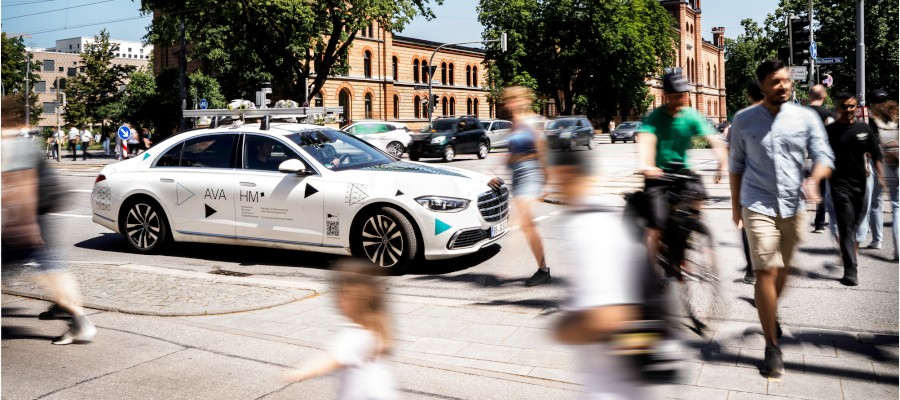

After three and a half years, the STADT:up collaborative project held its closing event at the Aldenhoven Testing Center. With 62.2 million euros in funding from the Federal Ministry for Economic Affairs and Energy, 20 partners from industry and academia worked on solutions for fully automated driving in complex urban environments. Munich University of Applied Sciences provided crucial AI-based technologies for detecting vulnerable road users.
The Challenge of Urban Traffic: Why AI Makes the Difference
Whilst autonomous driving is already well established on motorways, urban traffic – with its unpredictable traffic flows, complex right-of-way rules and pedestrians or cyclists appearing suddenly – presents a significantly greater challenge. The STADT:up project aimed to tackle this complexity without the need for human intervention. To this end, Munich University of Applied Sciences presented three innovative approaches based on data-driven AI methods that could prove to be a game-changer for urban mobility.
The AVA research vehicle uses cameras, LiDAR, and high-performance hardware not only to detect the position of pedestrians but also to anticipate their intended movements in real time. In addition, the university developed a VR-based simulation environment that makes it possible to test critical edge cases—such as a child suddenly running into the street—in a highly realistic virtual environment without safety risks.
Cooperative Perception: When Vehicles Look Around Corners
Another key component is the so-called FUSE-Bike. Equipped with 360° LiDAR, cameras, and GPS, the e-bike functions as a mobile data collector. Through cooperative perception, it shares its live data with other vehicles. This enables cars to detect road users before they even enter the field of view of the vehicle’s sensors. Prof. Dr. Fabian Flohr, Professor of Machine Learning and Autonomous Systems at Munich University of Applied Sciences, emphasizes that, with the right data quality, AI systems are capable of bringing structure to urban chaos and making the unpredictable predictable.
The technologies developed in the project for cooperative perception and AI-supported anticipation of movement patterns can be directly applied to the operation of unmanned aerial vehicles in urban areas. Particularly in the field of urban air mobility and the use of delivery drones, the ability to interpret complex, dynamic environments in real time and communicate with other systems is a fundamental prerequisite for safe BVLOS flights.
Furthermore, the project underscores the trend toward sensor fusion and data exchange between different modes of transportation. For drone manufacturers and software developers, the methodology demonstrated in the project—ranging from virtual testing in simulation environments to the intelligent networking of sensor data—offers valuable approaches for significantly increasing the safety and efficiency of autonomous flight systems in densely populated areas.
If you use Google as your search engine, you can set Drones as your preferred source so that our content appears more frequently in your search results. Add Drones as your preferred source.