„What is still holding us back?”


100,000 commercially operated drones in the air over Europe. Every day. At least. And this is not something to happen in a distant, vague future. It needs to happen within the next few years. This is not wishful thinking. It is necessary to make Europe independent and resilient. And it is not a utopia. It is a well-founded assessment – based on technological maturity, economic demand, and what we already see today.
Meaningful commercial UAS applications exist. They are technically feasible. Many of them are already a reality today. And yet we still operate far below what is possible and necessary to keep pace with other regions of the world, where the willingness – you might also say: the courage – to implement is greater. The question, therefore, is not: Are 100,000 commercially operated drones daily realistic? The question is: What is still holding us back?
First: Regulation
Europe has set global standards with the U-Space and EASA regulatory frameworks. We can be proud of that. But pride should not turn into complacency and then into stagnation. We are currently experiencing that well-intentioned and theoretically coherent regulations are becoming bottlenecks in practice. Not because safety is misunderstood, but because standard processes are not treated in a standardized way. We need speed where risks are clearly defined and manageable. We need proportionality. And we need regulatory courage, for instance, to make BVLOS operations the norm rather than the exception. Or to allow drones to operate for commercial purposes within controlled zones.
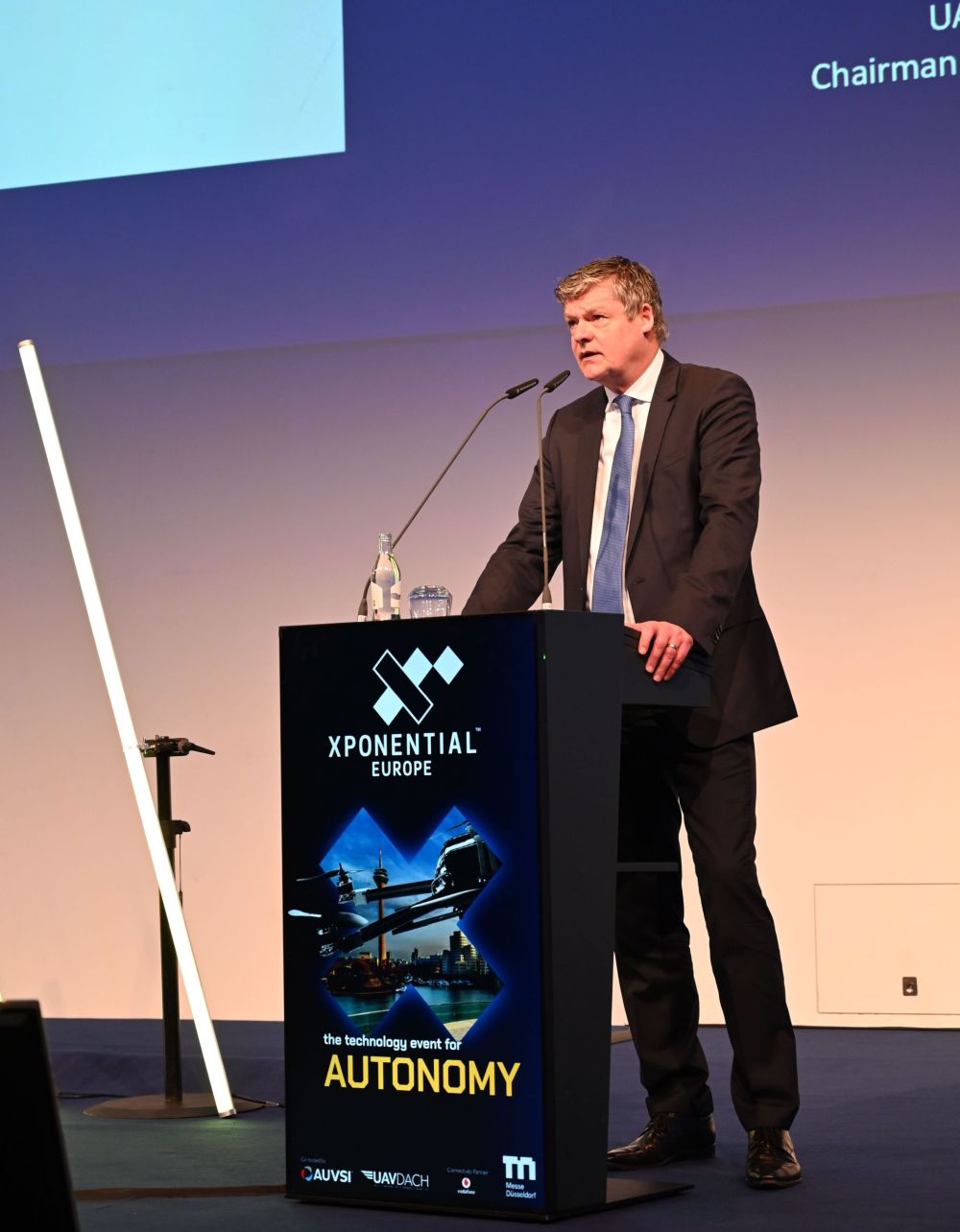
With his plea for courage and determination, Dr. Gerald Wissel received much support at the opening of XPONENTIAL Europe
Second: Acceptance
Drones remain a source of distrust in some parts of society. This cannot be solved with marketing campaigns – only with what commercial aviation has built over decades: reliable processes, clear responsibilities, a transparent culture of failure, and a safety record that speaks for itself. Trust is the result of practical implementation – not of communication about what is theoretically possible. However, it requires political leadership. Because demanding proven operational safety without enabling operations is like trying to square the circle.
Third: Mass production and scaling
A market does not arise from prototypes. A market is created through network effects and through economic and operational reliability. With predictable costs and robust supply chains. Without industrial manufacturing, standardized platforms, and professional maintenance and spare parts logistics, UAS operations often remain too expensive, fragile, and ultimately unprofitable. If Europe truly wants to be independent from other regions of the world and, furthermore, become the driving force of global development in unmanned aviation, we as Europeans must improve together.
Fourth: Drones are aircraft
While they generally operate in lower airspace, they are nonetheless part of the common airspace. This means airworthiness, operational procedures, maintenance, qualifications, and situational awareness – none of which are optional. They are the DNA of a system that scales. Ignoring this logic will lead to failure – technically, economically, or in regulatory terms. Most likely in all three areas.
We need a clear European regulatory framework that enables scalable operations. The guiding principle must be: as few limitations as necessary – as much safety as possible. If a drone is demonstrably safe, it should generally be allowed to fly anywhere. For this, we must grant unmanned systems the necessary trust.

The EASA regulations are widely regarded as pioneering, but in practice, they create significant braking effects in some areas
We need complete situational awareness in the lower airspace. Everyone who flies legally must be visible. And those who are not visible must be made visible. ADS-L for all aircraft, eConspicuity as a standard, a fully digitized, transparent, and interoperable airspace in which all aircraft – manned and unmanned – can technically recognize each other and avoid potential conflicts independently, so that a pilot or operator retains the final decision but only needs to intervene in exceptional cases.
It is also true that illegally operated drones and the threat to critical infrastructure are realities that we must resolutely confront. Identification, detection, and effective defense require coordinated standards, legally secure procedures, and interoperable systems. A secure ecosystem is not just a shield; it is the prerequisite for growth in the legal market.
All of this makes it easier to enable BVLOS missions in multi-drone operations. Only when the mandatory 1:1 principle between operators and UAS is finally a thing of the past can the economic and social benefits of modern drone technology be fully realized. Those monitoring infrastructure or operating logistics networks need economies of scale. It will therefore be crucial for Europe to have suitable platforms available in sufficient numbers and at competitive prices to create appropriate ecosystems around them. Europe’s strategic sovereignty is not a nice-to-have; it is a matter of survival.
The good news is that the conditions are great. We have excellent research and science. We have innovative start-ups with founders who genuinely want to make a difference. We have political stability, legal certainty, and one of the world’s largest domestic markets. We have an industry that is ready. And we have a community that collaborates.
If we combine these strengths with a clear regulatory vision, an industry-capable scaling strategy, and a safety understanding based on the proven model of traditional aviation, then Europe will not only be a user of this technology. Europe will be its architect.
DISCLOSURE
More News
Wellhausen & Marquardt Medien, the publishing company of Drones Magazine, is a supporting member of UAV DACH. Editor-in-Chief Jan Schönberg is a member of the Executive Board of the European Association for Unmanned Aviation.
If you use Google as your search engine, you can set Drones as your preferred source so that our content appears more frequently in your search results. Add Drones as your preferred source.