Study shows: Autonomous driving makes public transport cheaper and better
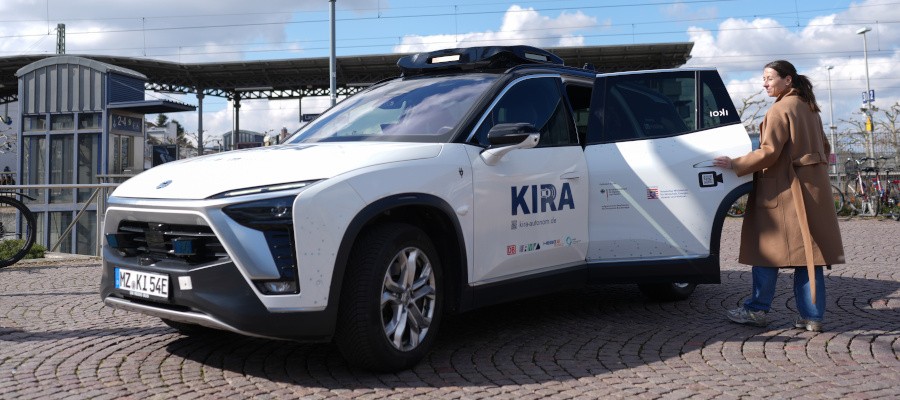

Traffic congestion in urban centers calls for an urgent mobility revolution. Switching from private cars to public transport is becoming a necessity. However, this requires a comprehensive and efficient public transport network. Local authorities are facing complex problems in this regard. High personnel costs place a considerable strain on budgets. At the same time, the acute shortage of qualified drivers prevents the provision of appropriate services at economically viable fares. But there is good news: these supply deficits can be efficiently compensated for by the strategic use of autonomously operating shuttles and buses, as a recent study commissioned by DB Regio shows.
The study was conducted in collaboration with the software and transport planning company ioki, the Karlsruhe Institute of Technology (KIT), the German Aerospace Center (DLR), and Prognos AG. An expert advisory board accompanied the project.
The study works with three scenarios. These are intended to outline the possible applications of autonomous vehicles in local public transport. The scenarios are chosen to illustrate the fundamental effect of a particular development. The deliberate differentiation of the scenarios serves to understand and evaluate possible development paths.
Each scenario shows a new equilibrium in 2045, after the technology has been fully established. They consider everyday mobility: people are on the move on foot, by bicycle, by car, or by public transport, for example as commuters, in their leisure time, or to go shopping.
A traffic analysis was carried out for the scenarios, in which a changed mobility offering was planned in detail in a representative sample region. For each journey made by people in the sample region, the individual choice of transport mode was simulated based on decision criteria such as cost, travel time, and socioeconomic characteristics such as salary or level of education. The results were then extrapolated to the whole of Germany.
The results are clear: autonomous driving makes public transport more attractive and affordable throughout Germany. Today, 14 percent of people have access to attractive public transport services. With the right use of autonomous vehicles, this could apply to everyone in the future. In concrete terms, this means that it would take 5 to 13 minutes to board the vehicle. Travel times would be similar to those in a private car. At the same time, passengers who switch from their own cars to public transport could save around €170 per month. The public sector would have to finance public transport with 20 percent less money than it does today. In addition, the economy could tap into a €74 billion market for AI and digitally supported products and services.
What sounds like a perfect solution in theory, however, first requires a clear vision for the mobility system of the future and, at the same time, concrete steps in the present. After all, autonomous driving only unfolds its benefits if technological development, political control, and market design are geared toward an integrated mobility system. In certain scenarios, mobility services should be developed together with the local population. Model regions for autonomous driving can play a key role in testing such systems under real-world conditions, creating planning security for industry and public actors, and gaining reliable insights for a later nationwide rollout. The study concludes that, on this basis, autonomous driving can gradually become a key component of a sustainable mobility system.
Read more about autonomous driving here:
https://www.drones-magazin.de/en/articles/benteler-acquires-db-subsidiary-ioki/
The complete study is available here:
Photo: Deutsche Bahn