Reimagining Industrial Production Processes

The blueprint for the “factory of the future” is located in the heart of the Port of Rotterdam. At least that’s the vision of innocent drinks, an internationally operating producer of fruit juices and smoothies. With the production site named “Blender,” they have not only created a fully electric and carbon-neutral manufacturing facility but are also rethinking production processes — overall, and particularly with a focus on responsibility. Uncrewed systems play a role in this vision.
After passing the safety barrier at the entrance to the “Blender” factory grounds, you don’t exactly step into a new world, but things are different from traditional manufacturing sites. Those who want to park must do so in reverse — for safety reasons. After a long day at work, reactions and alertness can decline, making it safer to drive forward out of the parking space. This is the philosophy at innocent. Inside, the modern building, adorned with artificial grass in a vibrant green, lots of bright wood, open office spaces, video call booths, foosball tables, and ping-pong tables, feels more like an pr agency than an industrial production plant, where an average of 40,000 bottles are filled with juice and smoothie mixtures every hour. Production happens only as needed, based on actual orders.
“Food Hub” in Europe’s Largest Container Port
They take pride in what they have created right in the Port of Rotterdam. At the forefront of a largely undeveloped peninsula, they combine fruit juices and concentrates delivered from around the world into various flavors. One will search in vain for whole fruits and vegetables — what arrives here is best thawed using waste heat from the production process before being transformed into classics like various multivitamin juices, seasonal limited editions like “Summer Crush”, or even ginger shots. The name “Blender” (to blend) is indeed the program. According to the leadership at innocent drinks, a subsidiary of the Coca-Cola Company, they envision more companies from the food industry settling in the neighborhood. The vision: a “Food Hub” in Europe’s largest container port. They have support from the port operator and the city administration. Currently, much of the raw material and goods handling still depends on trade in chemicals and fossil fuels, making more sustainable concepts essential. A network of modern companies committed to sustainable food production would be highly welcomed.
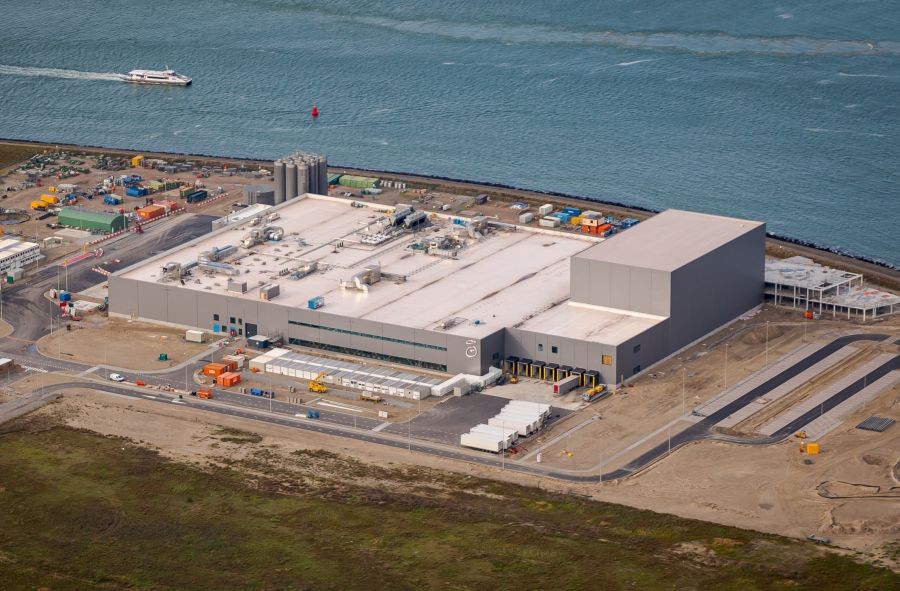
The modern “Blender” production facility is located in the heart of the Port of Rotterdam (Source: innocent drinks)
In the production area of the “Blender”, there are few signs that food is being processed. The complex network of pipes and valves does not reveal what flows through it. Without the filling machines and meter-long labeling lines, one might suspect they were in an oil refinery.
Digitalized, Fully Automated Processes and Operations
A total of 226 staff members operate in a five-shift system to keep the facility running nearly continuously. Many of them do not work directly with the production machines but are instead crucial in the “command center”. For the “factory of the future”, the machines are not the heart; it’s the digitalized, fully automated processes and workflows that matter, which include 24 Automated Guided Vehicles (AGVs) with an increasing trend. These driverless transport systems deliver various raw materials and items to where they are needed, manage packaging waste, and collect and sort trash for recycling and reuse. They also transport finished juice bottles to the loading stations.
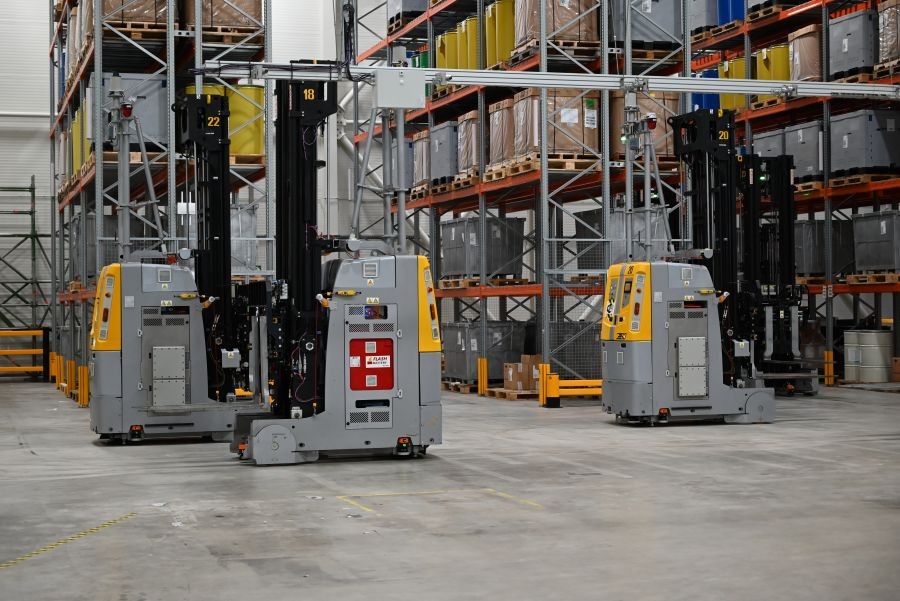
Automated guided vehicles are part of everyday operations — such as here in the high-bay warehouse
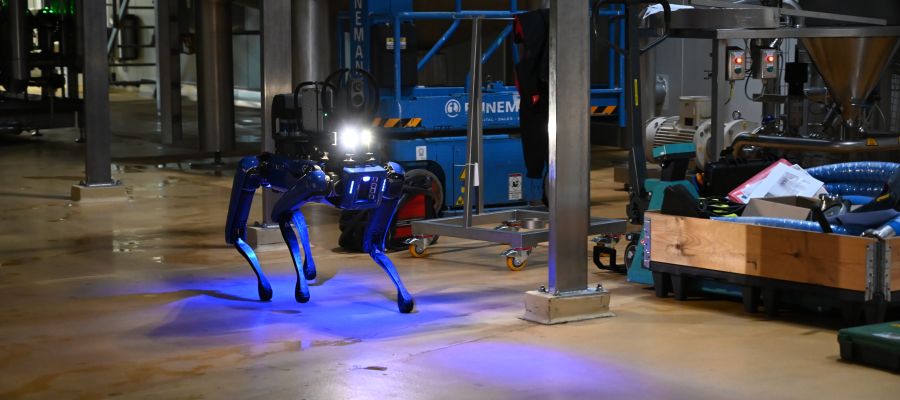
While the workforce quickly adapted to the slowly rolling AGVs, their acceptance of another “colleague” was somewhat more hesitant. The robot dog affectionately named “Blueberry”, a Spot from Boston Dynamics, was emotionally less relatable for many due to its lifelike appearance and machine-like, stereotypical movements.
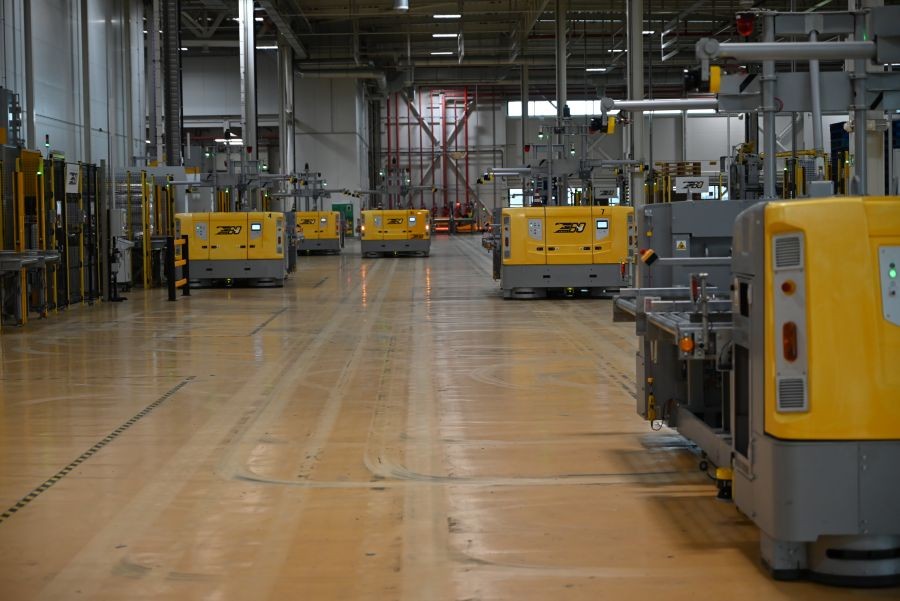
Like a herd of pack mules, automated transport systems move materials, finished products, and even waste and recyclable materials through the factory complex
While primal instincts can lead to affection and care — think of the well-known “baby schema” — unconscious behaviors can lead to the opposite. In acceptance research, this phenomenon is called the Uncanny Valley. It describes a situation that can arise when humanoid and zoomorphic robots are visually close to humans and animals but still evoke discomfort.
Habituation Effect Establishes Itself
Although a habituation effect quickly set in, companies considering integrating comparable technologies should be aware that skepticism and fear can still arise, even in a highly technified environment like “Blender”. While employees in the modern Rotterdam factory have been accustomed to using the latest technologies and AI-based processes since its opening five years ago, this effect could be significantly stronger in more traditionally structured businesses.
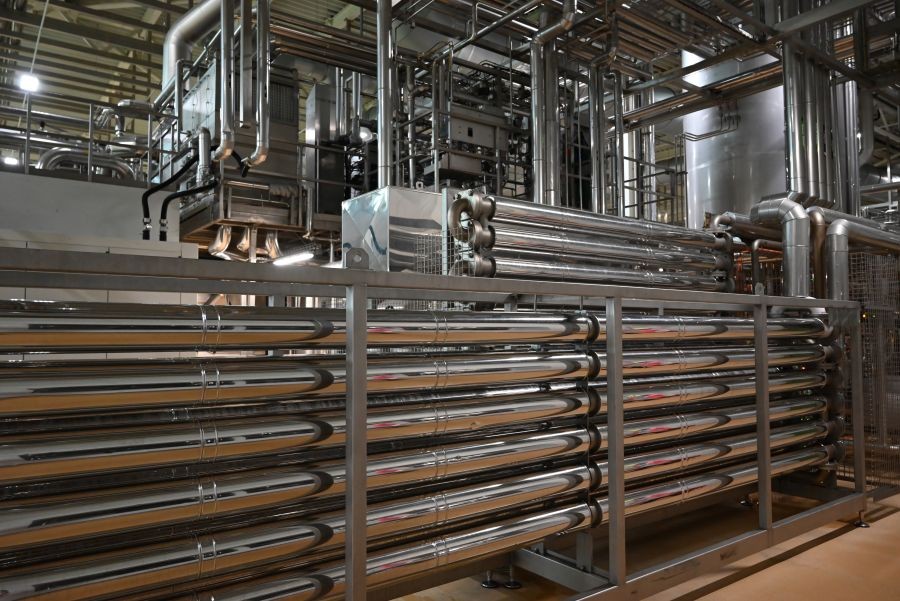
At first glance, the complex system of pipes and valves does not hint that one is in a food production facility
As “Blueberry” begins its tour of the factory, it has several tasks on its to-do list. During its rounds, it conducts temperature, vibration, and acoustic measurements. This collects important information about systems and production processes, making maintenance work more efficient. The main advantage is digital data collection, so measurement values and information about potential leaks can be transmitted directly to the management system and processed almost in real time. It completely eliminates the tedious, error-prone transfer of visually captured measurement values into an input mask.
Additional Usage Options
More News
However, “Blueberry” is currently facing limitations that restrict its range of action. While stairs are not an obstacle, the robot dog cannot open doors, which limits its territory to part of the building. There are already considerations for a sensor-supported option. Following the principle of modern cat flaps, an automated door opening could be realized via a transponder to expand the system’s area of operation. This would also allow the system to address additional areas of responsibility, for example, perimeter protection.
If you use Google as your search engine, you can set Drones as your preferred source so that our content appears more frequently in your search results. Add Drones as your preferred source.