Innovative technology for near-range UAS detection unveiled
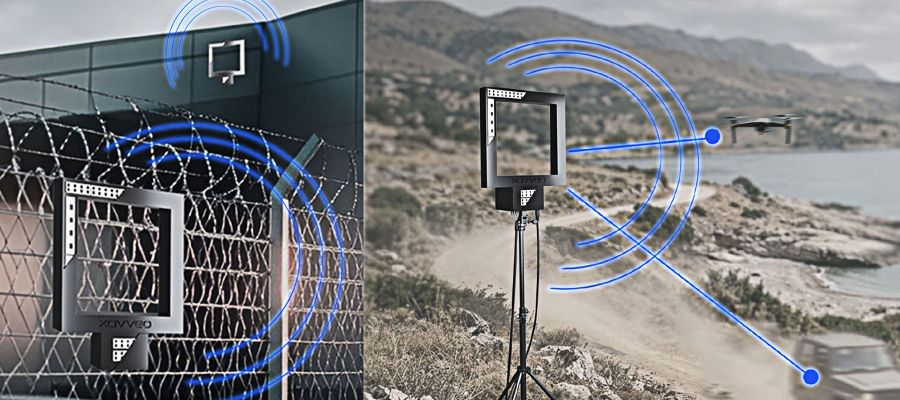

At first glance, autonomous driving and the protection of sensitive areas from illegally used unmanned aerial systems (UAS) have little in common. However, there are very concrete intersections. In both segments of the UxS industry, automated and as precise as possible environmental monitoring in near-range is crucial. Xavveo is therefore expanding its perception technology with a drone detection system. In doing so, it relies on „German engineering“ with its patented silicon photonics chips.
Traditional airspace monitoring systems are generally designed to detect large aircraft over long distances and at higher altitudes securely. When commercial airplanes, fighter jets, or cruise missiles are in operation, it’s essential to be aware of them as early as possible. In such cases, the threats approach over longer distances rather than launching in one’s backyard. The result: UAS detection in near-range and at low altitudes often represents a vulnerability in airspace surveillance.
Short reaction times, small objects
This gap became evident, especially with the Russian full-scale invasion of Ukraine. Consequently, small, flexible drones, which are often designed for espionage operations or quick „one-way missions“, have increasingly become a central challenge for modern protection concepts. Where reaction times are shorter and the systems to be detected are smaller, the need to optimize the precision of airspace monitoring rises.
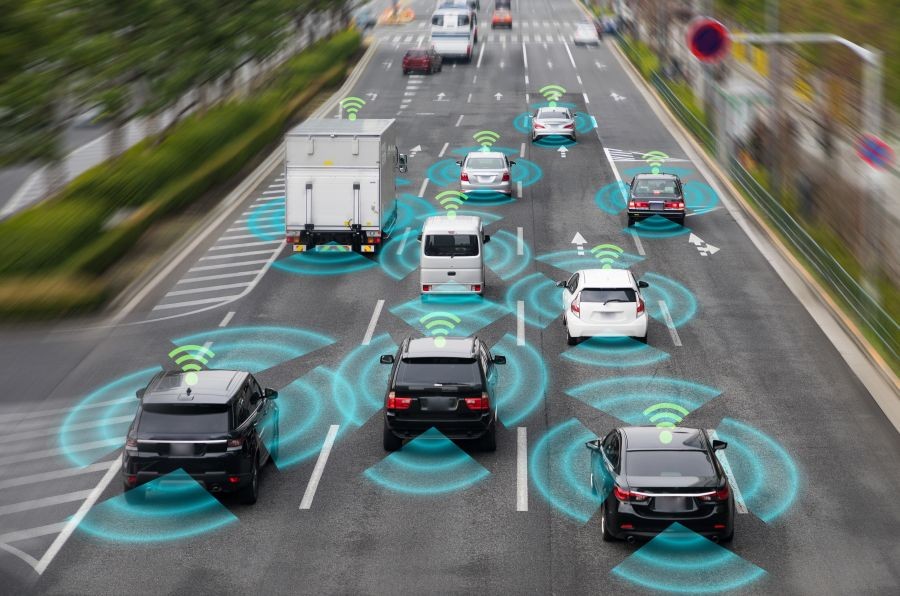
Reliable environmental monitoring at near range is a basic requirement for autonomous driving – and for the creation of a real-time aerial situational awareness
Fast, high-precision environmental monitoring over short and close distances is also vital in the field of autonomous driving. In this sector of future mobility, the Berlin startup Xavveo has been active since its founding in 2023. This deep-tech company develops state-of-the-art semiconductors and recently made waves at the Consumer Electronics Show in January in Las Vegas and in March at XPONENTIAL Europe in Düsseldorf. With a newly developed technology primarily based on high-resolution radar sensing for environmental detection, Xavveo offers a solution that aims to open new options for both unmanned vehicles and perimeter protection. The key point: alongside an allegedly exceptionally high resolution and speed, the required sensors are also small and light enough to potentially be integrated into unmanned aerial systems in the future.
Coherent signal integration
The overall system is designed so that, in addition to radar technology, other sensors can generally be integrated to incorporate optical or acoustic signals into situational assessment. Alongside this flexibility, it is primarily the speed of data transmission and integration that sets Xavveo technology apart in the market. Signals are transmitted via optical fibers and coherently combined in a central unit. This enables the coupling of decentralized sensors to achieve 360-degree environmental detection, an ability emphasized by Dr. Sven Otte, co-founder and CEO of Xavveo, who states that this occurs 20 to 30 times per second.
The sensors act purely as signal collectors, continuously transmitting data via fiber optic technology. The platform utilizes monolithic silicon photonics technology and, according to Xavveo, delivers a native angular resolution of less than 0.1°. This allows for a resolution and detailing comparable to LiDAR systems. The advantage lies not least in the ability to accurately detect and subsequently classify objects – from small drones to low-flying reconnaissance aircraft – even at night or in adverse weather conditions.
Large-scale situational awareness
Thanks to the higher data resolution, it should be possible to reliably distinguish UAS from birds and differentiate individual drones within a swarm. This option is of concrete benefit to the security of military installations and to the protection of critical infrastructure, such as power plants and airports. Moreover, with a sufficient number of installed sensors, large areas can be monitored to generate an urban or even nationwide air situational picture.

Unmanned aerial systems represent an enormous challenge for close-range airspace surveillance
„We are not building a marginally better radar. We are building a new perception architecture that is initially being proven in defense and protection. Cheap, readily available drones are becoming a central element and a significant threat to Western critical infrastructures and defense systems. Drone defense is becoming a central component of national security and economic stability“, explains Dr. Sven Otte. „When operators of defense and security infrastructures informed us that they could not reliably detect and classify small FPV and reconnaissance drones with existing systems, it became clear that our technology platform offers the right solution.”
If you use Google as your search engine, you can set Drones as your preferred source so that our content appears more frequently in your search results. Add Drones as your preferred source.