How driverless minibuses can drive the mobility transition in rural areas
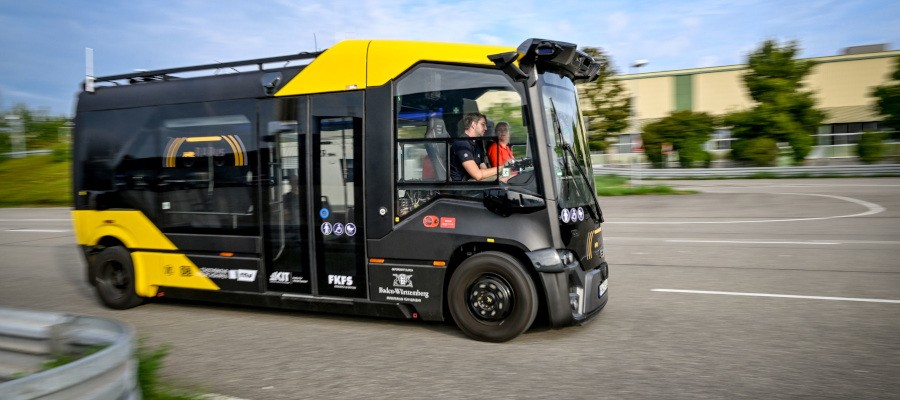

Autonomous shuttles are seen by many as a revolution in public transport, especially in rural areas. A recent study by the Karlsruhe Institute of Technology (KIT) now provides sound data on the acceptance and technical reliability of these systems. The evaluation of over 1,600 test drives clearly shows the conditions under which automated minibuses can replace conventional car journeys.
The results of the RABus project – a real-world laboratory for automated bus operation – are based on a comprehensive analysis of more than 1,600 test drives with passengers in the cities of Mannheim and Friedrichshafen. Researchers at the Institute for Transport (IFV) not only examined the technical reliability of autonomous shuttles in everyday use, but also the reaction of the population and the necessary organisational framework conditions. According to Professor Martin Kagerbauer from KIT, automated services can significantly increase mobility in rural areas, provided they function reliably and users understand the capabilities of the vehicle.
Safety as a success factor
A key finding of the study is the high level of openness among the population towards the new technology. However, a prerequisite for its use is a strong sense of safety during the journey. This applies both to the reliability of the technical systems and to protection against aggressive or threatening behaviour by other passengers. Christian Klinkhardt from the IFV emphasises that a clearly visible interior, a direct connection to the control centre and comprehensible information during the journey are essential for passenger confidence. Only when people feel safe will these systems be accepted as an alternative to their own cars.
The analysis also shows that autonomous shuttles can make everyday journeys to the shops, school or train station much easier. However, practical questions of responsibility must be clarified in order to ensure reliable everyday operation. It is necessary to determine who operates the vehicles and software solutions and who assumes responsibility if the autonomous system is unavailable. This division of roles between vehicle manufacturers, software providers and municipal transport companies is a basic prerequisite for widespread roll-out, as these issues do not arise in traditional bus transport.
Unaccompanied into the future
A decisive milestone for further development is the transition to vehicles without safety attendants. Only with regularly approved vehicle models that operate completely autonomously can the large model regions planned by politicians be realised. The findings from Baden-Württemberg are already being incorporated into ongoing projects such as KIRA and ALIKE, which are testing autonomous minibuses in Hamburg, Darmstadt and the Offenbach district. In the medium term, these systems could ensure mobility wherever there is a shortage of personnel or buses run infrequently.
For the UxS industry, this report demonstrates the transferability of autonomous fleet concepts to the public sphere. The challenges of integration into existing transport infrastructures, the necessary control centre connections and the definition of operator responsibilities reflect the hurdles that the automated logistics drone industry also faces. In addition, the study emphasises that the acceptance of unmanned systems depends largely on transparent communication of the system’s capabilities and social security.
These findings can be directly applied to the operation of delivery drones or automated surveillance systems in urban areas, where public trust is also the decisive factor for successful scaling.
The final report of the KIT study is available here: https://www.ifv.kit.edu/downloads/25519_RABus%20Abschlussbericht_RZ.pdf
Drones has already reported several times on projects involving autonomous vehicles in public transport:
Autonome Shuttles als Chance für den ÖPNV: Hohe Akzeptanz und Potenzial
Mobilität: Vollautomatisierte Kleinbusse mit hohem Potenzial für flexiblen ÖPNV
Wie autonomes Fahren die unbemannte Mobilität nach vorne bringt