Efficiency Improvement and Utilization Optimization
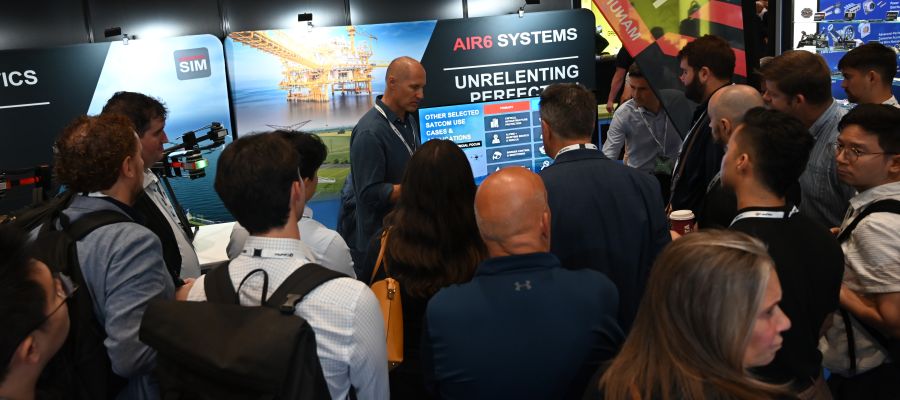

In the year following Adnan Hiroli’s takeover as the sole responsible organizer of DroneX – Part of Uncrewed Tech Expo at ExCeL London, the event didn’t fundamentally change, but it certainly felt like a breath of fresh air. The well-filled aisles during the two days stood out. So did the large number of accessory providers compared to manufacturers of uncrewed systems. And despite new impulses, the core question remained an old familiar one.
The technology works and is safe to operate, whether on water, on the ground, or in the air. Attendees at DroneX generally agreed. So the question that likely came up in most conversations at the exhibitors’ booths, in the aisles, or at the edges of the presentation stages sooner or later was not how to use UxS sensibly. Rather, it was about how to achieve this economically and sustainably.
Competition for Attendees’ Favor
It’s no secret that the actual uncrewed system is only part of the equation. The operating concept and its integration into operational processes, as well as suitable products and services for production, supply chain, and implementation, are at least equally significant. Accordingly, the variety of components and accessories showcased in London was wide. Battery and rotor-blade manufacturers, in particular, competed for visitors’ favor. It was also striking to see the large number of Chinese companies at DroneX, especially compared with the comparatively few British firms.
The structure of the exhibiting companies – few drones, a lot of accessories – reflects a trend that has become increasingly apparent in recent years. After years when drones and their disruptive potential as an innovation were central, the focus has now shifted more toward efficiency improvement and utilization optimization. In short, that uncrewed systems offer enormous possibilities is no longer new. The industry has evolved and is now looking towards implementation and optimization, just as potential customers and future application industries – even beyond military users – expect.

The panel on “From Research to Regulation” drew strong interest, where Sophie O’Sullivan (UK Civil Aviation Authority), Paul Strande (Federal Aviation Administration), and Andy Sage (National Air Traffic Services UK, left) discussed how practical UAS operational experience can be incorporated into regulation
As with other international trade shows, DroneX 2026’s “framework program” in London also attracted significant attention. For many attendees who are already well-versed in the market, this is at least as important as the exhibition booths. Notable changes from the previous year included smaller lecture areas that were still well attended. Additionally, interested participants had to obtain one of the limited headphones to follow the speakers. This disappointed those left empty-handed, but it also created a quieter atmosphere for conversations at nearby booths. However, since this concept is well known from numerous other professional events, everyone accepted it calmly and simply arrived a bit earlier for the next panel.
What Remains from DroneX 2026?
More News

Even though the event is certainly not among the largest international gatherings for the UxS industry, its special status due to England’s position in the global drone economy makes it particularly interesting. Geographically, the United Kingdom lies between the EU and the USA. Regulatory and economic policy aspects have also developed certain minor peculiarities on the island, despite its continued close ties to the European Union. Naturally, the English market interests companies from around the world. Therefore, the most established pure drone fair on “the island” comes into sharp focus, and ExCeL London will likely again be a highly frequented meeting point for the international drone industry on September 28 and 29, 2027.
If you use Google as your search engine, you can set Drones as your preferred source so that our content appears more frequently in your search results. Add Drones as your preferred source.