Autonomous navigation inspired by the honeybee
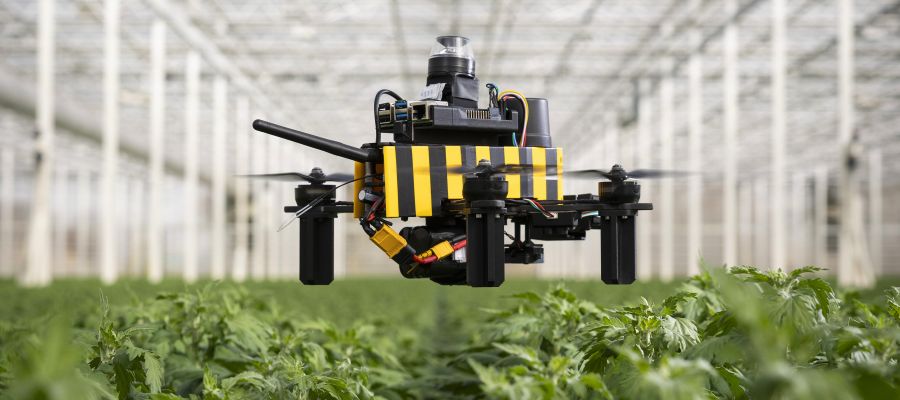

To enable unmanned systems to orient themselves without GNSS data, image-based software solutions are often used. However, there’s a drawback: The technology utilized consumes a lot of energy and requires considerable onboard equipment, increasing takeoff weight and limiting range. Scientists have now developed a system modeled on honeybees’ natural behavior, which could be particularly interesting for very small drones.
The further you move away from your home, the less familiar you generally are. And vice versa. If you know the approximate direction, you will eventually find yourself back in familiar territory, and the fastest way home is a straightforward matter. This applies not only to humans but also to honeybees, which essentially rely on similar behavior. During their initial flights outside the hive, they only venture a short distance from the starting point and memorize visual landmarks to guide them on their return flight. Given their limited memory capacity, this “visual mapping” only works up to a certain point. For further excursions in search of nectar and pollen, bees enhance their navigation with an internal „step counter“.
A combination of odometrics and visual navigation
In addition to their visual memory, they use odometry. This means bees can relate their position in terms of distance and direction relative to the entrance of the hive. Even if they fly back and forth through their environment while foraging, they can always head directly back to the starting point. When they finally arrive in visually familiar terrain, finding the fastest way home becomes straightforward for the bees as well. This combination is especially necessary, as odometric information loses precision the further one is from the starting point.
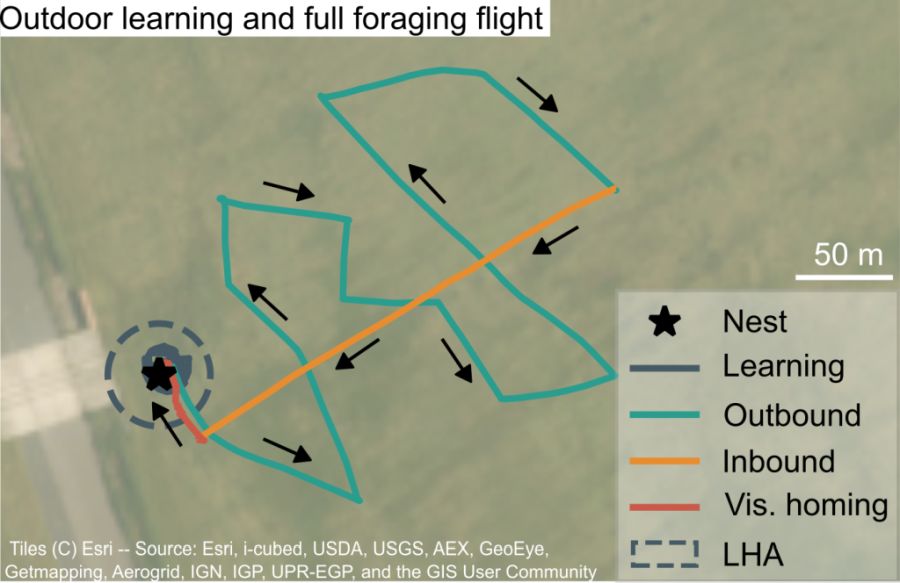
Even if the previous path did not follow a straight course, the return journey is made on the “as-the-crow-flies” route (Source: TU Delft, by Dequan Ou)
A Dutch-German team of researchers from Delft University of Technology, Wageningen University, and Carl von Ossietzky University of Oldenburg has successfully transferred this natural behavior to small UAS with a system named „Bee-Nav“. During initial exploratory flights around the starting point, optical data were collected and processed by a neural network into a three-dimensional map. Additionally, the AI was trained using odometric estimates of distance and direction relative to „home“.
„We were fascinated by the fact that honeybees can fly far away from home along winding paths, yet return almost straight back“, explains Guido de Croon, Professor of Bio-inspired AI for drones at Delft University of Technology (The Netherlands). „Biologists have shown that bees rely on odometry for the return journey, and use visual memory more as they get closer to home. But exactly what they learn and how they learn it for their visual memory are still not fully understood. That was the gap we needed to bridge to create a practical navigation strategy for robots.”
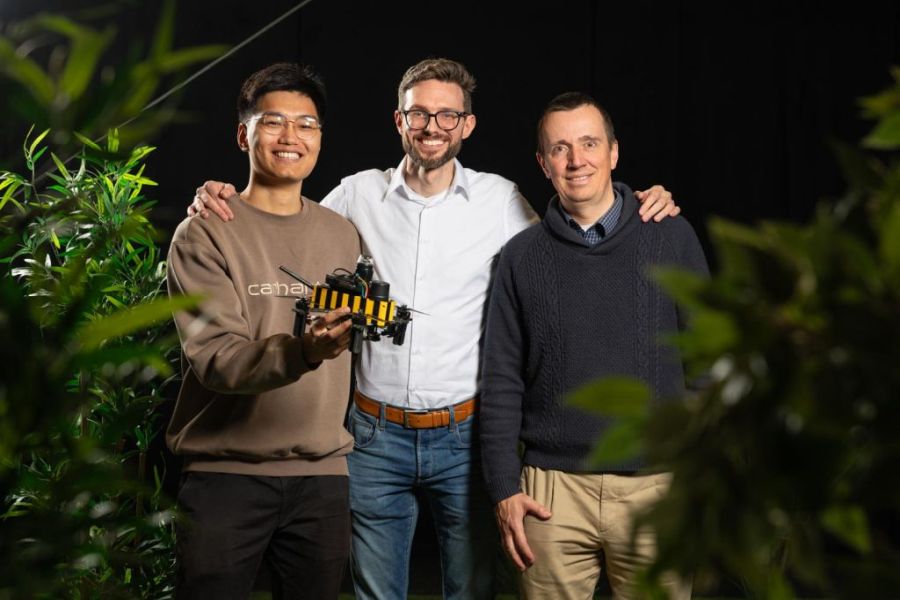
Together with their colleagues from Delft, Wageningen, and Oldenburg, Dequan Ou, Guido de Croon, and Christophe de Wagter (from left) have developed a technology that could shape future UAS applications
High success rate – but remaining challenges
With remarkable success. Under protected indoor conditions, the drones reliably found their way in all tests. The system also functions reliably outdoors. However, wind can reduce the success rate. The researchers suspect this is because the small drones need to lean forward to fly against the resistance.
As a result, the optical data collected within the radius around the takeoff and target point, which was mapped as the „home region“ through visual mapping, no longer corresponds to what the drone „sees“ in the altered flight position. Nonetheless, even under challenging environmental conditions, about 70 percent of the tests were successful. „The experiments are very encouraging“, says Dequan Ou, PhD candidate at Delft University of Technology and first author of the paper „Efficient robot navigation inspired by honeybee learning flights“ published in the well-established Nature magazine. „But they also show that our current system needs to become more robust in real-world conditions.”
More News
Images: TU Delft, by Oostrum Studio
If you use Google as your search engine, you can set Drones as your preferred source so that our content appears more frequently in your search results. Add Drones as your preferred source.