All for one, one for all
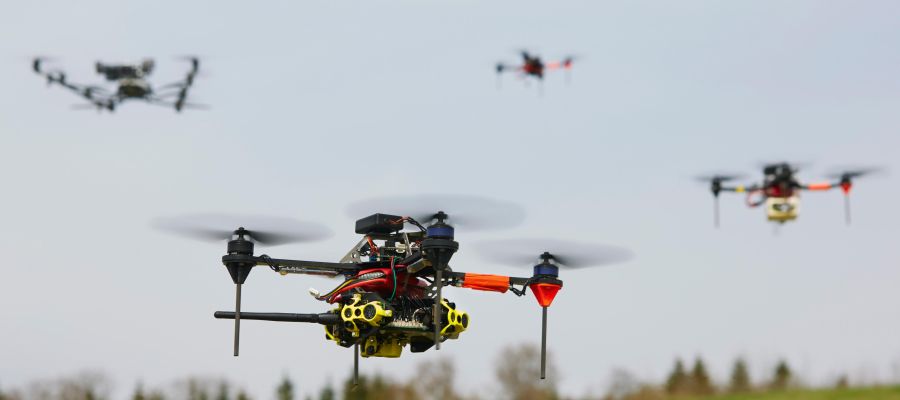

Many hands make quick work. When larger groups collaborate, tasks that would take each individual an eternity to complete can be done in no time. This also applies to unmanned systems. This effect is amplified when individual members of a drone swarm possess specialized capabilities, coordinate autonomously, or operate across different domains.
At the end of the day, it’s about cost, efficiency, and speed. Or putting a military adversary under pressure through sheer mass. With the advancing technological and conceptual maturity of unmanned systems, the question of how to further leverage the undeniable potential of this disruptive technology is increasingly in focus. One answer: drone swarms. When multiple unmanned systems (UxS) work on the same task in parallel, scalability effects can be achieved. The more drones, for example, that simultaneously survey an area, the faster missing persons, enemy positions, or hotspots can be found. Especially when the swarms operate in a connected manner and automatically share information with one another, eliminating the need for human intervention to respond as effectively and swiftly as possible to current events. If a reconnaissance drone locates a fire source, the firefighting drone can be provided with the necessary coordinates to immediately begin combating a forest fire — and all this autonomously within a swarm network.
„Toolbox“
If we think further about the principle of the swarm, we arrive at the so-called multi-domain operations. This means the collaboration of operating drones on land, in water, and in the air. In addition to increasing the number of cooperating units, this also removes the human factor further from the equation. The less human intervention is required, the more cost-effective, quicker, and error-resistant the processes typically become. The remaining human personnel can then focus on planning and control.
Thus, the unmanned systems themselves are less significant. They can be understood more as a type of tool, deployed depending on the task at hand. Central to the coordinated use of UxS, both in civilian and military operations, is a universally usable planning and monitoring software. This forms the core of connected systems. An open system architecture is key to maximizing usability. The greater the freedom to incorporate specialized drones and payloads into the “toolbox,” the broader the range of applications. Consequently, this enables greater scalability and efficiency improvements.
More News

Photo: DLR
If you use Google as your search engine, you can set Drones as your preferred source so that our content appears more frequently in your search results. Add Drones as your preferred source.