Embention releases upgraded Veronte KAI FCC
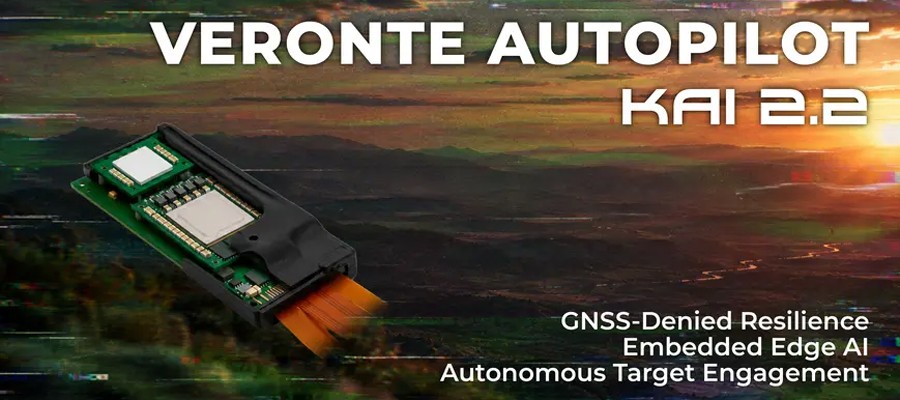

Embention has officially unveiled the latest iteration of the Veronte KAI, at the MSPO 2026 defense exposition. Engineered specifically to address the rigorous demands of modern loitering munitions, C-UAS platforms, and one-way kinetic drones.
At the core of the Veronte KAI upgrade, it incorporates a newly upgraded, high-grade tactical IMU capable of tracking extreme dynamic maneuvers up to 40g and rotational rates of 2,000o/s. To maintain positioning accuracy when GNSS coverage is denied, the platform introduces upgraded embedded AI computer vision algorithms and high-precision terminal guidance. Complementing these vision-based capabilities is an integrated radio-frequency PNT suite that leverages Low Earth Orbit (LEO) satellite signals alongside 4G/LTE cellular positioning, offering redundant, multi-layered navigation references.
Modular PNT: ensuring uninterrupted navigation in GNSS-denied environments
KAI 2.0 delivers an adaptable 3-layer PNT architecture designed to guarantee mission success across contested environments. By offering configurable positioning modules, system integrators can seamlessly tailor the flight-control architecture to match specific operational demands. Alternative PNT sources feed real-time sensor data into the flight-control and guidance architecture when GNSS navigation is unavailable, degraded, or spoofed.
Safety-critical Flight Control and Inertial Navigation
The flight-control layer is engineered for deterministic, safety-critical execution. Architected in rigorous compliance with DO-178C (software) and DO-254 (hardware) certification standards, KAI delivers high-integrity flight management and fail-safe warhead activation logic specifically tailored for one-way kinetic drones.
The KAI system integrates a high-performance sensor suite, featuring a tactical IMU rated for high-dynamic maneuvers up to 40g and 2,000o/s, alongside an integrated magnetometer, barometer, and pitot static sensor for complete air data sensing providing inertial navigation in the absence of GNSS signals.
Vision PNT for AI-based computer vision positioning
During the navigation phase, Vision PNT utilizes a dual-camera architecture where one camera is specifically dedicated to GNSS-denied navigation. By leveraging advanced core vision technologies, including visual odometry, terrain map matching, SLAM, and optical flow, the system ensures reliable positioning even when GNSS signals are completely unavailable or jammed.
For the terminal guidance phase, the second camera serves as a high-precision optical seeker. Integrated with an AI-driven target acquisition and autonomous optical tracking module, it enables accurate target lock-on and terminal engagement, guaranteeing high mission precision within heavily jammed operational theaters.
RF PNT: LEO Satellite, 4G/LTE & Anti-Jamming GNSS
The RF PNT module incorporates Low Earth Orbit (LEO) satellite navigation references, which deliver signals up to 1,000 times stronger than traditional GNSS constellations. This dramatically higher signal strength enhances signal acquisition, anti-jamming resilience, and positioning integrity in heavily contested operational environments.
Complementing LEO positioning is an integrated, high-performance GNSS module fully compatible with CRPA antenna technology for advanced jammer mitigation. Additionally, an integrated 4G/LTE receiver enables robust network-based positioning to provide a supplementary navigation layer.
Autonomous Terminal Engagement and AI Target Acquisition
Terminal guidance governs the final high-precision attack phase of loitering munitions and kinetic airframes. KAI leverages onboard edge AI and computer vision for autonomous target recognition, optical tracking, lock-on, and dynamic terminal guidance shaping.
This capability helps decision-makers assess the limits of alternative navigation sources. En-route navigation maintains the vehicle’s path, while Terminal Guidance provides the final guidance function needed to approach a designated target with the required precision.
The described architecture allows an operator to designate a target and define a desired impact angle, while autonomous functions can support target identification and tracking.
Accelerating mass production and defense procurement compliance
Engineered for high-volume defense production and rapid rate scaling, KAI features a streamlined production architecture, automated testing, and custom harness integration to minimize assembly time, maximize manufacturing throughput, and guarantee unit-to-unit operational reliability.
To meet strict sovereign defense procurement mandates, Embention offers flexible manufacturing across Spain, the United Arab Emirates, and the United States, delivering technological sovereignty, supply chain security, and local program compliance. Furthermore, the platform is fully NDAA and Blue UAS compliant to streamline government acquisition and defense integration.
Wenn Sie Google als Suchmaschine nutzen, können Sie Drones als bevorzugte Quelle hinterlegen, damit unsere Inhalte häufiger für Sie erscheinen. Fügen Sie Drones als bevorzugte Quelle hinzu.
Im Drones PR-Portal erscheinen Nachrichten und Meldungen von Unternehmen aus der Drone-Economy. Für die Inhalte der Pressemitteilungen sind die jeweiligen Unternehmen verantwortlich.