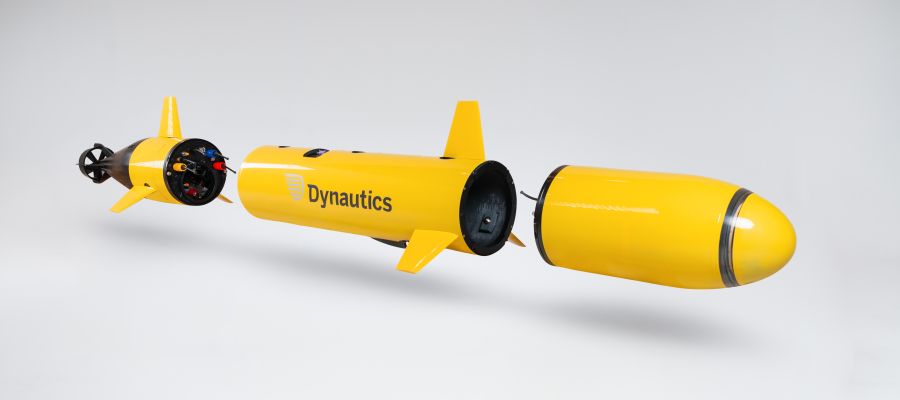

Coastal waters and offshore areas are increasingly in the focus of science, industry, and the military. Not least because technological advancements provide insights into a world that has been hidden from humans or could only be accessed at high costs until now. We are just at the beginning of a development that is significantly driven by uncrewed systems. Systems like the Uncrewed Underwater Vessel (UUV) Phantom 2 from Dynautics.
Whether it’s ensuring critical infrastructure – keyword: North Stream 2 – or fisheries, scientific research, or environmental monitoring, uncrewed underwater vehicles offer solutions for various tasks and mission profiles. This also includes areas related to the military and border protection.
Unnoticed by large parts of the public, UUV technology has steadily evolved and established itself in recent years. Key factors behind this are advancements in drive systems, battery and navigation technologies, and data collection. In addition to technical innovations, current efforts are particularly focused on increasing reliability, range, and cost-effectiveness to unlock even more underwater applications.
Increased flexibility
For many users, it’s important to be able to perform as many tasks as possible with a carrier platform. Questions of payload compatibility and capacity are crucial not only above the water surface but also below it. A modular design approach, as Dynautics has chosen for the 3-meter-long UUV Phantom 2, enhances flexibility and reduces downtime by allowing payloads to be swapped quickly and easily.