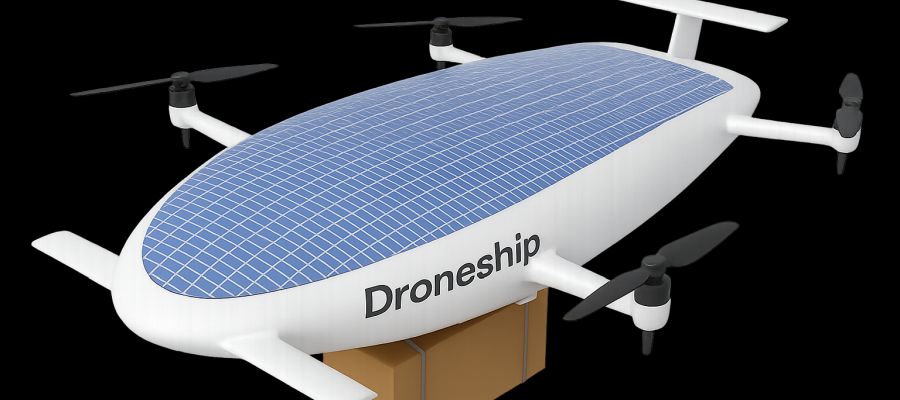

The idea of harnessing the buoyancy of warm air or gases like helium to transport goods and people is not new. However, the history of airships has been eventful, and for decades, they were considered less efficient than airplanes and helicopters. The Canadian company Win Global is now developing the „DroneShip“, a heavy-lift drone that uses the „lighter-than-air“ principle.
Somewhere between the factory and the destination abroad, things can go wrong: a shipment gets stuck in customs, a supplier drops out, or a promising market turns out to be a regulatory minefield. For many companies, crossing borders is a moment of uncertainty. Win Global was founded precisely for these situations. Since its establishment in 2009, the innovative trading company based in Richmond Hill, Ontario, has been helping businesses succeed in international markets for over 15 years. This Canadian consulting firm has guided countless clients through the maze of bureaucracy, regulations, and fees that can complicate cross-border trade.
Heavy-lift air vehicle
However, Win Global’s ambitions have now expanded to include logistics itself. With the DroneShip project, the company aims to develop an unmanned, emissions-free heavy-lift air vehicle designed to expedite intermodal logistics and reduce costs by simplifying processes. The idea is to transport fully loaded containers directly from the point of origin to the destination over short, medium, and long distances, ideally without reliance on fossil fuels and a massive logistics infrastructure. Through this, Win Global intends to address the inherent inefficiencies within global goods transportation. As Win Global’s co-founder Igor Chigrin puts it: „The real problem we are solving is the lack of technology to transport freight globally directly from origin to destination.”
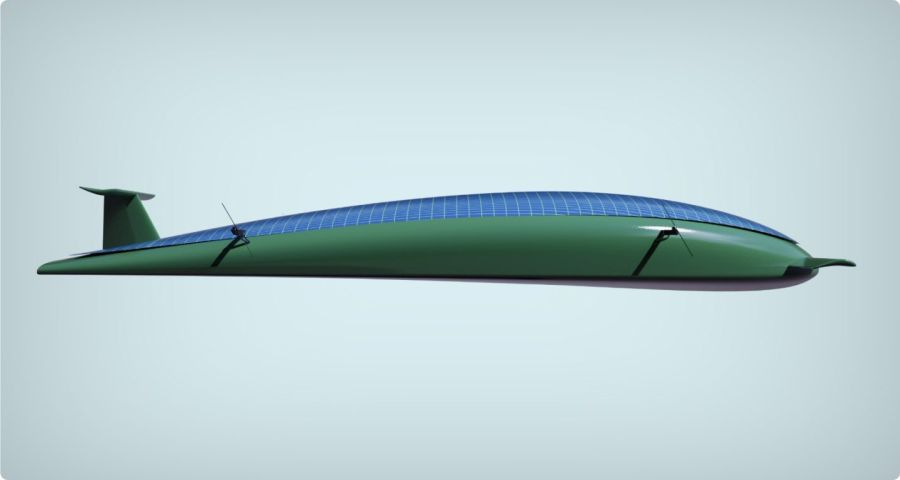
The aerodynamically optimized shape of the design concept points to the efficiency thought that underlies the project
Currently, international freight transport is essentially based on two pillars: sea freight, which is relatively inexpensive but slow, and air freight, which is fast but costly. There is a gap between these extremes that limits international trade, drives up cargo costs, and harms the climate. Standard logistics concepts rely on an intermodal approach. This means that goods must be handled multiple times and switch transport modes before reaching their destination.
This exposes the cargo to the risk of damage or loss and incurs high additional costs that eat into profit margins. In the logistics world, there is simply a lack of efficient technology for direct transport over long distances from A to B. Moreover, the transportation sector is one of the largest contributors to greenhouse gas emissions. According to the U.S. Department of Energy and Statistics Canada, it is responsible for around 28 percent of global CO2 emissions.
More News
The dependence on specialized infrastructure exacerbates these problems further. Today’s logistics networks are built around ports, airports, and distribution centers, which serve as sensible central hubs but can also lead to bottlenecks, traffic jams, and delays. A shipment from the factory to the end customer often passes through half a dozen stations, each introducing delays, costs, and…
If you use Google as your search engine, you can set Drones as your preferred source so that our content appears more frequently in your search results. Add Drones as your preferred source.