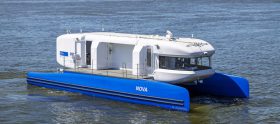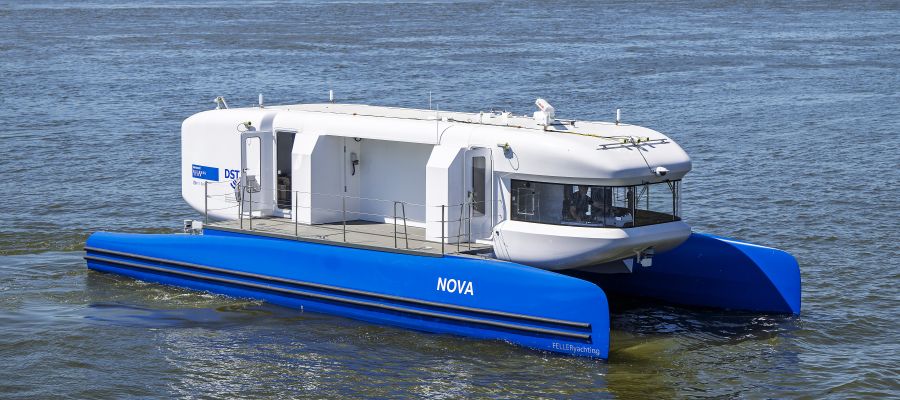

The shortage of skilled workers and increasingly extreme weather events present significant challenges for inland shipping. At the same time, there is a growing need to integrate waterways more into freight transportation. Teams from the University of Duisburg-Essen and the Development Center for Ship Technology and Transport Systems (DST) are testing whether electrically powered, unmanned vessels can provide new impetus in this area using the research catamaran Nova.
The Rhine and Ruhr rivers are heavily trafficked waterways, and Duisburg is home to the largest inland port in the world. It is an optimal area for developing and testing new technologies under real-world conditions. The research vessel NOVA serves as a test platform for two important future technologies: environmentally friendly propulsion systems and automated navigation functions.
Its catamaran design offers several advantages. For one, Nova can be operated with an „inland boat license“ despite its length of 15 meters. Additionally, it has a very shallow draft, and the two hulls provide ample space for sensors and testing equipment.
Environmental detection
With an eye on an uncrewed future, the practical test drives focus on the ship autonomously following a predefined route, maintaining a stable position, and reliably perceiving its surroundings. This includes detecting other traffic participants, safe maneuvering in traffic, and automated procedures such as docking, undocking, and navigating locks.
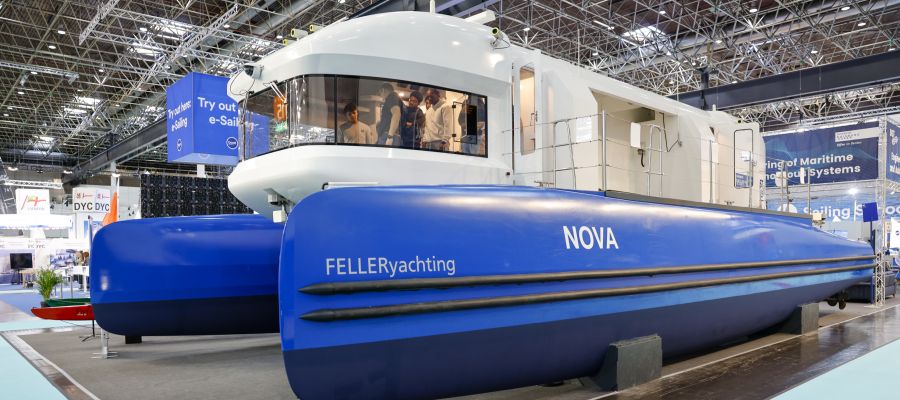
While the research cata…