Study examines drones in logistics

Whether drones will soon revolutionize our parcel delivery is not just a question of technology, but above all one of acceptance and bureaucracy. The German Federal Environment Agency (UBA) has examined this complex issue in detail in its study “Opportunities and risks of unmanned aviation for humans and the environment” (publication 09/2026). Using the urban region of Aachen as an example, the experts analyzed how the use of unmanned aircraft systems would affect our everyday lives, the environment, and the existing transport infrastructure.
The study is based on three theoretical models to illustrate the consequences. First, the status quo (scenario A) was established as a reference – i.e., logistics as we know it today without aircraft. Building on this, scenario B examined what would happen if cargo drones autonomously delivered to a total of 317 parcel stations in the Aachen region, with customers picking up their goods there themselves. The most radical model, scenario C, simulated direct doorstep delivery. Here, lightweight parcel drones deliver shipments weighing up to 5 kg directly to the end recipient.
Where theory and practice collide
The results dampen expectations of rapid, widespread deployment. The study does recognize clear advantages such as selective time savings and, in niche areas, lower operating costs and energy benefits. However, efficiency is a volatile commodity: flight tests show that energy consumption is heavily dependent on the weather. Gusty winds in particular can quickly negate the positive balance.
Humans as a limiting factor
One critical point highlighted by the study is human well-being. Drones not only cause noise, which occurs mainly near take-off and landing sites. The unmanned aerial systems could also be perceived as visually disturbing. This “visual impairment” is determined by the frequency of sightings and the number of devices flying simultaneously. While the noise level could be counteracted by technical or structural measures, the constant presence of aircraft in the sky would remain a factor with the potential to jeopardize the important acceptance of UAS-based business models among the population.
Regulatory and economic hurdles
In addition to the social aspects, there are hard economic facts. Drones cannot replace truck traffic, as heavy goods still have to be transported by land – a hybrid concept therefore remains unavoidable. Added to this is the thicket of bureaucracy: the approval processes for flights in densely populated areas are currently considered extremely complex and time-consuming.
The experts’ conclusion is therefore sobering: unmanned aviation offers exciting approaches for specific niche applications. However, given the technical hurdles, weather dependency, and conflicting noise protection goals, a comprehensive replacement of traditional logistics structures is not currently in sight.
The complete study is available here: https://www.umweltbundesamt.de/publikationen/chancen-risiken-der-unbemannten-luftfahrt-fur
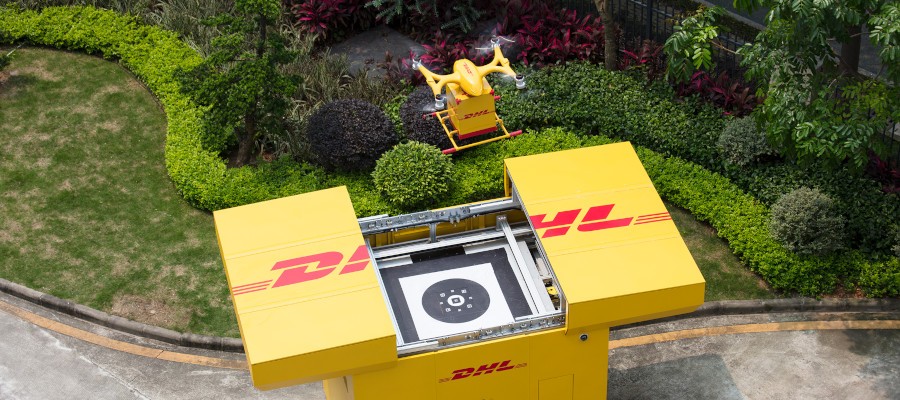
Photo: DHL