What penalties apply for illegal UAS operation?

Ignorance is no defense, as the saying goes. And in aviation, it can sometimes quickly become dangerous. That is why there are clear rules, and violations of these rules are anything but a trivial offense. It is not without reason that the penalties range from heavy fines to prison sentences of several years. Anyone who fails to obtain sufficient information or acts with deliberate negligence not only takes an operational risk, but ultimately also jeopardizes their own economic existence.
A small town somewhere in the remote region of Mecklenburg-Western Pomerania. Close to the Polish border. An aerial photographer prepares his drone. He has been commissioned by a customer to take pictures of the harbor festival in Ueckermünde, just a few kilometers away. Once he arrives at the location, he launches his unmanned system several times and takes the pictures requested by the client. Shortly afterwards, the photos are published. But while everyone directly involved quickly considers the matter closed, for the relevant authorities it is anything but over.
The problem: no flight permit was obtained for this seemingly simple, quick job. However, given the flight area and the fact that the UAS was flying over people, a permit would of course have been necessary. The Mecklenburg-Western Pomerania Ministry of Transport therefore imposed a fine of €1,500. The photographer accepted the penalty. By way of comparison, a permit would have cost around €150. Nevertheless, the man was lucky, because depending on the violation, the fine could have been as high as €50,000.
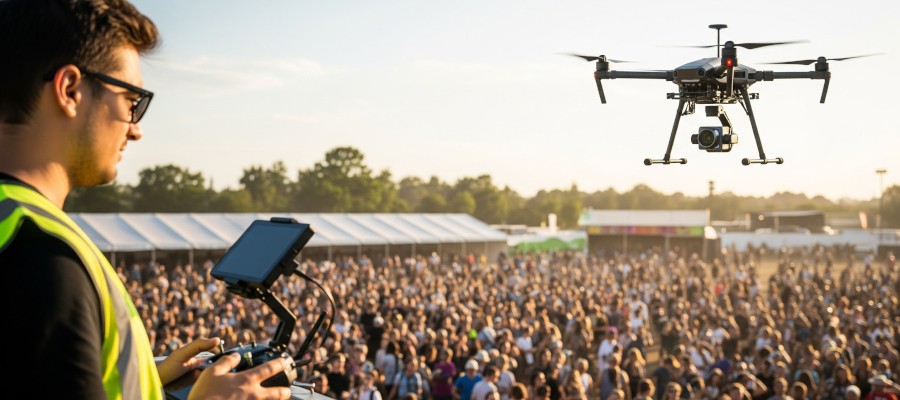
Anyone who wants to take photos or videos with a drone at an event must obtain the appropriate permission (photo: AI-generated)
Errors can lead to prison sentences
This example shows that even commercial drone operators are sometimes unaware of the requirements for UAS use. Or they may even deliberately ignore them in order to avoid the hassle of obtaining a permit and gain a price advantage over their competitors. But whether a violation of the rules is the result of ignorance, negligence, or intent, it remains a violation of the rules in any case. And it can have serious consequences. For example, a collision with a police or rescue helicopter. Illegal UAS operation can therefore not only lead to risks in the air and on the ground. Any misconduct also does a disservice to the drone economy.
Safety is the top priority in air traffic. Violations of the rules are therefore punished with severe penalties. What’s more, in aviation law, certain offenses are no longer considered administrative offenses, but fall into the much more serious category of criminal offenses.
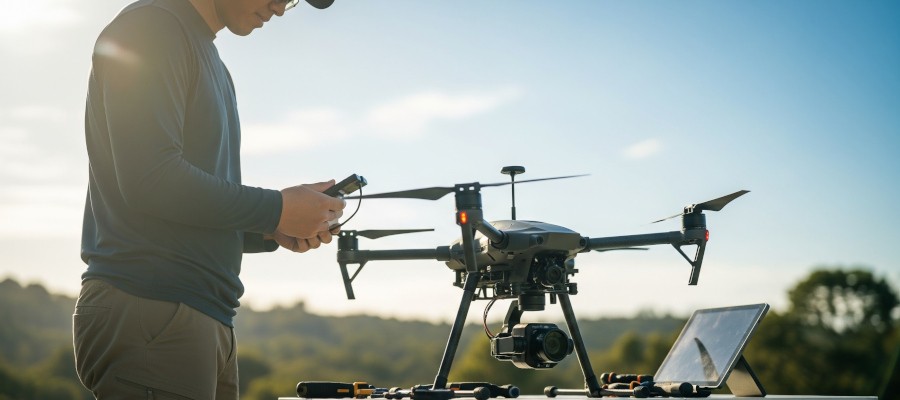
Careful preparation is essential for a safe flight (photo: AI-generated)
When is it an administrative offense, when is it a criminal offense?
An administrative offense (OWI) is generally a less serious violation than a criminal offense. In the case of an OWI, authorities such as the police or the fines office investigate. The main aim here is to ensure compliance with rules in order to guarantee safe operation—in other words, to maintain or restore public order. Everyone is familiar with this system in the form of parking tickets or speeding tickets from road traffic.
Anyone who violates the regulations and procedures for the operation of unmanned aircraft set out in European Implementing Regulation 2019/947 or the German Air Traffic Regulations (LuftVO) can expect a fine of up to €50,000 in administrative offense proceedings. However, as examples show (see box), in practice, significantly lower penalties are usually imposed.
TYPICAL VIOLATIONS
- Flying without valid registration or eID
- Lack of proof of competence (“drone license”)
- Flying over crowds or sensitive areas (e.g., hospitals, industrial facilities, or during police operations)
- Violations of flight altitude restrictions
- Flying in controlled airspace without authorization
- Flying in no-fly zones
- Endangering air traffic (e.g., by flying drones near airports)
Up to 10 years imprisonment
If a criminal offense is suspected, the public prosecutor’s office will investigate the incident. Unlike administrative offenses, which are generally minor violations of applicable regulations, a potential criminal offense involves violations of the law. If a preliminary investigation is initiated, it is initially assumed that the accused person has acted unlawfully, either intentionally or through gross negligence. Perhaps the best-known criminal offense in this context is dangerous interference with air traffic pursuant to Section 315 of the German Criminal Code (StGB). This includes, for example, operating drones in the approach path of an airport or at altitudes where unmanned systems are not permitted without authorization. A conviction can result in up to 10 years’ imprisonment.
Anyone who flies a drone is participating in air traffic. And anyone who does so commercially should strive to establish defined processes and procedures to ensure a consistent level of quality and safety. In addition, checklists and documentation processes help to prove compliance with all requirements in the event of an emergency. For example, a pre-flight check should be mandatory before each flight. Not only should the technical operational readiness of the drone be checked, but questions about the pilot and the legal framework should also be examined in advance.
- Is the drone pilot sufficiently qualified to control the aircraft within the scope of the planned mission profile – keyword “drone license”?
- What requirements apply to flying in the desired flight sector?
- Are all necessary permits and approvals available in writing?
- Have possible restrictions in the flight sector due to potentially temporary no-fly zones (ED-Rs) been checked?
- Do the external conditions (weather, exceptional events) allow for safe flight at all times?
In addition, it is advisable – in your own interest – to check yourself and the drone for unrestricted airworthiness before each flight:
- Is the drone functioning properly?
- Are all batteries charged? And: Can the mission objective be achieved with the available flight time (including adequate reserve)?
- Does the drone show any visible damage, such as defective propeller blades?
- Is the pilot mentally and physically capable of operating the drone safely in any situation?
- Has a briefing taken place and are there clear agreements for emergency scenarios?
The latter in particular should be recorded and, in the event of an incident, is a helpful means of proving that everything necessary was done to ensure safety, for example in the event of a total loss of the drone.
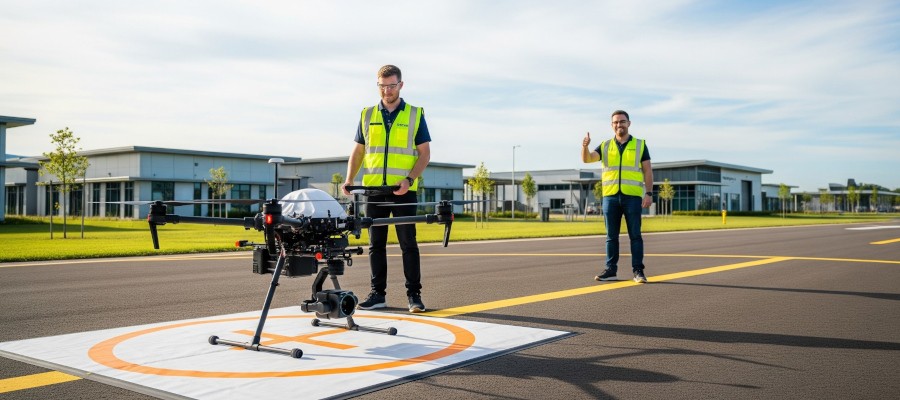
If all conditions are met, nothing stands in the way of the flight (photo: AI-generated)
Operating drones is complex not only from a technical perspective, but also in terms of regulations. Even though the drone economy as a whole has a very good safety record, there are always negative examples that attract media attention. It should therefore be in the interests of all stakeholders to follow the rules. Operators who fail to do so not only risk heavy fines or even imprisonment. They also damage the good reputation of the industry as a whole – and pose a risk to air traffic and uninvolved persons.
INFO
Extensive information on the operation of drones, including the various categories and classes of drones, can be found on the websites of German Air Traffic Control and the Federal Aviation Authority:
https://www.dfs.de/homepage/de/drohnenflug/checkliste-fuer-drohnenpiloten
https://www.lba.de/DE/Drohnen/Drohnen_node.html
General and location-specific information on requirements and restrictions for operating unmanned systems is available on the Digital Platform for Unmanned Aviation operated by the Federal Ministry of Transport:
The German Air Traffic Control Authority publishes up-to-date information on no-fly zones and restricted areas in the form of NOTAMs (Notices to Airmen or Notices to Air Missions):
https://www.dfs.de/homepage/de/medien/ifr-vfr-informationen
Responsibility for issuing operating permits is generally not based on the location of use, but on the place of residence or company headquarters of the UAS operator. In the case of Baden-Württemberg, Bremen, Hamburg, Hesse, Lower Saxony, and Rhineland-Palatinate, the respective state aviation authorities are responsible. The ten other federal states have transferred this responsibility to the LBA.
Featured photo: AI-generated