Frankfurt UAS publishes guide to AI drone development
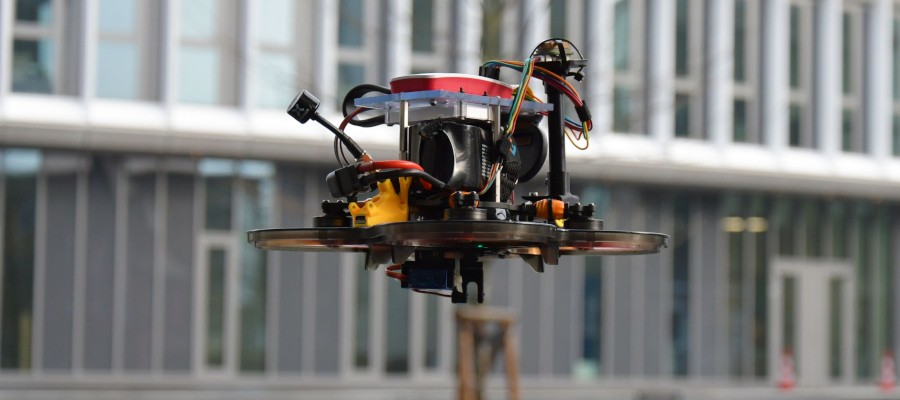

The Computer Science Department at Frankfurt University of Applied Sciences (Frankfurt UAS) has compiled the results of extensive research and teaching work on the topic of AI drones in a handbook. The bilingual guide, which contains technical basics and detailed construction instructions, is designed for various scenarios in research and teaching and is published under a free licence. Work on the topic of AI drones has been ongoing since 2025.
The handbook serves as an introduction to the complex field of drone systems with artificial intelligence. The focus is on the development – including the selection of suitable hardware and software components – the construction and the operation of unmanned systems. The guide has been published in German and English, with the aim of ongoing further development by the community.
How the community benefits from the free licence
‘Our goal is to create a vibrant community that not only uses these guides for teaching and research projects, but also develops them further,’ explains Prof. Dr. Christian Baun, programme director of the Master’s programme in General Computer Science. Comments and suggestions for improvement are explicitly welcome. An essential element in the selection of components was cost-effectiveness: When designing the instructions, attention was paid to acquisition costs, adaptability to different application scenarios, robustness and long-term market availability. The quality of documentation and manufacturer support also played a role in enabling the implementation of budget-oriented systems.
Focus on practical applications
The document deliberately does not represent a complete treatise on drones and AI. Instead, the focus is on technologies and solutions with which practical experience has already been gained in the field of computer science at Frankfurt UAS. The handbook incorporates findings from the research project ‘AI-supported drone platform’, which was funded by hessian.AI from the Connectom Networking and Innovation Fund, as well as from accompanying student theses. In addition, experience from the master’s course ‘AI Drones’ at Frankfurt UAS, which focuses on the independent development of AI-supported drone systems by small groups, was also taken into account. There, students develop, design and program innovative systems, with tasks including hardware integration, the connection of sensors and AI accelerators, and the design and testing of specific application scenarios.
From object to animal recognition
The areas of application examined include object and animal recognition, environmental monitoring, and inspection and logistics tasks. The guides also cover autonomous navigation and drop mechanisms. The publication of the guide offers the drone industry and the associated research community valuable insight into practical development methods. By providing technical basics and construction instructions under a free licence, Frankfurt UAS is lowering the barriers to entry for the development of AI-enabled unmanned aerial vehicle systems (UAS). This not only promotes the rapid dissemination of knowledge and the formation of an active developer community, but also accelerates the iteration of new application scenarios in the commercial and public sectors. For companies, this open-source approach means that standardised, cost-efficient components and proven architectures from academic research can be more easily adapted, directly supporting innovation and skilled worker training in the field of collaborative robotics.
Frankfurt University of Applied Sciences: www.frankfurt-university.de
Photo: B. Bieber – Frankfurt UAS