First urban air mobility strategy by a German city
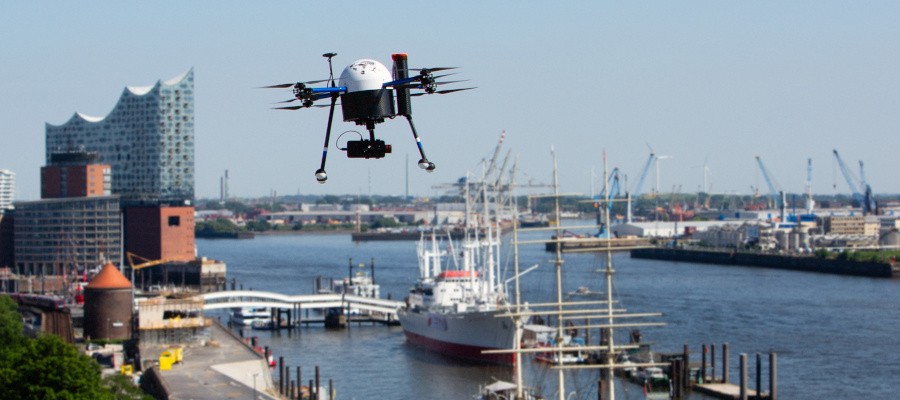

The future of urban mobility is taking shape in Hamburg. The city has become the first in Germany to present a strategy for the use of drones and automated aviation systems. By 2030, drones and automated aviation systems are to be deployed safely in urban areas. From medical transport to disaster relief – the potential applications are diverse.
Hamburg is further expanding its pioneering role in the drone industry. Back in mid-January, the Drones editorial team reported exclusively on the Urban Air Mobility (UAM) strategy adopted by the Hamburg Senate (https://www.drones-magazin.de/en/articles/drones-in-urban-airspace/). The document has now been published. With the UAM strategy, the Hanseatic city is creating a comprehensive framework for the use of drones and automated aviation systems in urban areas. The aim is to develop the metropolitan region into an internationally recognised leading location for urban air mobility applications by 2030.
The strategy process was initiated by the Ministry of Economic Affairs, Labour and Innovation and developed in collaboration with stakeholders from business, academia and public administration. It was closely supported by the Hamburg Aviation cluster and the Windrove drone network. Dr Melanie Leonhard, Senator for Economic Affairs, Labour and Innovation, emphasises the ambition: “Hamburg is set to become a European centre for Urban Air Mobility – a place where new drone applications are developed, tested and rapidly put into practice. With our strategy, we are creating the conditions for innovative technologies to be deployed safely and effectively in the city.”
A comprehensive framework for urban applications
Hamburg recognised the potential of drones and automated aviation systems early on and has been a European model city for Urban Air Mobility since 2018, boasting a strong network of industry, research institutions and start-ups in the field of unmanned aviation systems. The UAM strategy now published creates, for the first time, a structured framework for the further development of this ecosystem. The fields of application in Hamburg are wide-ranging, extending from infrastructure inspections and surveying through logistics to medical transport, disaster management and support for public safety authorities and organisations (BOS) such as the police and fire service.
The complex airspace over Hamburg, which encompasses two aerodromes and largely controlled airspace, presents a particular challenge. The strategy addresses these framework conditions and defines six key areas of action for establishing an efficient and safe UAM ecosystem: application areas and value chains, technology and industry, infrastructure, financing, training and further education, and regulation.
Two fundamental guiding principles run through all areas of action: social acceptance and the environmental compatibility of the new technology. The strategy is the result of a broad-based participatory process involving representatives from industry, start-ups, research institutions and public bodies. The aim was to bring together perspectives from technology development, regulation and practical application.
Joint implementation for scalable solutions
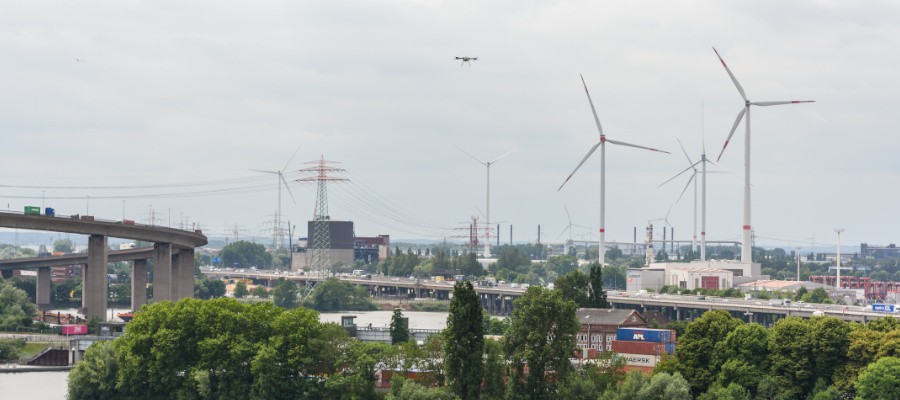
Implementation is also taking place in close cooperation with the drone industry. Building on existing pilot projects, the aim is to create scalable applications and new economic prospects for the sector in the future.
Hamburg’s Urban Air Mobility Strategy is of considerable relevance to the drone industry. It offers a concrete roadmap for the integration of unmanned aircraft systems into the urban environment, thereby creating an unprecedented model for other cities and regions. The detailed definition of application areas, fields of action and guidelines – such as social acceptance and environmental compatibility – provides manufacturers, service providers and developers with clear guidance for product development and business models.
The strategy not only promotes the development of new technologies, but also their safe and sensible application in practice. By creating a structured framework and working closely with the drone industry, new market opportunities and a stable environment for investment and innovation are emerging. This positions Hamburg as a key hub for the future of urban air mobility in Europe.
https://www.hamburg-aviation.de/themen/urban-air-mobility/urban-air-mobility-strategie/
Photo: Jan Brandes