Europe Wants Semiconductor Independence. But Who Will Build Machines That Make Chips?
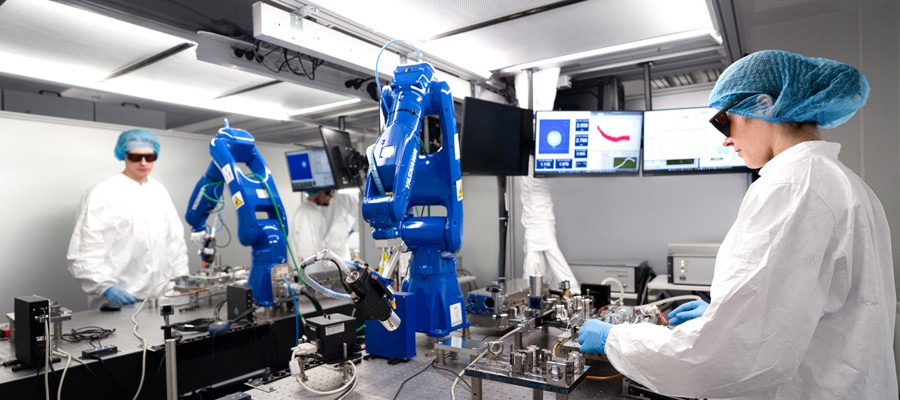

As the EU works on its next Chips Act, the focus is on strengthening Europe’s semiconductor production. Lithuanian femtosecond laser manufacturer LITILIT says Europe has an opportunity to go further: to become not only a chip producer, but also a global supplier of the critical technologies needed to make chips.
In September, EU ministers identified photonics and advanced chip packaging as priority areas for Chips Act 2.0. Oliver Schenk, the European Parliament’s lead rapporteur on the legislation, has argued that Europe should build on its existing technological strengths and focus on turning research into industrial-scale production rather than trying to manufacture everything itself. EU institutions are aiming to agree on the new legislation by the second quarter of 2027.
The photonics industry shows what is at stake. Europe remains one of the world’s leading photonics regions, with around 15% of the global market and strong research and engineering capabilities. At the same time, competition is intensifying: between 2005 and 2022, China’s share grew from 10% to 32%. For Europe, the opportunity lies in turning its expertise into industrial volumes.
Nikolajus Gavrilinas, co-founder and CEO of LITILIT, says the same opportunity applies not only to chipmakers but also to the companies developing the equipment they need.
“Europe does not need to manufacture every chip in the world to become a global semiconductor powerhouse. But it must control the critical technologies that make advanced chip manufacturing possible. Photonics is one of those technologies. Europe already has the knowledge. What we need now is industrial scale,” says Gavrilinas.
Femtosecond lasers are one of the technologies behind the next generation of chips. They use ultrashort pulses of light to process materials with extreme precision and minimal heat damage. This makes them well suited for advanced chip packaging – combining multiple chips into a single, more powerful package, an approach now widely used in AI processors and high-performance computing. For example, femtosecond lasers can drill microscopic holes in glass substrates, which the chip industry is developing as a material for next-generation packaging.
Until recently, femtosecond lasers were mostly complex scientific systems, built in small numbers for specialised applications rather than for automated mass production.
LITILIT has changed this with a patented laser architecture based on modular design and a high level of automation, which allows femtosecond lasers to be manufactured at industrial scale.
In October, the company opened a new automated laser factory in Vilnius – a €6 million investment covering more than 4,000 sq m. The factory is designed to produce up to 1,000 femtosecond lasers in its first year, with capacity planned to reach 3,000 lasers annually. With these volumes, LITILIT can supply femtosecond lasers from Europe and compete for customers worldwide. Most of the production will be sold to customers across Europe, North America, and Asia.
“Femtosecond lasers used to be built one by one for laboratories. Our patented technology and automation allow us to produce them on an automated line, with capacity planned to reach 3,000 lasers a year, here in Europe. Companies like ours can compete globally and help make Europe a leader not only in research, but in the technologies that power advanced manufacturing,” says Gavrilinas.
About LITILIT
LITILIT is a femtosecond laser company headquartered in Vilnius, Lithuania. The company manufactures lasers based on patented technology that enables scalable production and makes them easier to integrate into industrial systems. By bringing femtosecond lasers to the cost and integration simplicity of fiber nanosecond lasers, LITILIT aims to accelerate their adoption as the next standard for industrial manufacturing. The company is developing a large-scale production facility in Vilnius and plans to replicate this model in other regions together with international partners. Learn more at https://www.litilit.com/
If you use Google as your search engine, you can set Drones as your preferred source so that our content appears more frequently in your search results. Add Drones as your preferred source.
The Drones PR portal features news and reports from companies, universities, and associations. The respective organisations are responsible for the content of their press releases.