Autonomous driving in public transport: key technologies and challenges

They are no longer just a vision – they are already a reality:
automated, semi-autonomous and autonomous shuttle and
transport systems are in operation or undergoing testing worldwide. In recent years, autonomous driving has developed from a vision of the future into a technologically and regulatorily viable mobility concept. XPONENTIAL Europe, the leading European trade fair for autonomous technologies and robotics, will showcase the technologies that make autonomous mobility possible. “We were already able to present MIRA’s teleoperated shuttle at our trade fair premiere in February 2025. Autonomous buses and shuttles are now in use worldwide. I am convinced that they will soon be a natural part of our mobility,” says Malte Seifert, Director of XPONENTIAL Europe. This year’s patron of the trade fair is Federal Transport Minister Patrick Schnieder, who is committed to technological progress: “Autonomous driving is the key to the mobility of the future. We want to make Germany a world-leading innovation and production location for autonomous driving.”
Autonomous systems are opening up new possibilities, particularly in public transport: they promise greater flexibility, more efficient use of vehicles and new forms of on-demand mobility. Developments in Europe, the USA and Asia show how diverse and dynamic the market is currently evolving.
At the same time, the challenges are evident: software, sensor technology and system integration must meet the highest requirements. Infrastructure, traffic regulations and urban conditions must be adapted. In addition, autonomous mobility services must be economically viable in order to become established in public transport in the long term. Concepts and
technologies that can be easily implemented in a city such as Abu Dhabi, for example, encounter significantly more complex, historically evolved mobility structures in European cities such as Hamburg.
Hamburg launches trial operation with HOLON urban
With the ALIKE mobility project by Hamburger Hochbahn, two different types of vehicles are being tested in the Hanseatic city in highly automated on-demand operation: the ID. Buzz AD from MOIA, which is already operating in Hamburg, and now also the HOLON urban, which received approval from the Federal Motor Transport Authority (KBA) for autonomous test operations in November 2025.
Dr Flavio Friesen, Vice President of Engineering at HOLON, is delighted with the current progress: “Our vehicle system is impressive both technically and in terms of regulatory compliance. We are taking great strides towards a new era of mobility.” With the aim of making urban mobility more sustainable and inclusive through the use of autonomous movers, HOLON has developed a homologated, fully electric and autonomous shuttle specifically for public road transport. The HOLON urban can accommodate 15 people, is barrier-free, has automated ramp access, a full wheelchair space and comprehensive audiovisual assistance systems. Inclusion and accessibility are important prerequisites for becoming part of public transport.
The test area for the autonomous HOLON shuttles in Hamburg covers an area from the Elbe to the city park and from Schlump to Wandsbek. Covering 37 square kilometres in an area with 320,000 inhabitants, it is one of the largest test areas for autonomous shuttles in Germany.
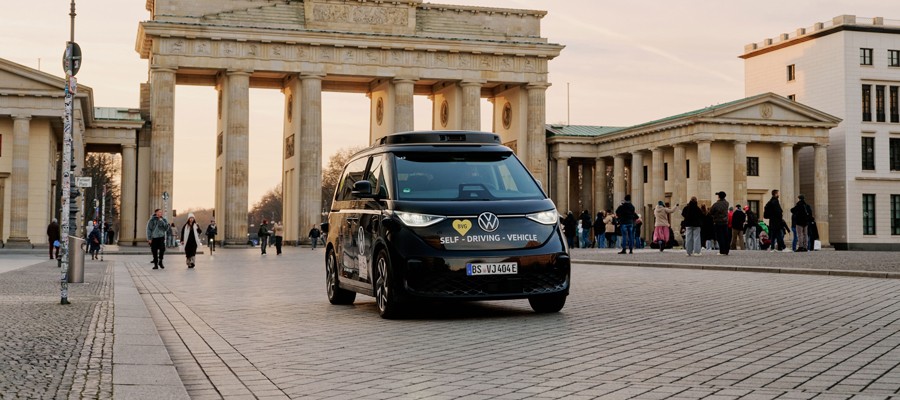
“Autonomous mobility ‘made in Europe’ is a reality” Malte Seifert is eagerly watching Hamburg: “What is being tested here – right in the centre of the Hanseatic city – is fantastic. But we are also seeing many good examples of autonomous driving in public transport in Berlin and internationally.” For example, the French EZ10 shuttles are already in use in more than 25 countries and many major cities, including Singapore, Dubai and Toronto. The VW ID. Buzz AD shuttle developed by Moia will also be in trial operation in Berlin from 2026. As part of a project with autonomy level 4, the capital is testing how local transport can be expanded to include flexible, self-driving services. The vehicles can drive without human intervention. However, for safety reasons, one person will remain on board during the test phase. “Autonomous mobility ‘made in Europe’ is already a reality,” emphasises Sascha Meyer, CEO of MOIA. “Scalable complete solutions comprising vehicles, software and services are important for the future of autonomous mobility. XPONENTIAL Europe will showcase the technologies behind them,” says Director Seifert.
XPONENTIAL Europe will take place from 24 to 26 March 2026 at the Düsseldorf Exhibition Centre.
Autonomous mobility at XPONENTIAL Europe
XPONENTIAL Europe 2026 will feature the following live demonstrations of autonomous mobility, among others:
– Teleoperated shuttles from Rheinmetall subsidiary MIRA
– Quantum Systems drone flights over the Rhine near the exhibition grounds
– “NOVA”, the autonomous research vessel of Duisburg Research on Ship Technology and Transport Systems (DST), which is in operation on the Rhine
– Daily live hacking demonstrations on a fully automated car
– Planned BVLOS (Beyond Visual Line of Sight) drone flights for XPONENTIAL Europe exhibitors in
cooperation with Mönchengladbach Airport (use of on-site airport infrastructure) and UAV DACH Further updated information on the event’s key topics and programme highlights is available on the industry portal: www.xponential-europe.com
The Drones PR portal features news and reports from companies, universities, and associations. The respective organisations are responsible for the content of their press releases.