Thoughts on International Women’s Day

The first International Women’s Day took place in 1911. In 1975, the United Nations established March 8 as the „United Nations Day for Women’s Rights and International Peace“. While progress has been made since then, full equality and a society free from gender-specific discrimination are still a significant distance away. However, for industries like the UxS sector, promoting women more actively would not only be morally right but also economically sensible.
This article first appeared in the Drones issue 5/2024. For International Women’s Day 2026, we publish it – freely accessible – on our website.
Much is discussed about regulatory hurdles and public acceptance as major barriers to advancing the drone economy. But like many other industries, the shortage of skilled workers is a significant challenge. A straightforward solution is at hand. Instead of competing with other players for existing „resources“, the UAS industry should make greater efforts to increase the proportion of women in the sector.
According to a study by the Association of Unmanned Aviation (VUL) in 2023, around 15,000 people in Germany are already predominantly working in drone-related professions. However, the numbers could be significantly higher, as many companies are desperately seeking personnel. The lack of qualified workers is by no means a problem limited to the German drone economy; this shortfall affects the UAS industry worldwide and represents a challenge for the sector’s development.
Seeking talent
This issue has hindered the industry’s development for years. As early as 2019, the Computing Technology Industry Association (CompTIA), an international trade association for the IT industry based in the USA, noted in its „Drone Market Study“ that 90 percent of companies offering UAS services or related products and services are struggling to fill positions connected to the drone business. The report also highlights that „innovation is outpacing training“, making it increasingly hard for businesses to find talent to fill specialized roles.
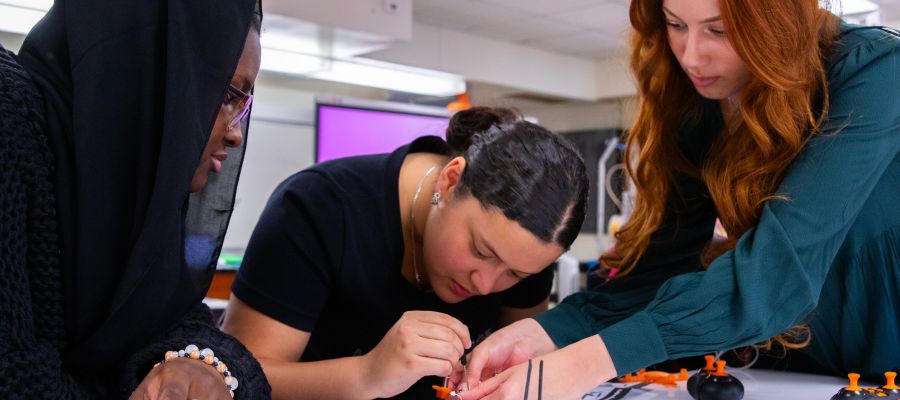
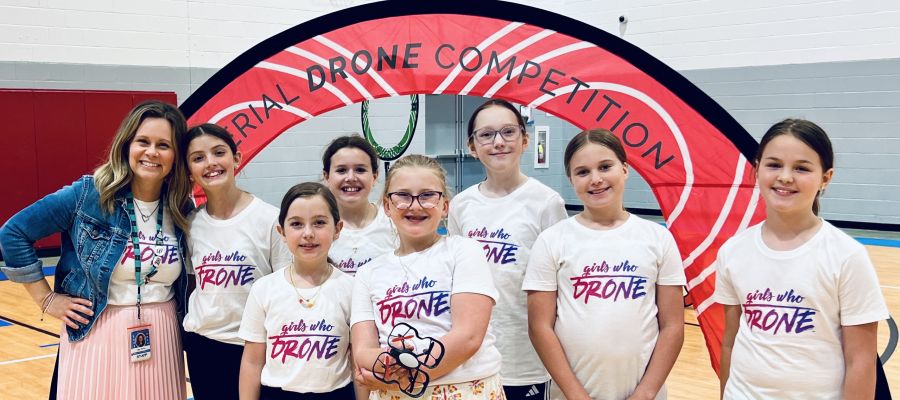
Special offerings for girls and women can help reduce apprehension towards technical subjects and foster talent early on
According to the annual „U.S. Civil Airmen Statistics“ published by the FAA, there were 30,935 female drone pilots registered in the USA in 2023. This marks a significant increase compared to 2022 (24,293). However, this still only accounts for 8.39 percent of all registrations (2022: 7.9 percent), as noted by the well-known U.S. journalist Sally French („The Drone Girl“) in her assessment of the FAA figures. This small example illustrates that the drone industry, like many other tech sectors, is predominantly male-dominated. This situation represents both part of the problem and a viable solution.
A matter of reason
Attracting and retaining women in the UAS sector is therefore not just a matter of gender equality. It is, above all, a pressing necessity. The shortage of skilled workers in the drone sector directly limits its ability to innovate, expand, and meet growing customer demand. The greater the sector’s challenges in keeping pace with technological advancement and meeting demand, the lower its competitiveness relative to traditional technologies. This could ultimately hinder the industry’s growth significantly.
Moreover, the lack of skilled personnel can impair the quality and reliability of services and products. A shortage of qualified staff leads to delays in maintenance and repairs, resulting in longer downtimes, reduced efficiency, and potentially diminished competitiveness. This, in turn, can undermine customer trust and impede the further establishment of drone technology.
The benefits of diversity
Increasing the number of women in the drone economy can bring significant advantages for both individual companies and the industry as a whole. Teams with greater diversity are demonstrably more innovative, creative, and better able to solve complex problems. They also reflect society at large and the (potential) customer base, leading to a better understanding of needs and the development of tailored solutions. This can positively influence customer satisfaction and loyalty, and enhance the industry’s overall competitiveness.
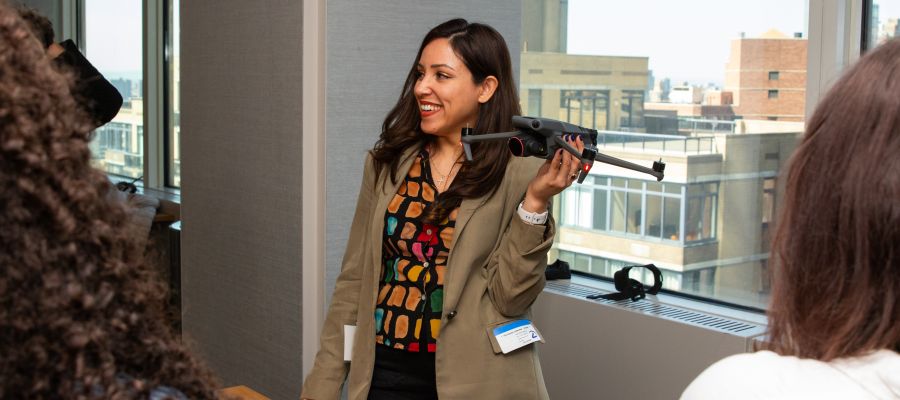
Elena Buenrostro identifies as a „DEI Leader“, actively promoting diversity, equity, and inclusion (DEI). The founder of the networks „Women Who Drone“ and „Girls Who Drone“ is intensely focused on paving the way for girls and women in the drone economy
To significantly reduce the quantitative gender gap in the UAS industry, various obstacles that women face when entering the drone economy and following their career paths must be removed.
Information: Many young women are not aware of the career opportunities available in the drone industry. They often lack (female) role models and mentors who can show them the way.
Prejudices: Women in technology sectors and other traditionally male-dominated industries often face (unconscious) biases and discrimination that hinder their professional advancement or prevent them from engaging in these fields altogether.
Educational opportunities: In some parts of the world and various cultural contexts, girls and women tend to have less access to training and educational programs. Even in Western industrial nations, there is still a need to improve STEM (science, technology, engineering, and mathematics) education.
To attract more women to professional careers in the UAS industry and to actively address the pressing shortage of skilled workers, all stakeholders are called to action. Particularly, companies and associations play a crucial role. Significant potential lies in specific collaborations to create sustainable initiatives.
- Partnerships with educational institutions to introduce young women to drone technology and related career fields. For example, the “Girls Who Drone” network organized a drone workshop for a STEM program at Columbia University. In Germany, the collaboration between the proTechnicale program, the Center for Applied Aviation Research, and the DroneMasters Academy followed a similar direction.
- Organization of support programs and special networking events that connect interested women with experienced professionals from the drone economy.
- Collaborations between companies, educational institutions, and professional associations to develop comprehensive programs and initiatives that promote qualification levels and gender diversity.
- Raising awareness among employees within companies to lower entry barriers and eliminate existing (unconscious) prejudices against women in technology professions.
By creating incentives for girls and women to engage professionally in UAS technology, the drone economy can unlock an enormous, yet largely untapped reservoir of talent for companies seeking skilled workers. Through targeted public relations, recruiting and retention strategies, as well as collaboration with educational institutions and industry partners, drone companies can create an inclusive and supportive environment that enables women to succeed in this emerging sector. Thus, contributing significantly to the sustainable establishment of the drone economy as a global tech industry.
Images: Girls Who Drone