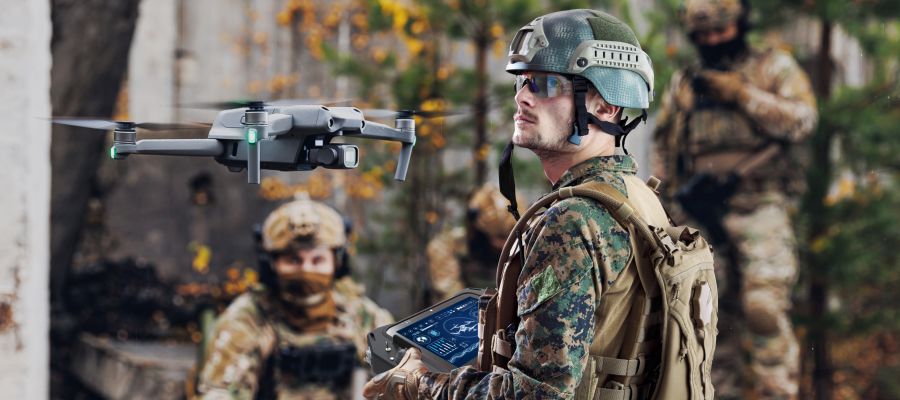

Unmanned Aerial Vehicles (UAVs) have become an indispensable part of modern armed forces. Their performance does not depend solely on sensor technology, range, or flight behavior, but significantly on the quality of the ground control station (GCS). These are the central interface between humans and machines. What guidelines, standards, and operating concepts shape the design of modern GCSs? And how does NATO define UAV interoperability, and what are the direct technical implications?
NATO standardization Stanag 4586 defines the interfaces and architecture of UAV control systems (UCS) for interoperability within the alliance. At the heart of this is the Core UCS, which is connected to the operator via the Human Control Interface (HCI). This functional separation allows different UAV platforms to be controlled using a uniform set of operating concepts, regardless of manufacturer.
The Ground Control Station (GCS) not only controls the drone, but also manages mission data, communication, sensors, and video transmission. The architecture allows multiple UAVs to be controlled simultaneously and different mission phases to be coordinated – from takeoff to navigation to return.
Architecture with a system
Looking at how soldiers operate the GCS, the underlying operating concept becomes clear: in military operations, every second counts. That is why modern GCS rely on an operating concept based on the Hotas (Hands On Throttle And Stick) philosophy. Although Hotas is not explicitly prescribed in MIL-STD-1472H, its design and operating logic comply with the principles of MIL-HDBK-759C: short operating distances, clearly prioritized control elements, and specifically reduced cognitive load.