

Avy presents a fully automated UAS hangar for the long-range drone Aera

Automated flight operations, minimal personnel requirements, 24/7 operational readiness: Where the „human factor“ is removed from the equation, UAS-based business models can scale. A fundamental prerequisite for this is often special hangars, where unmanned aerial systems wait for their missions, batteries are charged, and data is exchanged. The Dutch drone manufacturer Avy has now introduced a garage for long-range drones, such as its in-house Aera. Whether for inspection, surveillance, or emergency assistance: when a drone is needed, it’s always ready for takeoff and just a few flight minutes away. This is the idea behind dock solutions, where unmanned aerial systems – protected from wind and weather – wait to automatically fly to the location designated by mission planning from a control center via internet connection.

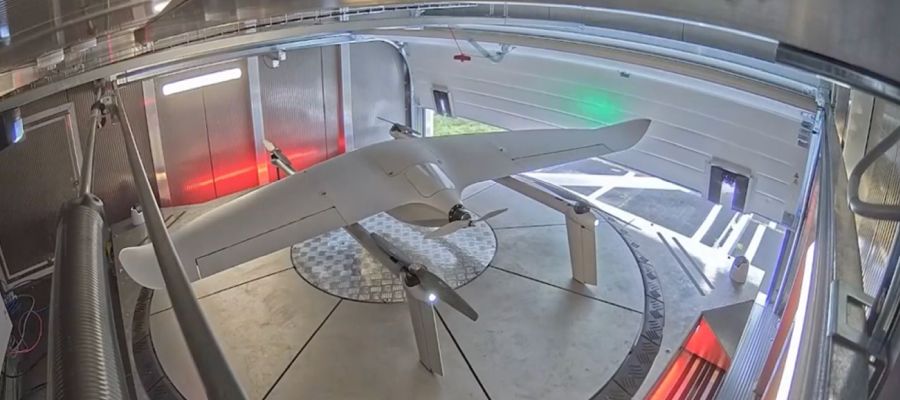
A network of several UAS hangars can solve range issues, shorten response times, and effectively cover large areas. To reduce the need for drone garages in a given area, Amsterdam-based Avy has introduced a new Avy Dock, from which its long-range VTOL drone, Aera, can take off on missions up to 100 kilometers and autonomously land. Users can visually inspect the drone for damage using cameras inside the hangar. Overview cameras ensure a clear view of the landing zone and the surroundings. After all, operators in the control center must be able to intervene at any time, for example, when people or animals are present in the takeoff and landing area despite mandatory barriers. The drone performs its flight maneuvers automatically according to the parameters set in the mission plan. Precise GNSS coordinates and RTK integration make this possible. Upon return, the Aera autonomously lands in the designated area and connects to the charging system via conductive tiles. Charging the batteries takes place inside the hangar, keeping the drone ready for the next mission quickly. „With the new Avy Dock, we eliminate a hurdle for scalable long-range drone operations. Operators do not need to assemble equipment or travel to a launch site“, explains Ben van der Hilst, CEO of Avy. „The aircraft is always ready for action, and missions can start immediately without ground personnel being present on-site.” [embedyt] https://www.youtube.com/watch?v=Ol0FrxrlEBU[/embedyt]

  • Deutsch
  • by

    Automated flight operations, minimal personnel requirements, 24/7 operational readiness: Where the „human factor“ is removed from the equation, UAS-based business models can scale. A fundamental prerequisite for this is often special hangars, where unmanned aerial systems wait for their missions, batteries are charged, and data is exchanged. The Dutch drone manufacturer Avy has now introduced a garage for long-range drones, such as its in-house Aera.

    Whether for inspection, surveillance, or emergency assistance: when a drone is needed, it’s always ready for takeoff and just a few flight minutes away. This is the idea behind dock solutions, where unmanned aerial systems – protected from wind and weather – wait to automatically fly to the location designated by mission planning from a control center via internet connection.

    A network of several UAS hangars can solve range issues, shorten response times, and effectively cover large areas. To reduce the need for drone garages in a given area, Amsterdam-based Avy has introduced a new Avy Dock, from which its long-range VTOL drone, Aera, can take off on missions up to 100 kilometers and autonomously land.

    Users can visually inspect the drone for damage using cameras inside the hangar. Overview cameras ensure a clear view of the landing zone and the surroundings. After all, operators in the control center must be able to intervene at any time, for example, when people or animals are present in the takeoff and landing area despite mandatory barriers. The drone performs its flight maneuvers automatically according to the parameters set in the mission plan. Precise GNSS coordinates and RTK integration make this possible. Upon return, the Aera autonomously lands in the designated area and connects to the charging system via conducti…


    Offers