Solar drone gets rolling

After intensive preparations, the German Aerospace Center (Deutsches Zentrum für Luft- und Raumfahrt, DLR) has successfully completed important ground tests with its solar-powered HAP-alpha. The unmanned aircraft, which will operate at an altitude of 20 kilometers and deliver important data, completed its first taxi tests outside the hangar. However, before the first flights at 150 meters begin in 2026, researchers still need to carry out final measurements and integration work.
In preparation for its maiden flight, the DLRs high-altitude platform HAP-alpha underwent extensive ground tests until fall 2025 – and passed, as the DLR announced on December 5. During these tests, scientists checked the systems of the unmanned platform for correct functioning and gathered further information on how to operate the system. With the successful tests, the DLR is one step closer to the first flight test at low altitudes, which is planned for 2026.
The high-altitude platform HAP-alpha is designed to perform long-duration flights at high altitudes and transport scientific payloads for Earth observation. The electrical power generated by the solar cells must be sufficient to supply the drives and systems with energy on a continuous basis. To keep the drive power as low as possible, the aircraft flies very slowly. This is made possible by a large and at the same time ultra-light wing.
Test under flight-like conditions
In spring 2025, the aircraft structure successfully passed a static vibration test, as reported by Drones: https://www.drones-magazin.de/news/test-bestanden-dlr-setzt-meilenstein-im-projekt-hap-alpha/ The elastic structure was subjected to vibrations similar to those that occur during takeoff or in flight. High-precision measuring systems analyzed each vibration, while the aircraft supplied itself with power and followed only the commands received via the radio link used in flight.
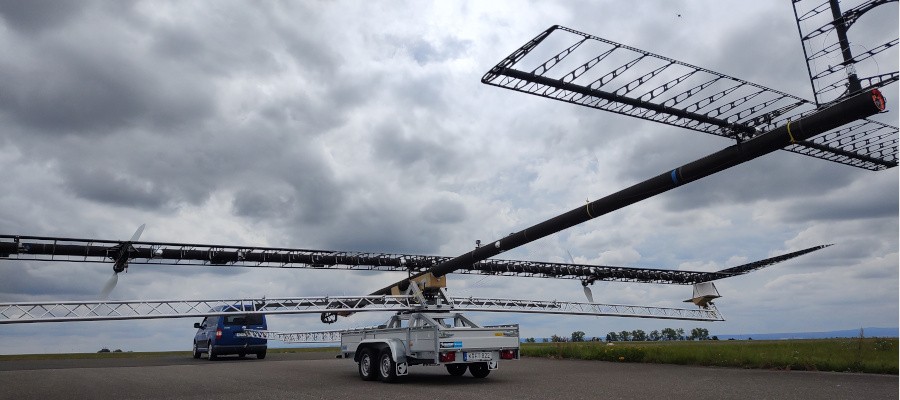
During the ground tests that have now been carried out, the HAP-alpha left the hangar of the DLR’s National Test Center for Unmanned Aerial Systems in Cochstedt for the first time in its fully assembled state. The DLR researchers planned the necessary procedures in advance and examined them in detail during this first real-life application. The aim of the ground tests was to check whether both the procedures developed and the systems functioned fully in flight-like conditions. During the test, the wings and tail of HAP-alpha remained unspanned to prevent aerodynamic forces from damaging the delicate structure.
The setting for the upcoming flight tests will remain largely the same: as in this taxi test, the HAP-alpha will take off from a special trailer. A patented mechanism first secures the aircraft and only releases it when the necessary angle of attack for takeoff has been reached. The lightweight aircraft then takes off automatically. It will later land gently on skids with the engine switched off.
Maiden flight within reach
Before flight clearance can be granted, final measurements and integration work are still to be carried out in the first quarter of 2026. Although the HAP-alpha is designed for flight altitudes of up to 20 kilometers, for safety reasons, initial test flights at the Cochstedt site will initially be limited to a maximum altitude of 150 meters. Initial flights at higher altitudes will be planned later in remote regions, such as over the sea. A total of 16 DLR institutes and facilities have developed the unmanned aircraft and associated ground systems, coordinated by the Institute of Flight Systems.
Photo: DLR (CC BY-NC-ND 3.0)