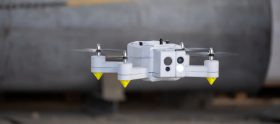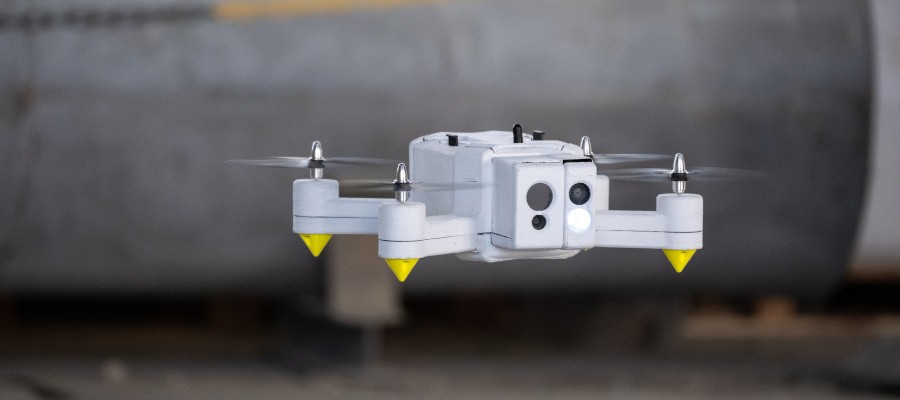

A ‘fireproof drone’ can help both rescuers and accident victims. But how can materials science and robotics be combined to create a life-saving tool? And what hurdles still need to be overcome on the way to a production-ready product? In this interview, FireDrone co-founder Dr Fabian Wiesemüller explains how his vision of no firefighter ever having to enter a burning building without digital advance support is set to become reality.
Drones: How did the idea to develop the FireDrone come about?
Fabian Wiesemüller: It all actually started with the Grenfell Tower fire in London, which claimed the lives of over 70 people. The problem was that there was no
tool available to advance into the burning building or even locate people who were still trapped by the fire. Our professor, who is the head of the laboratory that gave rise to the FireDrone project, was a professor at Imperial College London at the time and was asked if he had a tool that could assist in such a difficult operation. That’s how the idea came about.
What are the typical scenarios for using the FireDrone?
Firstly, of course, for fire brigades; that is the main reason why the project exists: to have a tool that can fly into smoke-filled or hot rooms. The drone is also interesting for industrial inspections. Especially where high-temperature plants are used: steelworks, cement works, waste incineration, oil and gas, glassworks or, for example, fertiliser production. All of these places have tanks or furnaces that have to be cooled down for a very long time before they can be inspected, until they reach 40 °C or below. A drone that can inspect at 200 °C saves a tremendous amount of…