Handy tool at an attractive price
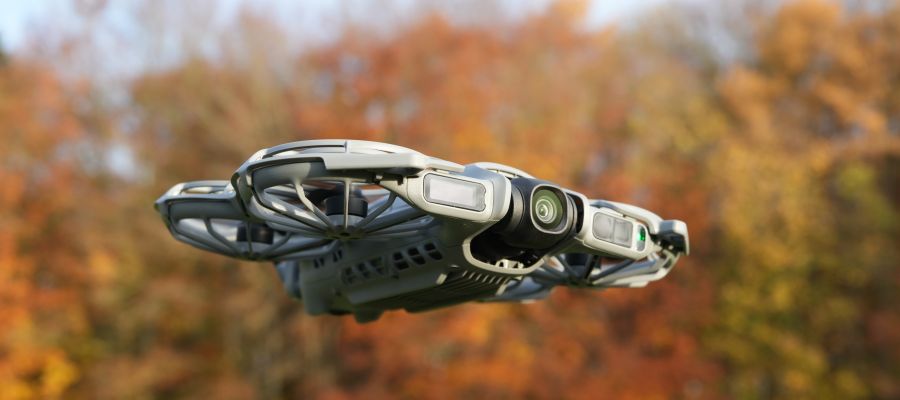

For most conceivable commercial applications, the Neo 2 from DJI is certainly not the first choice. However, one should not underestimate this lightweight for on-the-go. With its compact dimensions and a weight of under 200 grams, it is not only easy to transport but can also be used in places where larger drones cannot fit. With current camera technology, it opens up additional possibilities for marketing and documentation tasks.
Those looking to use the DJI Neo 2 need not only a current smartphone but also around 200,– euros and sufficient knowledge of where and under what conditions the small camera drone can be deployed. Given its C0 certification, there are comparatively few restrictions regarding the operational area compared to Mini, Mavic, or Matrice drones. This means the possibilities can get started quickly. For advertisers, journalists, influencers, and content creators, new options arise. Real estate agents, construction and project managers, as well as landscape gardeners and foresters, can also utilize this lightweight drone in various ways.
Omnidirectional obstacle detection
The reason the Neo 2 flies safely in the hands of inexperienced pilots is largely due to its omnidirectional obstacle detection. The manufacturer, DJI, has implemented a LiDAR sensor on the front of the housing, scanning a very large area (front, side, above, below) for obstacles. A downward-facing infrared sensor detects the environment in front, behind, to the sides, and below, as well as the distance to the ground. This is a real improvement over the previous model, Neo, from the fall of 2024.
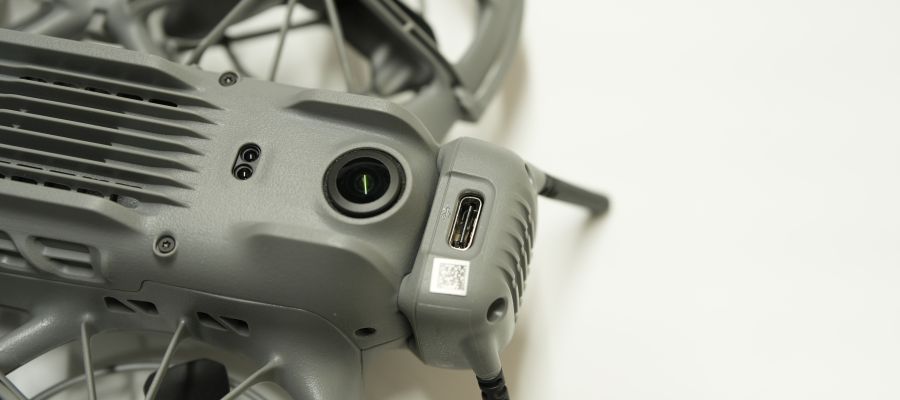
The infrared sensor (black button) is part of the omnidirectional obstacle detection system
A significant part of the „Safe-Space Concept“ is the construction of the drone itself. All four motors or propellers are housed within a solid frame and are additionally protected by removable safety cages. Durable plastics at various points ensure the necessary robustness. Thus, the drone can be used for indoor operations in locations such as warehouses or greenhouses. However, this full construction also contributes to the fact that the Neo 2 is relatively bulky for its size and requires more space for transport than a pocket or jacket can offer. Even in a backpack, the drone takes up some room, but then it shines with a maximum takeoff weight of 160 grams.
Price-performance highlight
But it’s not only the exterior that impresses. The internal specifications are also commendable. The two-axis gimbal, electronic image stabilization, and effective flight stability contribute to perfect photos and videos. Even in gusty winds, shakes are a rarity in the video – the Neo 2 is resistant to disturbing influences at speeds of up to 10.7 m/s, which corresponds to nearly wind force 6.
The image quality of the Neo 2 is excellent for its price range and is at least on par with mid-range smartphones. Although the 1/2-inch sensor only resolves at 12 megapixels (4000 x 3000 pixels) with an ISO range of 100 to 12,800, the overall image impression is very good. Colors and contrast are excellent, the dynamic range is broad, and details are finely rendered. It’s likely that the software also assists in image playback. However, since the drone will likely be used more for general documentation, monitoring tasks, or online content generation, such „shortcomings“ in photo quality and resolution are forgivable.
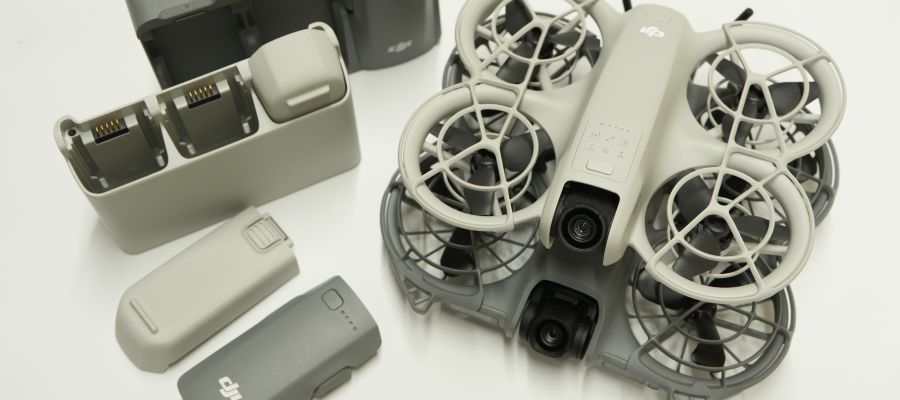
The predecessor, the Neo, is smaller and has significantly fewer technical features. Typical DJI: the batteries are not compatible
On the video side, the Neo 2 also positions itself visibly ahead of the Neo. It can capture beautifully colored, high-contrast, and finely resolved 4K videos at up to 100 fps (frames per second). The small sensor chip handles light-dark transitions very well. Filming with the camera drone is truly enjoyable. The Neo 2 even supports vertical orientation for social media content, recording at 1,512 x 2,688 pixels in 9:16 format.
Battery management
Manufacturer claims regarding flight times are essentially akin to fuel consumption data in automobiles. According to DJI, the Neo 2 is supposed to fly for a remarkable 19 minutes, which may be accurate under lab conditions. However, in real-life scenarios, more realistic flight times range from 12 to 13 minutes. To extend flight time, it is advisable to invest in the Fly More Combo offered by DJI. At a reasonable extra cost, two additional flight batteries and a fast charging dock are included. When connected to a power USB-C charger (at least 65 W, sold separately), three completely depleted batteries can be charged simultaneously in just one hour. This is incredibly fast and convenient. If charging on the go with a PD-capable power bank, the downtime between flights can be reduced to under 15 minutes. This should suffice for a few „camera flights“ in follow-me mode, making this lightweight drone a great companion for various endeavors.