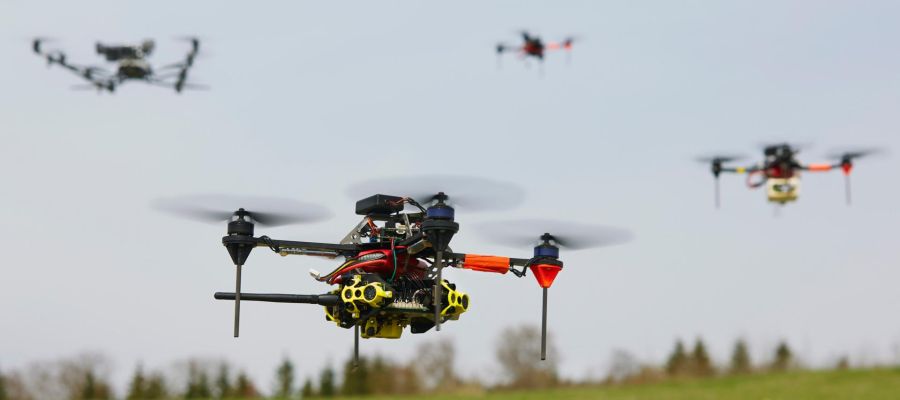

For years, the delivery of individual goods by drones has been considered by some in the public as the epitome of a futuristic vision. However, for this to be economically feasible, the transition from isolated single missions to coordinated, automated swarm maneuvers must succeed. A prerequisite for this is the departure from the 1:1 principle: one pilot, one drone. The use of quantum computing, 6G mesh networks, and digital twins can pave the way for an operational 1:n relationship.
The UxS (Unmanned Systems) industry is on the path from vision to profitability. While the technological foundations for unmanned systems have largely been laid, many economically viable concepts remain lacking. For example, for delivery services using drones to evolve from PR-heavy experiments to profitable business models, not only do suitable legal frameworks need to be established and societal acceptance promoted. Automated backend processes must also be developed. In fact, in goods and delivery logistics, the underlying software is more important than the transport device itself.
Economic necessity
The economic potential underscores why investments in research and development can pay off at this juncture. According to a forecast from the Indian market research firm Mordor Intelligence, the global drone logistics market will reach 13.92 billion US dollars in 2031. Studies published on platforms such as MDPI and ResearchGate show that multimodal swarm configurations using two different UAS types can achieve 22 percent energy savings compared with a single drone model for logistics services. Further research suggests that electrically powered UAS swarms could reduce CO2 emissions in the last mile by up to 90 percent compared with current combustion-engine solutions.