Federal government adopts measures to secure airspace
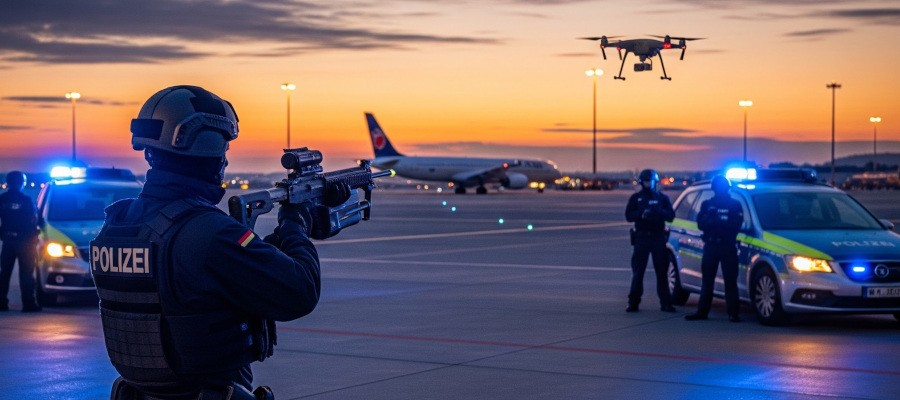

The federal government is stepping up measures to defend against drones. With far-reaching changes to the Air Security Act, which were recently approved by the Bundesrat, and the introduction of new operational units and research centres, Germany is responding to the increasing challenges posed by uncooperative unmanned aerial systems. These measures aim to significantly increase the security of critical infrastructure and public spaces.
A key innovation concerns the powers of the armed forces. In future, they will be allowed to support the state police forces in drone defence by way of administrative assistance. As a last resort, the use of armed force is also envisaged if averting danger would be impossible or only possible with considerable difficulty without this support.
At the same time, the decision-making process for such deployment of the armed forces has been simplified and accelerated. Responsibility now lies with the Federal Ministry of Defence, which can delegate the decision. The previous requirement to make decisions in consultation with the Federal Ministry of the Interior no longer applies. Another amendment to the law makes intentional, unauthorised entry onto airport grounds a criminal offence in future, whereas previously it was only punishable by fines.
Where drone flights are prohibited and what penalties apply
The Air Traffic Regulations (LuftVO) continue to regulate where drone flights are prohibited, restricted or only possible with permission in Germany. This includes flights over airfields and airports, industrial facilities, military installations, power plants and energy distribution facilities. Buildings belonging to federal or state constitutional bodies, as well as properties belonging to the police and other security authorities, are also designated as no-fly zones.
Violations are subject to severe penalties. A dangerous interference with air traffic pursuant to Section 315 of the Criminal Code constitutes a criminal offence that can be punished with imprisonment of up to ten years. Air traffic offences can also result in fines of up to €50,000. You can read more about penalties in this article: https://www.drones-magazin.de/news/welche-strafen-bei-illegalem-uas-betrieb-drohen/
Operational strengthening of defence capabilities
In addition to the legal adjustments, the Federal Government has taken further concrete measures to improve drone defence. Since December 2025, the Federal Police has had a specialised unit for defending against drones. This unit is deployed nationwide and equipped with the latest technology for smart drone defence. With an initial staff of 130, it will operate at various locations. The federal government is investing a total of €100 million in this initiative.
In addition, a drone defence centre has been set up by the federal and state governments. Its task is to create a national picture of drone movements and enable a joint assessment of risks. This is done in close cooperation with the German Armed Forces. One of the centre’s main focuses is on research and development in order to keep pace with technological innovations and be able to respond to new threats. It is emphasised that many drone flights are not primarily aimed at direct attacks, but at causing uncertainty, which nevertheless requires rapid, coordinated responses. In addition, a research centre is to be established to accompany the rapid development of drone technology and transfer new technologies into practical application.
What the new measures mean
The comprehensive measures taken by the German government to strengthen drone defence have far-reaching implications for the entire drone scene. On the one hand, the expanded powers for security authorities and the new criminal provisions signal an increased sensitivity to the potential risks of unmanned systems. This underlines the need for civilian drone operators to take a closer look at the current legal situation and to strictly comply with compliance requirements in order to avoid legal consequences.
On the other hand, the massive investments in defence technologies and the establishment of research and development centres open up new opportunities for companies active in the field of drone defence. Demand for innovative solutions for detecting, identifying and neutralising drones will increase. This will promote the development of new technologies and services that may be relevant for both government actors and the protection of private and industrial infrastructure. The industry is thus challenged to adapt to changing security requirements while exploiting the potential for technological advances and new business areas.
Photo: AI-generated