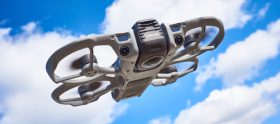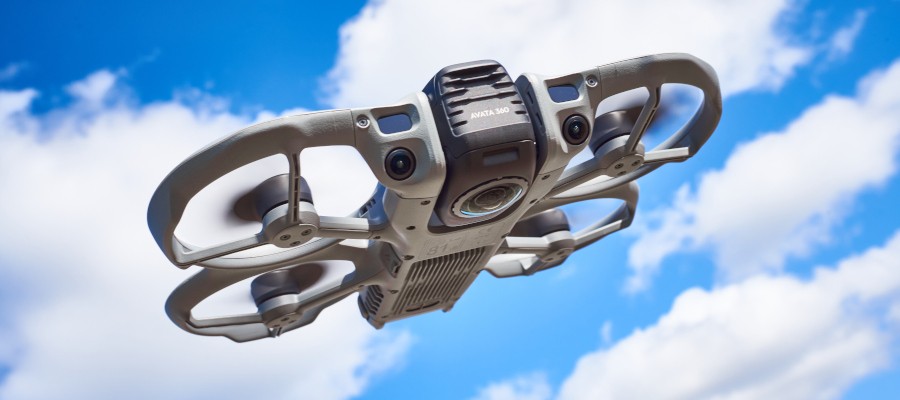

Until now, anyone wanting to create complex camera movements often ran into problems: controlling a drone smoothly and always capturing the perfect shot with the camera required a great deal of skill or a dedicated camera operator. With the Avata 360, DJI now aims to change that and promises a ‘flagship of image quality’, where the flight serves solely to capture data. The camera’s frame and angle of view are only determined in the editing suite.
From the very first encounter with the Avata 360, it becomes clear that DJI is pursuing a completely new concept here. Whilst on traditional camera drones the optics are often mounted quite exposed on a delicate gimbal, the new Avata features a robust-looking camera module with two lenses that can only be panned around the horizontal axis. Another difference compared to many other drones is the propellers integrated into the housing. This is not only a safety feature for beginners, but also an advantage for professionals who have to operate in confined spaces. The design allows you to concentrate more on flying without risking a crash.
The FlyMore Combo tested here includes the Avata 360 with the RC 2 controller, as well as three batteries, a triple charger, a carry bag, spare propellers and small parts. The price: €939. Those looking for a cheaper option can also purchase the drone with just the remote control and one battery for €719. Also available: a Motion Fly More Combo with FPV goggles and an RC Motion 3 controller for €939. Under real-world conditions, flight time on a single battery rarely exceeds 15 minutes, which is sufficient but not outstanding.
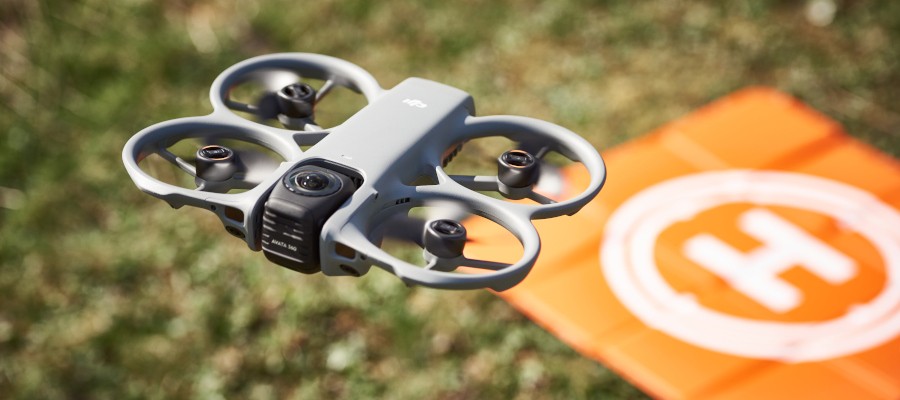
At the heart of the drone is the dual camera system with two 1/1,1-inch sensors. With an aperture of f/1.9 and a native dual ISO of 100 and 800, the hardware is designe…