Development of an autonomous capable rescue aircraft
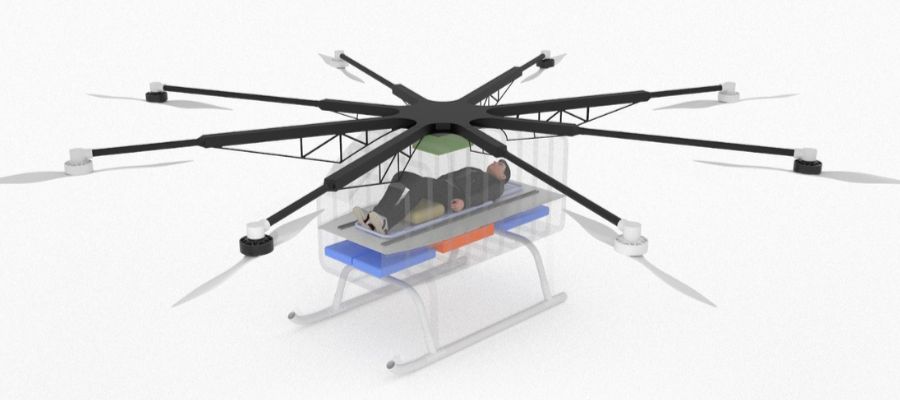

With the transportation of medications, blood supplies, or defibrillators, the potential of drones in emergency services is far from fully utilized. The subject of how an autonomous rescue aircraft can transport patients and first responders in the future is central to the international GoAERO challenge. Among the 200 participating teams from around the world, the student initiative Team Horyzn from TU Munich stands out.
The aim of the GoAERO mission is to develop life-saving aerial systems that can be deployed in disaster areas, urban environments, and remote regions. The competition is divided into three phases: after developing a technical concept, the second phase required the creation of a prototype scaled to 35 percent of the final flight system. As announced in late 2025, Team Horyzn was one of the eight participating teams awarded as winners of Phase 2. The student initiative from TU Munich had already completed Phase 1 as one of the eleven winning teams.
With the concept and a 1:3 prototype of their octocopter named „Isar Falke“, Horyzn is the only German team and one of only two European teams to win the first two phases. In the upcoming Phase 3, the goal is to build a full-scale „Isar Falke“ with a payload capacity of over 80 kilograms. According to their own statements, this would be the largest drone ever built by students in Europe. The final of the GoAERO Challenge will take place in February 2027 at NASA Ames Research Center in San Francisco.
Image: GoAERO