Autonomous ships in the Port of Hamburg
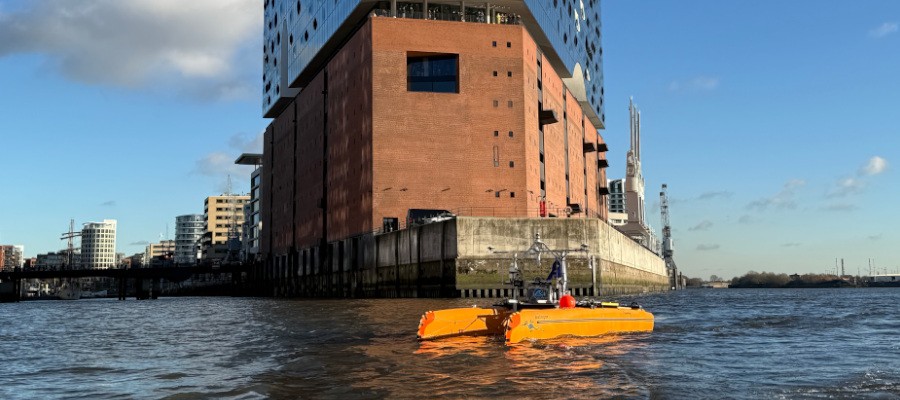

Unmanned, automated watercraft are no longer a thing of the future. However, it is still unclear how they can be integrated into complex environments. This is precisely what the iPORTUS project, led by the Hamburg Port Authority (HPA), aims to investigate. The aim of the project, which is funded by the Federal Ministry of Transport with around €1.7 million, is to develop an overall concept for the safe and efficient integration of semi-autonomous and remotely monitored uncrewed surface vessels (USVs) into port operations.
From the regulatory framework to practical issues of fleet management and cyber resilience: Together with its consortium partners, the Fraunhofer Center for Maritime Logistics and Services (CML) and Kongsberg Maritime Germany, the Hamburg Port Authority (HPA) wants to show how unmanned ships and boats can be safely integrated into everyday life and used for various tasks within a port facility. The iPORTUS initiative therefore promises to be a major step toward networked, climate-friendly processes. The project aims to show how semi-autonomous and remotely monitored watercraft can be safely integrated into the complex processes involved in container handling and passenger transport. “With iPORTUS, we are setting a milestone for the safe integration of semi-autonomous systems into port operations. The project is not only creating technological innovations, but also the regulatory basis for the use of these technologies in Germany,” says Benjamin Blanck, Project Manager Research & Development at the HPA.
Who is supporting the iPORTUS project?
The iPORTUS consortium brings together the Hamburg Port Authority, the Fraunhofer Center for Maritime Logistics and Services (CML), and Kongsberg Maritime Germany. The initiative is funded with around €1.7 million from the IHATEC II program of the German Federal Ministry of Transport. The focus is on the integration of low-emission autonomous surface vessels (ASVs) into ongoing port operations. Safety and trust are key priorities for both port authorities and ship operators.
The project addresses nautical safety, cyber security, and the development of a high degree of autonomy, even though the ships are monitored from a remote control center. iPORTUS also aims to create regulatory and economic conditions that could enable autonomous watercraft to operate routinely even in the largest international ports.
How does the project contribute to cyber resilience?
Cyber resilience is a key concern for ship managers who monitor increasingly networked fleets. The ASVs used in the research project are therefore equipped to withstand cyber attacks. “iPORTUS strengthens confidence in maritime autonomy: we equip ASVs against cyberattacks, validate them in port operations, and translate the results into approvable operating models – a measurable contribution to digitalization and decarbonization,” explains Lennart Grambow, research associate at Fraunhofer CML.
The validation in port operations and the translation of the results into approvable operating models are a tangible contribution to the digitalization and decarbonization of shipping. “As a leading technology company, we are very pleased to be involved in this forward-looking topic and to successfully transfer the technology into operational use. In doing so, we are making an important contribution to digital transformation and laying the foundation for sustainable innovations that offer our customers and partners long-term added value,” says Olaf Lautenschläger, Team Lead Projects at Kongsberg Maritime Germany GmbH.
The HPA online:
https://www.hamburg-port-authority.de
Photo: Fraunhofer CML