Art form: abstract drone photography
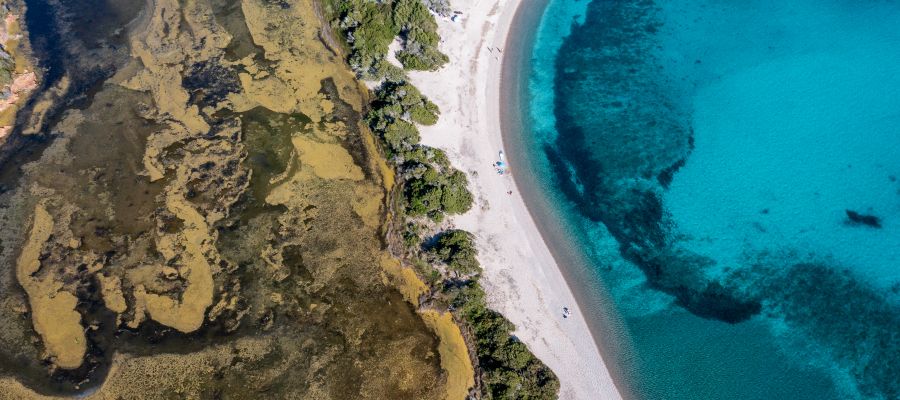

Hardly any new technology has changed our visual perception of the environment as profoundly as the drone. This is particularly evident in abstract drone photography, a genre that pursues artistic rather than documentary intentions. The world is not shown as we know it, but as it appears from a distance and from an unusual height. Three-dimensional structures transform into a two-dimensional painting – an interplay of lines, colors, and textures.
The essence of this type of photography lies in alienation. Not through digital manipulation, but solely through perspective. What may appear chaotic from the ground reveals an order from the air. A river forks like the branching of a network of veins, sandbanks appear as graphic areas, and the rectangular evaporation ponds of a saltworks resemble color fields of an abstract painting. By detaching from the familiar viewpoint, the drone transforms reality into art – art not created by human hand, but shaped by natural forces, geological processes, and sometimes even industrial structures.
Design principles
Those who engage in abstract drone photography quickly learn that composition plays a central role. While some motifs work naturally, others require a precise choice of height and angle. The balance between too much and too little height is crucial. If the perspective is too high, the shot becomes too documentary and loses its abstract effect. If too low, the subject does not fully reveal its structure.
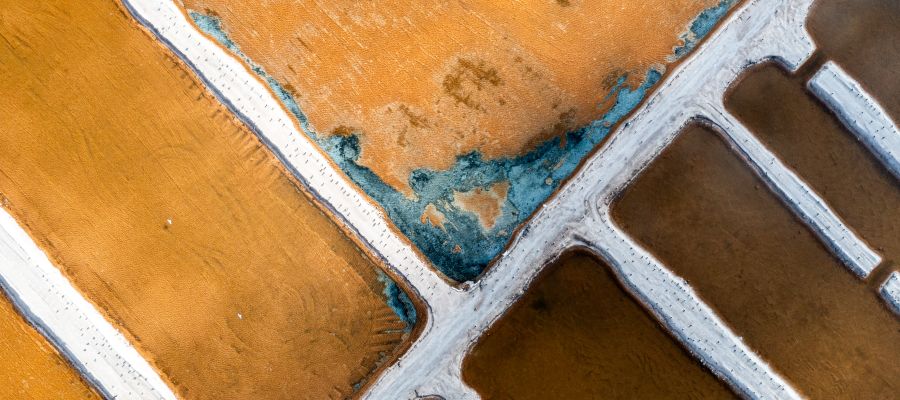
The artificially created basins of salt pans provide wonderful motifs
Light also plays a decisive role. Midday light, often avoided in classic photography, works well here because it enhances colors and reduces hard shadows. Cloudy conditions can be ideal as well, minimizing reflections and allowing patterns to stand out more clearly.
Subtle gradients
From a technical perspective, a good sensor is beneficial because it can capture fine textures and subtle color gradients more effectively. RAW images are standard to allow full flexibility during post-processing. Editing rarely aims to distort reality, but rather to enhance the effect that the eye already perceives: Color adjustments, contrast corrections, and clarity settings help to highlight the abstract structure.
The special appeal of this type of drone photography lies in its interplay of reality and abstraction. The image shows something real, yet it appears surreal. It is a documented nature, but it simultaneously seems enigmatic. The drone observes landscapes from a distance that, while technically accessible to humans, is not intuitively familiar. This transforms photography into a discovery of the hidden order of our environment. A river that appears chaotic from the ground follows clear patterns from above. A salt pan that may seem mundane emerges as a precise color composition.
Natural drawings
River courses are among the most photographed subjects in this genre and serve as a perfect example of how aerial perspectives change our view of landscapes. Glacier rivers, particularly striking with high sediment concentrations, display an unusual spectrum of colors. Viewed from above, they look as if someone experimented with ink and watercolors. The interplay of milky turquoise, light beige, and brown tones appears harmonious, despite being entirely random. The branches spreading across the valley floors resemble calligraphic lines or abstract ink drawings. It is often difficult to say whether one is looking at a nature photograph or an abstract artwork.
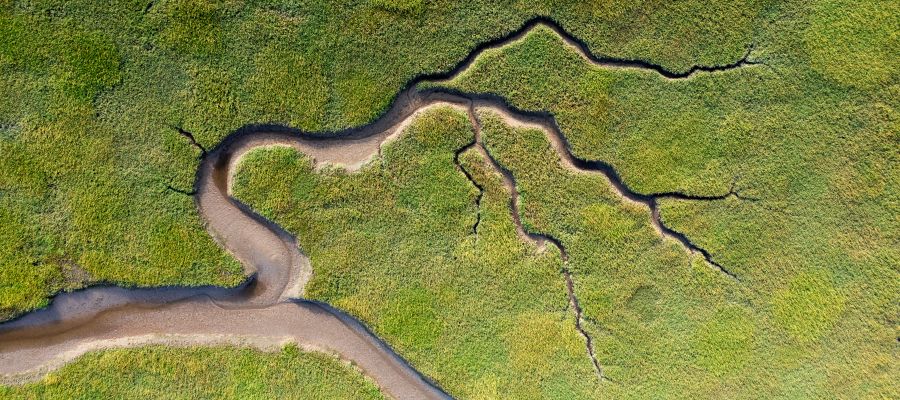
This river, from the drone perspective, resembles a tree structure with fine branches
The unique aesthetics of these motifs lie in their transience. River courses change with each season, often even daily. An image taken today can look entirely different tomorrow. This fleeting nature gives abstract drone photography a documentary value that extends far beyond artistic interpretation.
Encounter of two worlds
Coastal landscapes are equally fascinating. From above, the boundary between land and sea becomes a line that flows through the composition like a graphic element. Sometimes it forms a stark contrast—dark water next to bright sand—while at other times it merges into a soft transition as waves wash over shallow shores. The patterns the surf draws in the sand suddenly appear as rhythmic, recurring structures. Particularly in combination with different water colors, harmonious or even dramatic compositions reveal themselves: turquoise lagoons, dark depths, and shimmering foam crests.
Coasts have a special quality: they appear both ordered and chaotic. The lines are clearly recognizable, yet the shapes never repeat exactly. This creates a tension that characterizes many images of this genre. Often, it is the seemingly banal – a sandbank, a river mouth, a changing tide line – that becomes a visual revelation from a bird’s-eye view.
Industry and agriculture
Another, but no less impressive, source of abstract structures is salt pans. Here, it is not only natural forces that determine the image but the combination of artificially created basins and natural chemical processes. Due to varying concentrations of salt and minerals, intense colors are formed. From the air, these basins appear as geometrically arranged color fields, neatly separated by straight boundaries. The result resembles modern abstract art, created solely by evaporation and salt deposits.
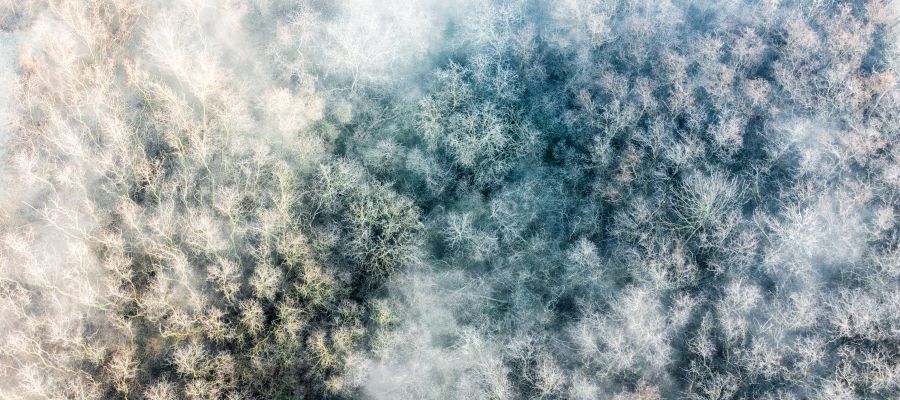
Fog and frost over a forest area
Agriculturally used areas, desert landscapes, ice surfaces, or volcanic regions are also excellent for abstract aerial photography. Fields look like giant patchwork blankets, their colors and patterns changing depending on the season and cultivation stage. Circular irrigation systems transform barren landscapes into geometric shapes. In deserts, wind-shaped dune lines appear as if drawn with a comb. Ice surfaces showcase cracks and layers that are graphically hard to surpass. Some of the most impressive images come from regions that at first glance seem monotonous – because monotonous landscapes are particularly sensitive to light, height, and perspective.
Surreal beauty
Abstract drone photography is much more than a trend. It is a new way to see and document the world. River courses, glacier streams, coastal areas, and salt pans are just a few examples of motifs that take on entirely new meanings from the air. The genre combines technical precision, artistic intuition, and an extraordinary perspective on our environment. Once you have seen the surreal beauty of a glacier stream or the perfectly ordered color fields of a salt pan from above, you immediately understand: the world is a work of art. We just need to fly high enough.