Aerial reconnaissance for rescue forces
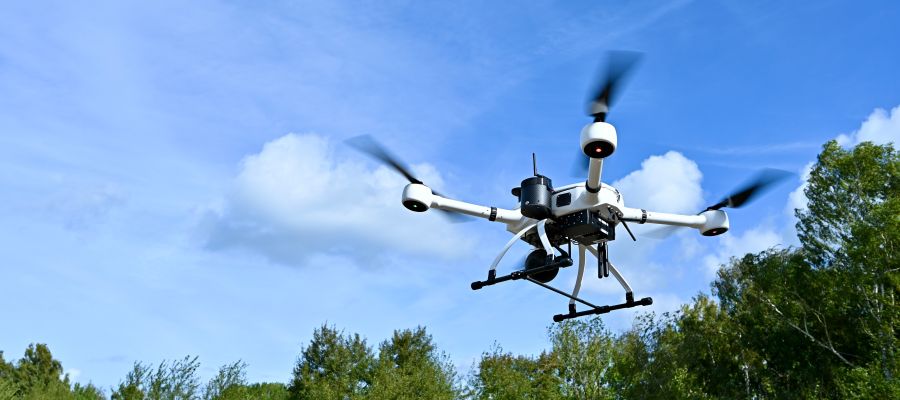

When the fire department receives a call, everything from false alarms to major incidents is possible. However, a reliable assessment of the situation can only be made once the first emergency responders have arrived at the scene. Valuable time often passes before an optimal response to the specific emergency scenario can be initiated. The ADELE project has now tested how assistance measures can be optimized and, in particular, accelerated with automated scouting drones.
How many emergency personnel are needed, and what rescue equipment is required? How many injured people are expected? In which direction and at what speed is a vegetation fire spreading? Is the access to the accident site clear, or can traffic jams and blockages at least be bypassed? And how can I best reach the area where the flames are raging during a wildfire? Questions like these are what emergency dispatch personnel must answer based on the available information. And in cases of doubt, they can pose challenges for on-site rescue teams, potentially complicating and even delaying the operation. It is mainly missing or incomplete information that prolongs reaction times.
Concrete Tasks
Especially in rural areas or at deployment sites on the outskirts of the city, aerial reconnaissance using reconnaissance drones could provide a significant added value. If the operational command can gather valuable information via a camera livestream, the first concrete measures can already be planned and initiated before arriving at the accident site. Verification, localization, and evaluation are the specific tasks here, which could be accelerated with the help of UAS.
How relevant technologies can be technically and structurally integrated into existing operational concepts was the subject of the research project ADELE (Automated Drone Deployment from the Control Center), led by the Institute for Flight Guidance at the German Aerospace Center. Together with the companies Frequentis and Vodafone, the Rostock Fire Brigade, and the Mecklenburg-West Pomerania State Police, a system was developed and tested that can improve the information situation regarding the operation even before the first rescue teams arrive and can continuously provide situational awareness throughout the deployment.

At the operational site, a drone can be used to provide all response personnel with a current aerial situational picture
An essential goal was to make the entire system as open as possible. Because, of course, it should be possible, for example, to use different drones and drone hangars and, if necessary, switch or combine them during an ongoing operation. For quick initial reconnaissance of an area, fixed-wing drones are helpful, while multicopters can leverage their strengths to provide situational awareness during ongoing rescue operations. And this should be done so that various units can access a common source of information.
Decision aid
The core element of the ADELE concept is therefore not the drone itself, but the mission-control software. Here, Frequentis benefits from its many years of experience in developing and operating control center systems such as the language interpretation system ASGARD or the communication and cooperation platform LifeX. Through a specific interface, the so-called Automated Drone Dispatch System (ADD) from Frequentis can be integrated. When an emergency call is received, the control center software can transmit the location determined from the emergency call data as geo-coordinates to the ADD. The system then suggests a possible drone deployment and a conceivable flight path based on GPS data and the specific deployment location. The final decision lies with the control center staff, who can start the fully automated BVLOS operation at the push of a button. This provides valuable assistance in making decisions under time pressure, considering operational tactical factors, and keeping potential risks associated with drone deployments in view.
Even though different legal requirements apply to BOS operations compared to private or commercial UAS operations, authorities and organizations with security responsibilities are, of course, also obliged to ensure the highest possible safety when using unmanned flight systems. Therefore, at Frequentis, an effort has been made to incorporate both the internal logic of the current “Recommendations for Common Regulations on the Use of Drones in Civil Protection” (short: EGRED) and the methodology of the SORA procedure (Specific Operation Risk Assessment) in risk assessment using the ADD software.
Live data
In the event of an emergency call, where quick decision-making ultimately determines life or death, the Automated Drone Dispatch System relies on current, dynamic data on mobile network quality and ground risk, which Vodafone provides through the „DroNet Hub“ platform. This includes not only the coverage of the Vodafone mobile network but also the projected population density. This data is not derived from static census information but is currently determined based on the number of mobile phones logged into a mobile network cell. This allows the ADD system to account for the theoretical risk associated with a drone operation, based on the actual „population density“ at the time of operation.

When emergency personnel already receive live information en route to the scene, the necessary measures can be planned before arriving
Even though a final evaluation of the ADELE project is still pending, it is feasible to integrate reconnaissance drones into fire departments’ and other emergency services’ equipment as a permanent fixture. However, specific operational tactical questions remain unanswered. For example, in which emergency scenarios could UAS (Unmanned Aerial Systems) be beneficial. And how this can inform the optimal placement of drone hangars. Last but not least, funding issues also need to be addressed. For instance, firefighting services are a municipal responsibility. At the same time, most municipalities report a lack of financial resources. Whether the necessary funds for purchasing and operating such systems can actually be provided everywhere would be sensible, especially considering that such a worthwhile investment could ultimately save lives and improve the safety of rescue personnel in the field.
Images: DLR, Vodafone